“Our newest flower offerings combine the fresh flavours of summer with the convenience of a pre-roll, making them the perfect complement to any occasion. Together with our team of master growers and cultivators, we continue to innovate with new flavours and formats to deliver exceptional flower and infused products to ensure high quality product offerings for our consumers.” — Dave Paterson, resident, Canada, Canopy Growth
New products rolling out under Canopy Growth’s flower portfolio include:
Tweed Distillate Infused
Bursting with flavour, Tweed Distillate Infused Pre-Rolls are available in two new flavours – Black Cherry Chronic and Outlandish Orange. Black Cherry Chronic is a high-THC Sativa that provides a perfect blend of sweet and tart for a robust flavour and 33-39 per cent THC. Outlandish Orange is a high-THC Sativa that delivers a bright and zesty burst of flavour with 33-39 per cent THC. Tweed Infusion Black Cherry Chronic and Outlandish Orange are available in 5×0.35g pre-roll packages.
7ACRES Burners
7ACRES Burners are designed to be the G.O.A.T of the pre-roll. Small batch grown with thoughtfully selected flavourful genetics comprised of a cross between Sour Dubble and Tahoe Alien to create Alien Rock Candy. Offered in a 3×0.7g format with 26 – 32 per cent THC, these Burners are designed to deliver a slow and consistent burn. The unique filter design serves to optimize airflow enabling a smoother smoke to ensure the flavour of the true craft flower can be fully enjoyed.
Advertisement
Spectrum Red No 1
Spectrum Red No 1 pre-rolls emit a fruity and gassy aroma and flavour profile thanks to the product’s primary terpenes Terpinolene, Caryophyllene, and Limonene*. With 22-28 per cent THC, the 20 masterfully pre-rolled 0.5g joints are the first large pack offering in the Spectrum range.
Spectrum Green
Spectrum Green pre-rolls are an indica leaning hybrid strain with low amounts of THC with 2-8 per cent and 10-16 per cent CBD. This strain is well-suited for those who would like to try THC for the first time, as well as experienced consumers looking to add CBD to their routine. Spectrum Green pre-rolls come in a 20×0.5g pack, and some associate spicy, woody, lemon, or fuel flavours with this strain.
Tweed and 7ACRES new pre-roll offerings are available for purchase via legal recreational cannabis e-commerce channels and retail locations in select regions. Spectrum products are available for purchase online at spectrumtherapeutics.com. For more information, please visit Tweed, 7ACRES, Spectrum Therapeutics.
Lexaria’s NIC-H22-1 study proved that its patented DehydraTECH(TM)-nicotine tobacco-free pouch was statistically significantly faster-acting than alternatives
The study, which involved 36 participants, embraced a randomized, double-blind, cross-over study design
It also affirmed Lexaria’s product superiority while also showing DehydraTECH’s potential
Lexaria Bioscience Corp. (NASDAQ: LEXX), a global innovator in drug delivery platforms, just released results from its 2023 human oral nicotine study NIC-H22-1. Of note was its patented DehydraTECH(TM)–nicotine tobacco-free pouch product superiority, particularly when pitted against world-leading brands ZYN(R) and on!(R). The study proved that Lexaria’s product was statistically significantly faster than the two alternatives in the median time required to reach comparable maximum nicotine concentrations (“Tmax”) levels (https://cnw.fm/17JMQ).
Lexaria’s CEO, Chris Bunka, lauded his team for this achievement, especially considering they had to work without as many resources as global multi-billion-dollar behemoths. He also lauded the company’s technology, citing its potential and advantages, as demonstrated in the study.
“This is a remarkable achievement that speaks to the capabilities of the DehydraTECH technology and also to the Lexaria R&D team, working ardently with scarce resources relative to global multi-billion-dollar behemoths,” he noted (https://cnw.fm/17JMQ).
Several intriguing data trends were observed from the study. For one, most of the subjects reported that they felt euphoric at all time points when they used Lexaria’s product. Lexaria also got the highest endorsement score, with statistical significance demonstrated at the second dosing visit. The highest percentage of users reporting that they considered the experience “pleasurable” at the 30-minute mark were also Lexaria users, and the company also scored best on the enjoyment scale.
Negative effects, meanwhile, such as nausea and severe hiccups were experienced more by the mass-market products than by the Lexaria formulation.
The study embraced a randomized, double-blind, cross-over study design involving 36 participants, all long-time heavy cigarette smokers who smoke at least ten cigarettes a day. Subjective effects, both positive and adverse, were assessed at baseline, 5 minutes, 30 minutes, and 120 minutes using a questionnaire to capture 25 different effects. All laboratory procedures for the study were conducted entirely by U.S.—based, third-party independent contract service providers (https://cnw.fm/17JMQ).
The results from this study not only validate Lexaria’s efforts but also affirm its product superiority while also showing DehydraTECH’s potential. This is a tremendous achievement for the company, given that this has been achieved in just five years. It reflects the company’s commitment to making the world a better place and its resolve to create value for its shareholders.
“We’ve always had an overwhelming determination and fierce conviction that we can make the world a better place and reduce the carnage caused by smoked cigarettes, and now we have human study data that demonstrates the advantages of DehydraTECH processed nicotine relative to the competitive landscape,” noted Mr. Bunka (https://cnw.fm/17JMQ).
NOTE TO INVESTORS: The latest news and updates relating to LEXX are available in the company’s newsroom at https://cnw.fm/LEXX
About CannabisNewsWire
CannabisNewsWire (CNW) is an information service that provides (1) access to our news aggregation and syndication servers, (2) CannabisNewsBreaks that summarize corporate news and information, (3) enhanced press release services, (4) social media distribution and optimization services, and (5) a full array of corporate communication solutions. As a multifaceted financial news and content distribution company with an extensive team of contributing journalists and writers, CNW is uniquely positioned to best serve private and public companies that desire to reach a wide audience of investors, consumers, journalists and the general public. CNW has an ever-growing distribution network of more than 5,000 key syndication outlets across the country. By cutting through the overload of information in today’s market, CNW brings its clients unparalleled visibility, recognition and brand awareness. CNW is where news, content and information converge.
To receive instant SMS alerts, text CANNABIS to 21000 (U.S. Mobile Phones Only)
Please see full terms of use and disclaimers on the CannabisNewsWire website applicable to all content provided by CNW, wherever published or re-published: http://CNW.fm/Disclaimer
Do you have questions or are you interested in working with CNW? Ask our Editor
A recently released analysis has found a link between a history of cannabis usage and a decreased incidence of type 2 diabetes in adulthood. The analysis was done on seven studies, which include four cohorts and 11 surveys, by researchers at Iran’s Tabriz University of Medical Sciences. Compiling the findings, NORML stated that the four cohorts combined totaled more than 478,000 participants.
The comprehensive analysis revealed that the chances of developing type 2 diabetes in those who had been exposed to marijuana were diminished by a factor of 0.48 compared to those without any marijuana exposure.
The researchers highlighted that the act of consuming cannabis could potentially confer a safeguarding impact on the likelihood of type 2 diabetes development. However, they appended that due to the notable variation in findings across studies, it would be prudent to encourage investigations of heightened credibility, given the surge in marijuana consumption and legalization.
The researchers elaborated, saying “to the best of our knowledge, our analysis constitutes the most current body of evidence concerning the connection between T2DM and marijuana use,” as cited by NORML. They continued: “Given the increasing popularity of marijuana usage and the legalization thereof, there exists a growing imperative to design prospective, long-term, randomized studies that delve into the genuine ramifications of marijuana consumption and furnish pragmatic guidelines for its management.”
Commonly referred to as adult-onset diabetes and type 2 diabetes mellitus, type 2 diabetes is a chronic ailment characterized by elevated blood sugar levels. This form of diabetes is more prevalent than type 1, and, as Harvard Medical School states, although it typically manifests in middle and later life, it is progressively affecting younger demographics.
The Centers for Disease Control and Prevention (CDC) report that more than 37 million Americans have diabetes, with type 2 diabetes comprising 90% to 95% of these cases. The CDC further noted that “insulin, a hormone manufactured by the pancreas, functions akin to a key, enabling blood sugar to enter the body’s cells and be utilized as energy. However, in cases of type 2 diabetes, cells exhibit an abnormal response to insulin, a phenomenon known as insulin resistance.”
The CDC further clarified: “The pancreas compensates by generating more insulin in an attempt to provoke a cellular response. With time, the pancreas becomes overwhelmed, leading to escalated blood sugar levels, consequently setting the stage for prediabetes and eventually type 2 diabetes.”
In 2020, a study examined the potential of marijuana to reduce diabetes risk in individuals with hepatitis C. The study’s authors reported that “HCV infection heightens the risk of insulin resistance, consequently increasing susceptibility to diabetes. In the general populace, indications suggest that marijuana usage might offer protective effects against diabetes and related disorders.”
Furthermore, NORML highlighted that previous observational inquiries uncovered an inverse relationship between marijuana use and the odds of adult-onset diabetes and obesity. In clinical trial settings, it was revealed that administering THCV improved glycemic control in type 2 diabetes cases.
The researchers added that a placebo-controlled trial, documented in February, reported substantial enhancements in cholesterol and blood sugar levels among diabetic subjects who consumed plant-derived cannabinoid extracts via an eight-week regimen of two daily CBD sublingual spray doses.
There are other medicinal attributes of marijuana which companies such as IGC Pharma Inc. (NYSE American: IGC) are looking to leverage in order to come up with FDA-approved formulations aimed at treating several conditions, including chronic pain.
NOTE TO INVESTORS: The latest news and updates relating to IGC Pharma Inc. (NYSE American: IGC) are available in the company’s newsroom at https://cnw.fm/IGC
About CNW420
CNW420 spotlights the latest developments in the rapidly evolving cannabis industry through the release of two informative articles each business day. Our concise, informative content serves as a gateway for investors interested in the legalized cannabis sector and provides updates on how regulatory developments may impact financial markets. Articles are released each business day at 4:20 a.m. and 4:20 p.m. Eastern – our tribute to the time synonymous with cannabis culture. If marijuana and the burgeoning industry surrounding it are on your radar, CNW420 is for you! Check back daily to stay up-to-date on the latest milestones in the fast -changing world of cannabis.
To receive instant SMS alerts, text CANNABIS to 21000 (U.S. Mobile Phones Only)
Please see full terms of use and disclaimers on the CannabisNewsWire website applicable to all content provided by CNW420, wherever published or re-published: http://CNW.fm/Disclaimer
Do you have questions or are you interested in working with CNW420? Ask our Editor
Starting your journey of self-improvement is rewarding but it’s also difficult, dirty and scary. Good for you for getting this far! Now let’s talk about how walking this path of personal development affects the people around you.
In my experience, people are uncomfortable with change. Most people are so scared of change that they tend to rebel or act out against change itself as well as anyone who is trying to commit to it. This type of people is what I call “Still People”. People that are still doing the same old thing, still thinking the same old way, still not taking action, still not making goals, still not making money, still complaining… etc.
When you start to improve your life, your physique, emotional state, mental state, spiritual state or your financial situation those ‘Still People’ are forced to realize or acknowledge their lack of action. This realization makes them uncomfortable or jealous when they choose to ignore the need or want to grow. These are the type of people that can and will hinder your progress.
‘Still People’ are the first to be weeded from the proverbial garden of self-improvement. The saying that you are the average of the five people closest to you comes to mind. I personally don’t want to have my average brought down by people with toxic mindsets. The path of self-improvement is hard enough as it is without being brought down or tempted by fear or laziness.
Distancing yourself from ‘still people’ is absolutely necessary. It doesn’t mean that you have to hate them or never talk to them again. Some of these people can be people that we love or grew up with. It just means that we need space from them. Not spend as much time with or around them. I know it can be sad at first but that sadness will pass. Sometimes you have to do what is best for you. If that person truly loves you or values your friendship/relationship, they will understand. And if not then do you really want that type of person in your life?
That’s a tough question to ask yourself but a necessary one. What’s more important to you: maintaining a relationship that no longer serves you or bettering yourself and/or your situation? Improving your life absolutely requires asking yourself some tough questions and then facing the equally tough answers. Then take action towards the right path for you.
Freeing up the time wasted on bad habits that no longer serve you is essential to moving forward. It allows the time to develop the new habits that help you grow and progress. Instead of wasting time complaining about your lives and not coming up with solutions you can fill it with actions towards your holistic goals. Instead of being subjected to jealousy and criticism for making changes you can live by example and inspire others to do the same.
Giving yourself space from ‘still people’ doesn’t mean that now you are alone either. Now you can fill that gap with like-minded people who are also trying to better themselves, trying to grow. Or it frees up time to re-connect with your family or children. It frees up time to re-connect with your Self.
Continue on this path that you have started. You can do it! You are stronger than you think! Believe in yourself and by changing one habit at a time you will achieve your goals!
Want to hear more? Check out my Speaking Lucidly podcast where we outlet our everyday frustrations with the journey to self-improvement and talk about solutions to overcome.
My name is Robyn Matte and I am the consultant behind the scenes here at Lucid Living. I have completed the Taroscopes School of Mystery (though I don’t think the study of such work can ever be completed) as well as a decade plus of intense education and experience. I have studied many alternative psychological programs as well as self-improvement programs from exceptional teachers such as Mel Robinson, Evette Rose, Micheal Tsarion, Tony Robins, T. Harv Eker, Clarissa Pinkola Estes and more. I have experience with Psychopathology, NLP (Neuro-Linguistic Programming), Meta-psychology, Psycho-Analysis, Metaphysical Anatomy Analysis and more.
I have always been curious about how the mind works and why people behave the way they do. I have built up a vast knowledge base and want to share my experiences and knowledge with you. Helping others help themselves is a calling that I feel a need to answer and have made a positive impact on many lives, including my own.
We’ve all made mistakes, the question is what are we going to do to fix them and move forward with clarity and confidence.
The ability to understand ‘how’ and ‘why’ your mind works the way it does gives a new sense of control and confidence that empowers you to make the actions necessary to improve your situations and bring balance to your life.
Want to know more?
Do you want to know more about Robyn? Visit her blog to see her life experiences and challenges and how she overcame them using the same methods that she uses to help others like you.
Want to learn more about how you can achieve balance in your life? Visit the Speaking Lucidly Podcast page and enjoy exploring your inner world so that not only can you can take the right steps to manifest your desired reality but bring balance to both the inner and outer worlds. As within so without. robyn@lucidliving.ca
A new review of Health Canada’s cost recovery program for cannabis licence holders found the organization recovered less than half of the cost of administration of the cannabis licensing program in the first four years of legalization.
While Health Canada brought in just over $160 million in fees from 2018-2022, the cost of managing application screening fees, security screening fees, import/export fees, and annual regulatory fees was more than $430 million.
The review, shared this week by Health Canada, looked at the effectiveness of the cost recovery program. The program was a recommendation from the federal cannabis legalization and regulation task force and is common in other industries in Canada.
The review also notes that micro licence holders say they are more negatively impacted by regulatory fees, security requirements, and paperwork compared to larger standard licence holders.
The program has been increasing its ability to cover costs each year since legalization, with only 4.5 percent recovered in the first year of legalization, then jumping up to 45.8 percent in the second year, 26.5 percent in the third year and 65.8 percent in the fourth.
Excluding 2018-2019, since it was only a partial fiscal year for the legal cannabis market, the Government’s cost recovery rate from 2019-2020 to 2021-2022 was 46.2 percent of total cannabis regulatory program costs.
Application screening fees brought in about $2.5 million, security screening fees more than $11 million, import/export fees were about $1.8 million, and the annual regulatory fees were nearly $145 million.
Infograph via Health Canada
As of April 1, 2022, the application screening fee for standard cultivation, standard processing, and sale for medical purposes classes of licence applications was $3,527. The fee was discounted to $1,765 for micro-cultivation, micro-processing and nursery classes of licence applications.
As of April 1, 2022, the security clearance application fee was $1,781 for all relevant licence holders, which includes cultivation, processing, nursery and sales for medical purposes licences which are subject to fees. Industrial hemp licences, research and analytical testing licences, and manufacturers or importers of health products containing cannabis, do not pay fees.
As of April 1, 2022, the import/export permit fee was $658 for all relevant licence holders.
Infograph via Health Canada
For the annual regulatory fee, standard cultivation, standard processing and sale for medical purposes classes of licences are subject to a rate of 2.3 percent of cannabis revenue or $23,000, whichever is higher.
For micro-cultivation, micro-processing and nursery licence holders, the rate is 1 percent of cannabis revenue up to $1 million (and 2.3 percent on any revenue over $1 million), or $2,500, whichever is higher. The ARF rate for micro and nursery class licences is discounted between $13,000 and $20,500 per year compared to the ARF rate for standard class licences.
The goal of the annual regulatory fee is to recover the total costs of administering the federal cannabis regulatory program, which is not covered by transactional fees.
In their survey about the cost recovery program, Health Canada sent out 642 questionnaires to licence holders between August 2021 and March 2022. They received 72 responses. Two responses were from nurseries, 27 were from micros, and 42 were from standard licence holders.
The report found that the regulatory fees, compliance, and federal excise taxes have a greater impact on smaller producers like micro licence holders, given the economies of scale.
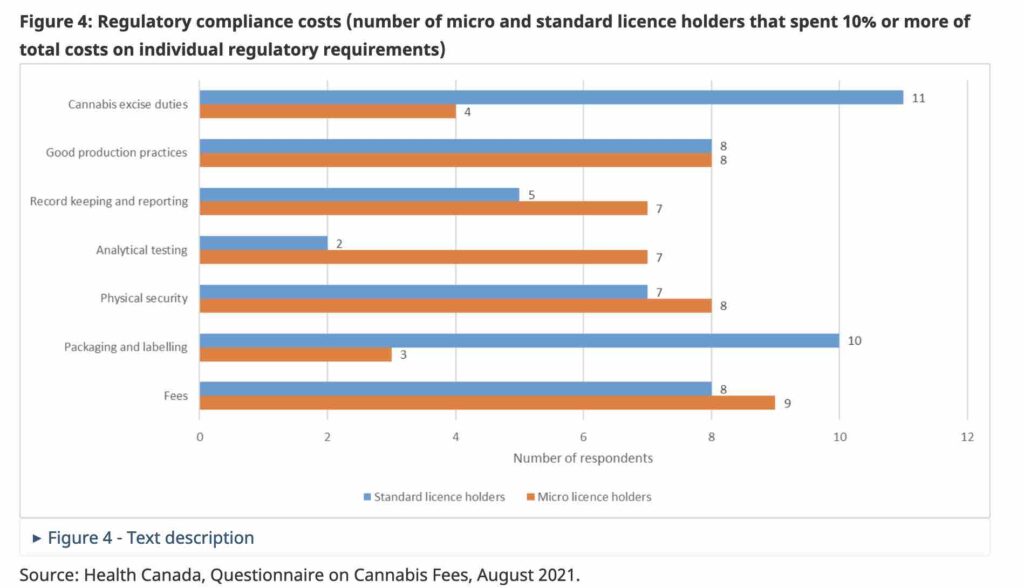
Micros were more likely to report spending more than 10 percent of their costs on security requirements compared to standard licence holders, despite having fewer security requirements than standards.
The same was true for record-keeping, with more than one-quarter of micros (26.9 percent) reporting spending more than 10 percent of their total costs on the record-keeping and reporting, compared to only 13.5 percent of standard licence holders.
Analytical testing was another area where micros reported spending a more significant portion of their total costs compared to standard licence holders, with 28 percent of micro licence holders spending more than 10 percent of their total costs compared to just 5.1 percent for standard licence holders.
(Note: Due to the small respondent size of nursery licence holders, Health Canada has used the term “micro” to represent micro and nursery licence holders.)
Infograph via Health Canada
Timelines for security clearances, which go through RCMP and have long been a sticking point for applicants, continue to be a problem, as well, said survey respondents.
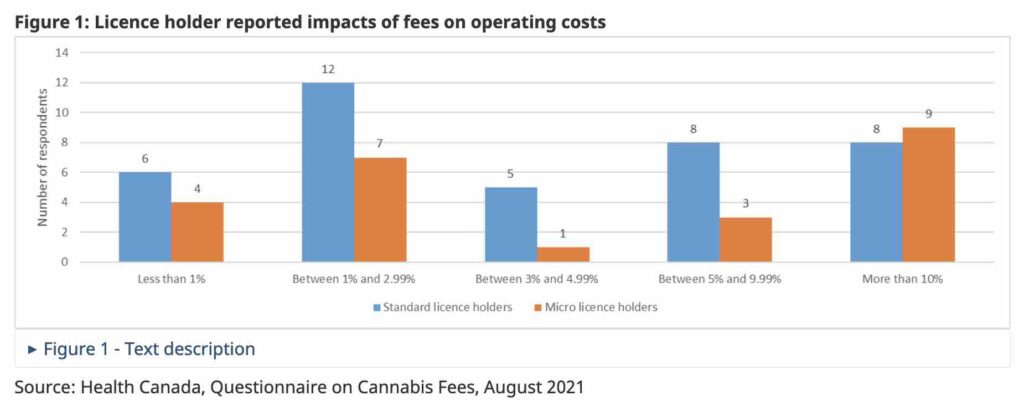
Licence holders said these fees were another barrier to profitability, although they were only a small portion of total operating costs. While one-fifth (20.5 percent) of standard licence holders said these fees represented over 10 percent of their total operating costs, almost twice as many micros (37.5 percent) reported the same.
Most respondents to the survey (63.9 percent) said the application screening fee was reasonably priced given the service provided, while 60 percent said the same for the import and export fee. Just under half (47.7 percent) said the services provided for the security screening fee were worth the cost, while only 41.8 percent said the annual regulatory fee was.
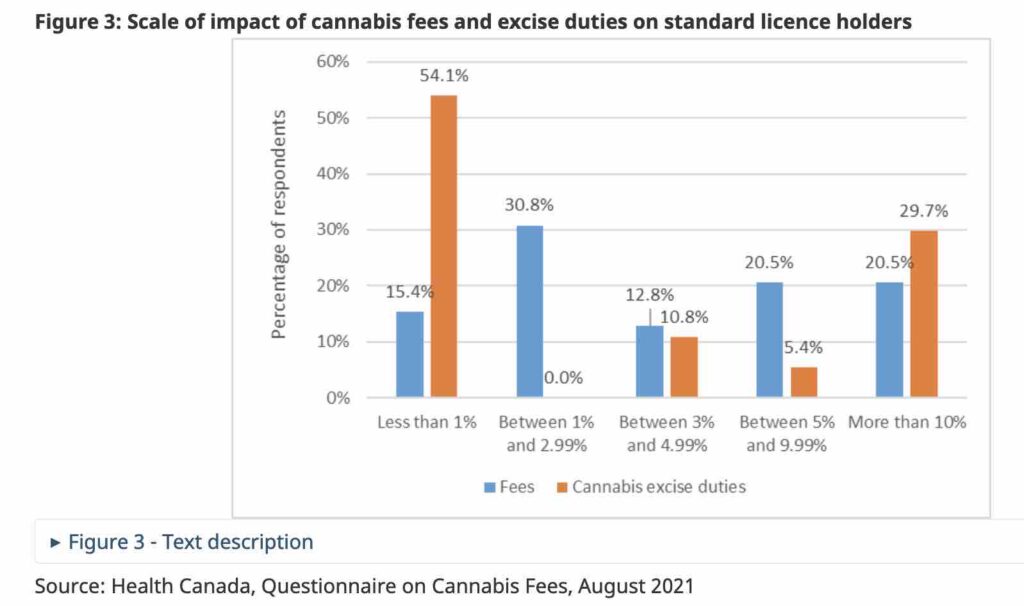
Although not specifically within the regulatory fee scheme, the survey also asked licensed holders about excise duties on cannabis products.
Just over half (54 percent) said the federal excise tax (which generally works out to $1 per gram of dried cannabis and $0.01 per mg of THC on extracts, edibles and topicals) represents less than 1 percent of their total costs. Another 30 percent said it represents more than 10 percent of their total operating costs. The report also notes that these fees are applied to all cannabis producers, regardless of their profitability. Newer producers may sell cannabis, but it can take several years to see any revenue from those sales.
Three-quarters of cannabis excise taxes go to the province, while Ottawa keeps one-quarter.
The cannabis excise tax is applied when producers sell cannabis into a provincial market or through the medical program. Cannabis producers have long expressed frustration with the high level of taxes on cannabis, which can be upwards of 30 percent of sales revenue for producers. Currently, wholesale prices for dried cannabis flower in Canada can range from less than $1 per gram to around $4 or $5.
Another issue, according to survey respondents, is getting into most provincial markets, arguing that provincial cannabis boards are favouring low-cost, high-THC products. Issues such as payment schedules, recall insurance, and return policies were also commonly noted challenges here. As was access to capital.
Health Canada says this review, along with the current legislative review of the Cannabis Act, will help inform the government as to the progress of legalization as it enters its fifth year.
Well, the COVID panic has been over for more than a year, and most people seem to be breathing a bit easier now, both literally and figuratively.
Most everyone has returned to their pre-COVID lives. The masks are mostly gone, and testing is only undertaken by a few people who remain in fear.
The great majority of people state that they did the “right thing” and got the requisite initial jabs, although a majority of people state that they decided against the boosters. The reason? Most are unclear on that, except to say that, “I was beginning to have doubts… but I’m still glad I got the initial injections.”
Of course, since the “all clear” signal was sounded, those doctors who initially jumped on board the COVID Express with both feet have calmed down a bit, and many research facilities have been doing studies on the possibility of vax damage.
Those studies have been showing with fair consistency that the jab was indeed detrimental – both short-term and long-term. At this point, scores of studies have come to this conclusion, and even many prominent doctors who initially supported vaxxing are now stating emphatically, “We were lied to.”
So, we might expect that those who filed into clinics like cattle to get the jab would now have learned three important lessons –
Don’t trust Big Pharma
Don’t trust the media as regards Big Pharma
Don’t trust the authorities as regards Big Pharma
And yet these lessons, with few exceptions, do not seem to have been learned.
Some people are still getting tested whenever they get cold symptoms. When asked why, they don’t seem to have a clear answer.
When asked if they would trust those who pushed the vaccines again, their eyes tend to glaze over. Again, they don’t really have an answer.
Most people who got the jab don’t seem to have advanced their thinking in the last year. Their learning curve appears to have halted the moment the media stopped talking about COVID.
But why should this be? Surely, the evidence of deception by Big Pharma and its support group is self-evident at this point. One only has to read the results of post-COVID studies that have been undertaken to arrive at the conclusion that the evidence is overwhelming: A major con has been played on the world – a con that netted tens of billions of dollars for Big Pharma.
The answer to the question, I’m afraid, may well be harder to face than the fact that the majority of people bought into the vaccine charade. The answer as to why very few people have advanced their understanding of what’s been done to them has more to do with human nature than medical perceptions.
It’s unfortunately true that, back when we went to school, we were taught almost entirely by rote. We weren’t asked to learn why the world believed that warfare was necessary; we were only told to memorise the names of the generals and the dates that the wars took place.
If we were asked to read the works of great writers, we weren’t expected to develop an understanding of their insights; we were merely expected to memorise some famous quotes by them.
And, once we had passed our exams, it was perfectly acceptable for us to forget what we’d memorized.
In short, a primary principle of “normal” education was that all that mattered was that we could parrot back whatever we had been fed most recently.
No surprise, then, that, in adulthood, we do the same. Of course, adults tend to study less than when they were in school. They rely instead on the evening news to keep them informed. We hear the latest urgent breaking news, and we pay careful attention. We then follow the instructions we receive from the “experts” doing the speaking and wait until the following evening to receive further indoctrination and instructions.
Along the way, we also hear “non-authoritative” information and are careful to classify such information as “conspiracy theory.” Such information enters the temporal lobe only briefly. In most cases, the human brain has been trained to delete such information, as it has no value with regard to following instructions. Worse, it makes us question that instruction. The temporal lobe becomes adept at deleting such information as though it had never been received.
And, here, we have a basic function of the human brain that affects the great majority of people – indeed, all people who have not, at some point in their lives, become independent thinkers:
Respond to controlled input and ignore peripheral input
For those who questioned the COVID scam early, a great deal was learned even as it was playing out. But the question remains, why did others, who bought into it, not learn from the plethora of studies that have been released over time?
After all, the controlled input regarding COVID ceased to be pushed a year or more ago. What that translates into is that those who simply memorise information and do not significantly question it now have nothing to go on. They’re stuck in neutral. They’re receiving occasional peripheral input that negates the controlled input, but they interpret it as peripheral input and, in a trained knee-jerk reaction, ignore it on each and every occasion. They don’t ever consider its totality, as they’re not programmed to think in that fashion.
As unpleasant as it is to consider, this inability is the norm, even for people who are otherwise intelligent and/or educated. Like hamsters on a wheel, they’re under the impression that they’re in forward motion, but in truth, they won’t move an inch forward until they receive controlled input instructing them to do so.
The COVID masks have been taken off, but an understanding of the fraud that has been perpetrated has, for the majority of people, not been understood.
It could be argued that the discussion presented above could be seen as being academic – pointless – as the COVID scare is now over, and the masks are gone.
But, in fact, unless we pay attention to what researchers have been concluding in the last year and, indeed, if we return to our well-ingrained training not to question, but merely to respond to immediate input, we’re primed to get suckered again.
If we and the majority of the people we know, once again, respond to the controlled input and ignore the peripheral input, we won’t merely have missed the boat on the reality of the COVID scam.
We’re primed to be fooled again.
Editor’s Note: In the years ahead, there will likely be much less stability of any kind.
That’s precisely why Doug Casey and his team just released this new report with all the details on how to play your cards—both for prudence and profit. Click here to get the details now.
The National Association for the Advancement of Colored People (NAACP) has reaffirmed its support for cannabis reform at the federal level and is calling on cannabis industry regulators to protect employee rights in the sector. During its 114th National Convention in late July, the civil rights organization adopted a resolution renewing its support for federal cannabis legalization.
Although America is home to an incredibly lucrative state-legal cannabis industry that is spread across dozens of states, federal law still classifies marijuana as a Schedule I drug alongside narcotics like heroin and cocaine. While the industry has managed to grow into a global behemoth valued at billions of dollars, marijuana’s federal classification causes a myriad of issues for players in America’s marijuana sector.
NAACP also took a position on labor agreements on worker protections in the marijuana sector, stating that most people in the industry will be “workers rather than owners” and that employees throughout the cannabis supply chain have the right to a fair and safe workplace as well as a living wage. The civil rights organization noted that granting marijuana workers access to union representation, apprenticeship and training will ensure a wide pool of workers benefit from the lucrative cannabis industry.
Protecting employee rights in the cannabis sector will be especially beneficial for individuals from communities that were disproportionately affected by marijuana prohibition during the failed drug war. As it stands, the challenges presented by marijuana’s federal status make it much harder for social-equity applicants to survive, much less thrive, in the industry because they often lack the capital and connections needed to be successful in America’s overly bureaucratic cannabis sector.
According to the NAACP’s resolution, the organization supports descheduling cannabis and legalizing it at the federal level. The resolution also reaffirmed the association’s prior resolutions on marijuana, decriminalization, cannabis industries and equity in the sector. Furthermore, the NAACP expressed that it intended to advocate for cannabis measures that make labor peace agreements a condition for receiving licenses.
The civil rights organization adopted the measure without any discussion by members during the session.
The United Foods and Commercial Workers International Union (UFCW) praised the NAACP’s resolution and called it a crucial step toward ensuring legislators and employees understand just how profoundly a worker-friendly marijuana industry would benefit people of color.
If these calls for the federal legalization of marijuana are acted upon, new markets are set to open up for various companies such as Advanced Container Technologies Inc. (OTC: ACTX) as demand for marijuana could explode and those supplying cannabis companies with the products they need will benefit too.
NOTE TO INVESTORS: The latest news and updates relating to Advanced Container Technologies Inc. (OTC: ACTX) are available in the company’s newsroom at https://cnw.fm/ACTX
About CNW420
CNW420 spotlights the latest developments in the rapidly evolving cannabis industry through the release of two informative articles each business day. Our concise, informative content serves as a gateway for investors interested in the legalized cannabis sector and provides updates on how regulatory developments may impact financial markets. Articles are released each business day at 4:20 a.m. and 4:20 p.m. Eastern – our tribute to the time synonymous with cannabis culture. If marijuana and the burgeoning industry surrounding it are on your radar, CNW420 is for you! Check back daily to stay up-to-date on the latest milestones in the fast -changing world of cannabis.
To receive instant SMS alerts, text CANNABIS to 21000 (U.S. Mobile Phones Only)
Please see full terms of use and disclaimers on the CannabisNewsWire website applicable to all content provided by CNW420, wherever published or re-published: http://CNW.fm/Disclaimer
Do you have questions or are you interested in working with CNW420? Ask our Editor
A Swiss woman who went to rehab 18 times in an attempt to alleviate her alcoholism says she only found relief once she turned to psychedelics. Hallucinogenics have taken over discourse in the psychiatry industry in recent years due to their potential as versatile and effective mental health treatments. Psychedelics present psychiatry with a chance to significantly improve treatment outcomes for a majority of mental health patients.
UK-born Amanda has suffered from alcoholism for 20 years and went to rehab nearly 20 times but couldn’t shake the condition. The 50-year-old also suffers from anxiety and severe depression due to childhood trauma that undoubtedly contributed to her alcoholism. Her anxiety disorders were at such an extreme degree that Amanda spent the past seven years living on her home’s balcony in a makeshift shelter.
After years of rehab, treatments and experimental therapies, Amanda’s mental health disorders still had a death grip on her life. It wasn’t until April 2022, when she tried a psychedelic-based treatment, that she felt some relief from her condition.
Amanda isn’t the first treatment-resistant depression patient to benefit from psychedelic treatments. Several studies have shown that only one dose of a psychedelic such as psilocybin coupled with talk therapy can significantly reduce depression symptoms in patients with treatment-resistant depression.
In a 2022 study that involved 79 participants with the condition, one-third of the patients reported improvements in mood after taking a single dose of psilocybin, the psychoactive agent in magic mushrooms. There is a growing body of literature on the potential benefits and risks of using psychedelics to treat mental conditions such as anxiety, post-traumatic stress disorder and eating disorders, proving that psychedelics could be safe and effective alternatives to traditional mental health treatments.
For patients such as Amanda, clinical trials and preliminary programs are among the few legal ways they can access psychedelics. Swiss doctors can apply for an official exemption from the government if they want to prescribe illegal substances such as MDMA and LSD to their patients.
It was this process that allowed Amanda to finally access a somewhat effective treatment after years of failed therapies and forced psychiatric ward commitments due to suicide attempts. After watching a documentary about treating alcoholics with psychedelics, Amanda signed up and was referred to Swiss doctor Livia Granata, who had her go through six 8-hour sessions while under the influence of psilocybin.
Amanda says she has experienced a ‘huge improvement’ in her severe anxiety and depression and has begun to slowly rebuild her social life. Most importantly, Amanda doesn’t feel the urge to drink and has abstained since last April, the longest she has ever gone without alcohol in two decades.
These testimonies from people who have benefited from psychedelics when nothing else could offer any help are a strong indicator that entities that are running psychedelic drug-development programs, such as Seelos Therapeutics Inc. (NASDAQ: SEEL), could deliver medicines that may change the current paradigm of mental health treatment.
About PsychedelicNewsWire
PsychedelicNewsWire (PNW) is a specialized content distribution company that (1) aggregates and distributes news and information on the latest developments in all aspects and advances of psychedelics and their use, (2) creates PsychedelicNewsBreaks designed to quickly update investors on important industry news, (3) leverages a team of expert editors to enhance press releases for maximum impact, (4) assists companies with the management and optimization of social media across a range of platforms, and (5) delivers unparalleled corporate communication solutions. PNW stays abreast of the latest information and has established a reputation as the go to source for coverage of psychedelics, therapeutics and emerging market opportunities. Our team of seasoned journalists has a proven track record of helping both public and private companies gain traction with a wide audience of investors, consumers, media outlets and the general public by leveraging our expansive dissemination network of more than 5,000 key syndication outlets. PNW is committed to delivering improved visibility and brand recognition to companies operating in the emerging markets of psychedelics.
To receive instant SMS alerts, text “Groovy” to 844-397-5787 (U.S. Mobile Phones Only)
Please see full terms of use and disclaimers on the PsychedelicNewsWire website applicable to all content provided by PNW, wherever published or re-published: https://www.psychedelicnewswire.com/Disclaimer
Do you have questions or are you interested in working with PNW? Ask our Editor
Hartford, CT and Oakland, CA (Aug. 21, 2023) – Connecticut celebrates a huge milestone for cannabis social equity with Connecticut Social Equity Council’s (SEC) inaugural Equity Business Pitch Day, Graduation Luncheon, Business Showcase & Cannabis Industry Mixer on Wednesday, Sept. 6 at the Norwalk Inn and Conference Center. The event features the graduation luncheon celebration for the first cohort of the state’s SEC-sponsored Oaksterdam CT Social Equity Cannabis Business Accelerator Program.
After a morning of pitches to cannabis industry investors, the networking will continue with the graduation celebration luncheon and the afternoon business showcase, both open to ticketed guests and featuring key members of the growing Connecticut cannabis industry, including social equity licensed cannabis businesses. Investors, interested companies, sponsors, and members of the public may learn more and get tickets for the Graduation Luncheon or the Mixer here.
“Connecticut’s free business accelerator program offered to qualified social equity cannabis licensees is a first-of-its-kind among states with Social Equity programs,” said Ginne-Rae Clay, Social Equity Council Executive Director. “Connecticut’s program is designed for individuals who won a Social Equity License to provide them the tools to take advantage of their license and open their businesses,” Clay said. “We’re pleased with the technical business assistance and cannabis industry-specific expertise that our providers Oaksterdam University and reSET were able to share with accelerator businesses.”
“Any time a new, limited-license adult use market comes online, it creates the potential for outsized investment returns. This event will offer investors a rare opportunity to connect with multiple licensed cannabis businesses in one place,” said David Abernathy, Principal at Arcview Management Consulting. “Any investor thinking about participating in the growth of Connecticut’s cannabis market won’t want to miss it.”
“We’re excited to work with our partners to bring visibility and investment opportunities to this hard-working cohort of entrepreneurs,” said Sarah Bodley, reSET Executive Director. “These innovative business leaders have worked hard throughout the past year, and this pitch opportunity gets them in front of key industry investors who can offer capital to help their businesses grow.”
“This trailblazing ten-month Accelerator Program has solidified the expertise of our Equity Entrepreneurs in Connecticut’s emerging cannabis industry, helping operators mitigate risks and positioning for long-term sustainability and success,” said OU Executive Chancellor Dale Sky Jones. “The one-on-one business pitch-building time with our deeply experienced coaches has made all the difference for our phenomenal cohort of entrepreneurs.”
Connecticut’s groundbreaking social equity program, launched in the fall of 2022, was designed to address the disparate impacts of the War on Drugs, help legacy cannabis operators with regulatory compliance and industry best practices, and help verified social equity applicants planning to start licensed cannabis businesses.
About Oaksterdam University
Oaksterdam University is America’s first cannabis college and academic institution to promote equity in the cannabis space, to lower barriers to cannabis licensing, entrepreneurship, and employment. With roots growing 27 years deep, OU is a dynamic, diverse, responsive academic institute dedicated to working locally to educate the global cannabis community, industry, regulators, and government. Visit Oaksterdam University – The World’s First Cannabis College.
About reSET
reSET is a nonprofit organization in Hartford, CT, whose mission is advancing the social enterprise sector. reSET specializes in social enterprise ― impact-driven business with a double or triple bottom line. In addition to providing coworking space, accelerator, and mentoring programs, reSET aims to inspire innovation and community collaboration and to support entrepreneurs in creating market-based solutions to community challenges. reSET’s goal is to meet entrepreneurs wherever they are in their trajectory and to help them take their businesses to the next level. Visit reSET | Where Great Companies Grow (resetco.org).
About the CT Social Equity Council (SEC)
The Social Equity Council was created to ensure the adult use cannabis program is grown equitably and that funds from the adult use cannabis program are brought back to the communities hit hardest by the “War on Drugs.” The SEC oversees the verification of equity applicants, creates new programs to support cannabis businesses and businesses in other industries, and manages the more general community investments derived from the cannabis tax revenue. To learn more about Social Equity Council announcements, upcoming meetings, and adult use cannabis information, visit Social Equity Council (ct.gov).













Recent Comments