Have you heard of a garden olla (oy-yah)? They’ve been around for thousands of years. According to the Farmer’s Almanac, they are one of the most eco-friendly ways to conserve between 50 to 70% of water usage in the garden.
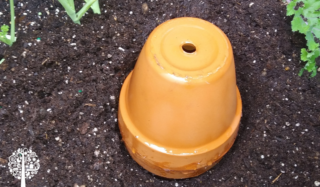
That statistic was enough to pique my interest and to discover that ollas are one of the simplest things to incorporate into my growing regime. Unglazed terracotta pots, with the drain holes sealed, are buried in the ground with the open neck of the pot just above the surface.
They are filled with water, and a lid is placed on the open top to prevent evaporation. Over time, water slowly seeps out of the porous pot, watering the surrounding plants.
Why They Work
An olla works because of something known as soil moisture tension. Moist soil is compact, tight, and able to exert pressure on the olla, holding it in equilibrium with the surrounding soil structure.
As the soil dries out, the pressure on the olla is released and water escapes. How far the water goes from the olla depends on its size and the soil quality surrounding it.
Dense soil doesn’t water out as far as loamy or sandy soil. Over time, the roots of the plants will begin to seek out the water source and grow toward and around the olla; this allows for even and consistent watering.
Benefits of Ollas
An olla gets an automatic gold star from me because of the time it saves me watering the garden. A small olla of about one liter will take a day or two to empty, even in hot weather.
Because you bury it in the soil, an olla provides a deeper watering than a hose or watering can facilitate; this encourages a more robust root system, which grows a healthier plant.
Creating a DIY Olla
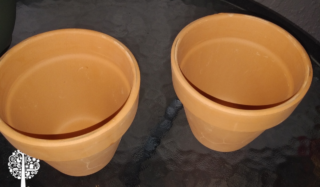
Garden centers are catching on to the garden olla craze, and many are selling them. But you can also make your own if you have some unglazed ceramic pots hanging around.
The first step is to ensure the pot’s bottom drain hole has a water-tight seal. When I made my olla, I used a waterproof silicon sealant and a piece of thin glass to cover the drain hole.
My pots were small; I glued two together, inverting one on top of the other to create an olla that would hold about half a liter of water. I could have just buried one pot and covered it with a lid, but I would have had to fill it more regularly, and it wouldn’t have been as deep into the soil as I would have liked.
After the silicon dried, I buried my olla in the veggie patch, but anywhere would have been fine. I left about 10-15cm of the pot above the surface so I could always find it.
I filled the olla using the drain hole of the inverted pot on top, covered it, and voila, I had a garden olla!
Easy, time-saving and healthier plants – what more can you ask for?
The cannabis industry in Canada has undergone significant changes in the past decade, and along with it, the software options have also evolved. Yet many producers still rely on outdated tools, like pen, paper and spreadsheets, and systems from the ACMPR days.
Companies today struggle to maintain a profitable operation most often arising from a common problem: high costs.Here’s why having the right software is one way for companies to help reduce costs.
The evolution of tools and systems for producers
As industries evolve, so too do the tools that enable players to be compliant and efficient within them.
During the ACMPR and Cannabis 1.0 era, operators were focused on the medical market and dried flower products. Within the facility, the emphasis was on compliance and software was used to support this. However, with the introduction of the recreational market and the advent of Cannabis 2.0 (the addition of products to the legal market such as vapes, edibles and extracts), more advanced software platforms have emerged. These systems continually adapt to create greater visibility and transparency within the production process, driving improvements in both quality and cost-effectiveness.
Advertisement
ACMPR 2013- 2018: Seed-to-Sale software
Between 2013-2018, the evolution of software was driven by the medical industry. The software platforms developed during this time were tailored to comply with the Access to Cannabis for Medical Purposes Regulations (ACMPR) and were commonly known as “Seed-to-Sale” offerings.
Seed-to-sale software assists producers in tracking various stages of the production process, including growth, harvests, drying, processing, packaging and sales and distribution. Though these tools were designed specifically for cannabis 1.0 and medical-only sales. As a result, they are unable to accommodate complicated workflows for complex SKUs leaving producers to rely on binders and spreadsheets to connect the dots between their cannabis inventory, non-cannabis inventory, current work-in-progress and QA programs.
The Cannabis Act 2018: Enterprise Resource Planning
Following the introduction of the Cannabis Act in October 2018, the recreational cannabis market began to find its feet. Large public companies emerged in the industry and as a result, financial reporting took precedence over compliance. This meant larger producers were pushed to enterprise resource planning software (ERPs) to plug the gaps left by traditional seed-to-sale platforms.
ERP software is used by organizations in all industries to manage day-to-day activities, but will not provide granular insight into operations on the facility floor.
Cannabis 2.0 2019 – Present: Manufacturing Execution Systems
When the recreational market evolved and new product forms became available, this led to the emergence of a new type of agile software in the industry.
MES helps producers track and document the transformation of flower or biomass into finished goods. Unlike seed-to-sale, this software captures all inventory movement, quality control work and environmental data into a central platform that can generate detailed batch reports and granular operational insights.
MES is all about increased visibility to critical data, automation processes andefficiency and productivity. It can also “connect the dots” between EPR and other software solutions, such as eQMS –a software system to help LPs set up, monitor and maintain their QA program.
What’s next? Artificial Intelligence
The integration of AI software is expected to play a revolutionary role, enhancing efficiency and productivity in the market.
AI-powered systems can optimize cultivation by analyzing data from sensors and making real-time adjustments for plant health and resource utilization. It can also enhance quality control by detecting pests, disease and abnormalities through image analysis. Inventory management systems driven by AI can track and predict inventory levels, reducing supply chain risks.
Cannabis companies now understand that modern day technology is vital for optimization in hopes of avoiding obsolescence in the highly competitive market.
Hardeep Shoker is the COO and a co-founder of Elevated Signals, which develops GMP-validated manufacturing software for the cannabis industry. He brings 15 years of experience in software development and best practices from other industries, and applies them to the cannabis marketplace.
SMITHS FALLS, Ont. — Canopy Growth Corp. says it has signed a deal to sell its facility in Smiths Falls, Ont., that was once home to a Hershey chocolate factory back to the chocolate maker.
The cannabis company says Hershey Canada Inc. has agreed to pay about $53 million in cash for the property.
Canopy, which has been selling assets and working to cut costs, says net proceeds received from the sale will be used primarily to pay down the company’s senior secured credit facility.
The company announced earlier this year that it was winding down operations at the Hershey Drive facility as part of a plan to lay off 800 workers.
Advertisement
The sale follows the centralization of the company’s post-harvest manufacturing at its former beverage facility in Smiths Falls and the consolidation of its flower cultivation at the company’s sites in Kincardine, Ont., and Kelowna, B.C.
Canopy says once the Hershey sale is complete it will have sold seven properties for a total of $155 million since April 1.
(AP) TEUPIN REUSEUP, Indonesia —Indonesian authorities on Wednesday burned a marijuana plantation in the northern province of Aceh after it was discovered by drones.
A joint team of the National Narcotic Agency, known as BNN, and the National Research and Innovation Agency using drones detected 4.5 hectares (11 acres) of land with an estimated 21,100 cannabis plants ready for harvest, said Wayan Sugiri, the deputy for eradication at BNN. The aerial operation was conducted from Aug. 3 to 13 in Teupin Reuseup village in North Aceh district.
More than 150 officers from the police, customs and BNN were deployed to uproot the 20 tons of marijuana for burning Wednesday, Sugiri said.
Advertisement
“This is a form of the government’s firmness against illegal drugs and their circulation,” Sugiri said. The burning was the fifth this year, he said. In March, authorities burned 43 hectares (106 acres) with an estimated 190,000 marijuana plants.
Indonesia, the world’s most populous Muslim-majority nation, adamantly prohibits the consumption of marijuana, even for medical treatment. Some countries, including Southeast Asian neighbor Thailand, allow its use for medical purposes, and others have decriminalized its recreational use.
Last year, Indonesia’s Constitutional Court rejected a judicial review of the country’s narcotics law that would have paved the way for legalizing marijuana for medicinal use.
The 2019 Global Drug Survey says cannabis is the world’s most commonly used drug after alcohol and tobacco.
It is also the most used illicit drug in Indonesia, according to 2022 data from BNN. The agency estimates there are 4.8 million drug users in the country of more than 270 million people.
The United Nations Office on Drugs and Crime says Indonesia is a major smuggling hub despite having some of the strictest drug laws in the world, in part because international drug syndicates target its young population.
A recent examination of survey data from Gallup shows that Republican backing for cannabis legalization has reached an unprecedented peak on a nationwide scale. However, a deepening partisan schism has emerged over the last couple of decades, with Democrats having swiftly and more openly embraced this cause. Most Democrats and Independents leaning toward the Democratic Party (amounting to 83%) and also Republicans and Independents with an inclination toward the GOP (accounting for 55%) are in favor of dismantling the ban on cannabis.
These insights, extracted from Gallup’s 2022 survey data, illustrate a disparity of 28% in opinion on the matter of cannabis reform between these political factions. The divergence is now broader compared to the scenario two decades ago when backing from both sides was less than 50%.
According to the most recent research, Democrats have demonstrated a more positive attitude toward marijuana legalization than Republicans since 2003. The data continues by revealing that between 2013 and 2022, there was a synchronized increase in the number of each political party’s supporters of legalizing marijuana. However, Democratic group growth has exceeded Republican faction growth. This has caused the political gap on this matter to be slightly more apparent in the most recent measuring year compared to two decades ago.
Marijuana legalization is one of nine issues out of the 24 analyzed by Gallup, where both political parties are typically in agreement with the majority opposition or support at different levels. The closest comparison to the marijuana debate is same-sex marriage, with a 28%-point political margin; it is supported by 57% of Republicans and 85% of Democrats.
“Political polarization continues to be a critically important feature of the American political landscape,” the report states. “On all 24 of the subjects examined in this analysis, there are now major — and in some cases, enormous — partisan disparities in opinion. This affirms the essential tenet of any American political analysis, which holds that people’s political identities are strongly connected with their opinions on policy and social problems giving rise to significant variations in those opinions among political segments.”
A number of other analyses issued this year support the idea that a majority of Americans, regardless of party affiliation, are willing to reform federal cannabis laws. However, while the majority of states have approved some kind of medical marijuana and 23 states have already passed legislation legalizing cannabis for recreational use, efforts to adopt federal changes have lagged well behind public sentiment.
This lag between public sentiment and actions in Congress suggest that it may take a while for federal marijuana policy to be overhauled. Despite this gloomy possibility, companies such as IGC Pharma Inc. (NYSE American: IGC) are on course to thrive as sellers of federally approved cannabis-based treatments if their R&D programs yield successful outcomes.
NOTE TO INVESTORS: The latest news and updates relating to IGC Pharma Inc. (NYSE American: IGC) are available in the company’s newsroom at https://cnw.fm/IGC
About CNW420
CNW420 spotlights the latest developments in the rapidly evolving cannabis industry through the release of two informative articles each business day. Our concise, informative content serves as a gateway for investors interested in the legalized cannabis sector and provides updates on how regulatory developments may impact financial markets. Articles are released each business day at 4:20 a.m. and 4:20 p.m. Eastern – our tribute to the time synonymous with cannabis culture. If marijuana and the burgeoning industry surrounding it are on your radar, CNW420 is for you! Check back daily to stay up-to-date on the latest milestones in the fast -changing world of cannabis.
To receive instant SMS alerts, text CANNABIS to 21000 (U.S. Mobile Phones Only)
Please see full terms of use and disclaimers on the CannabisNewsWire website applicable to all content provided by CNW420, wherever published or re-published: http://CNW.fm/Disclaimer
Do you have questions or are you interested in working with CNW420? Ask our Editor
A cannabis producer says they were recently told their product would no longer be sold in Alberta due to them containing too much CBN.
The notice—sent in an email by their category manager at the AGLC (Alberta Gaming, Liquor and Cannabis, which oversees cannabis sales in the province)—came without advanced notice, says Jen Meyers, the CEO of Zelca Ltd, a micro processor located in Calgary, Alberta.
Zelca sells cannabis-infused sugar under the brand Manna. The product being delisted, Maple Sugar, comes in 4 x 2g sachets, each containing 2.5 mg THC, 5 mg CBD, and 10 mg CBN.
Despite Zelca being caught off guard, the AGLC tells StratCann via email that these changes are not new and were part of a notice the provincial regulator sent out in February of this year that referenced “minor intoxicating cannabinoids.”
“This change came into effect from February 2023 and AGLC depleted the on-hand inventory of impacted products,” noted an AGLC media representative in an email to StratCann. “AGLC worked with licensed producers and retailers to ensure they had ample time to understand and adjust to the change. Earlier this year, the Ontario Cannabis Store also implemented the same requirements based on Health Canada’s recommendations. We were informed by Health Canada that they did send out a notice to all LP’s on the same topic.”
“Being able to provide our customers with unique formulations and highlighting different aspects of the plants in our product is one of the few competitive advantages we have over the black market,”
Jen Meyers, Zelca Ltd.
The February document in question contained no specific reference to CBN, a cannabinoid not universally considered intoxicating. Several similar products that contain more than 10mg THC per package when including CBN within that total are still listed by the OCS. OCS has not yet responded to a media request for comment.
Health Canada tells StratCann they are currently developing a response to the issue.
From an email to StratCann, a representative with the AGLC says:
“To minimize the risks of overconsumption and adverse effects of cannabis products containing intoxicating cannabinoids, Health Canada recommended all provinces and territories consider implementing policy that limits the chance that any combination of intoxicating cannabinoids found within a product should not [sic] exceed the THC limits set out for edibles and extract products in the Cannabis Regulations.
“With this in mind, AGLC informed licensed producers of additional controls that will be applied to all intoxicating cannabinoids, specifically, 1) THC limit: The total amount of all intoxicating cannabinoids (delta-9-THC and other intoxicating cannabinoids) does not exceed the regulatory limits set for total delta-9-THC. 2) Labelling: Accurate information regarding the name and quantity or concentration of all intoxicating cannabinoids be put on the product label.
“AGLC has temporarily stopped accepting product submissions for products that contain any combination of intoxicating cannabinoids that exceed these THC limits. Please note, CBG is considered a non-intoxicating cannabinoid and sales of CBG products will not be impacted.”
“AGLC has temporarily stopped accepting product submissions for products that contain any combination of intoxicating cannabinoids that exceed these THC limits. Please note, CBG is considered a non-intoxicating cannabinoid and sales of CBG products will not be impacted.”
Media representative with AGLC
The outreach from the AGLC so far doesn’t appear consistent. At least one other producer that also sells edibles products into the Alberta market with CBN—Indiva’s Pearls—tells StratCann that they have not received any specific notice about their products being delisted similar to Zelca’s.
In March of this year, Health Canada reached out to the cannabis industry seeking feedback on potential amendments to Cannabis Regulations, including whether the “limits on the maximum quantity of delta-9-THC contained in a cannabis product (by container and ingestible unit) apply to the sum total of all intoxicating cannabinoids found in the product.” It did not reference CBN specifically.
Sources close to the issue say the federal health agency has also floated a draft document to stakeholders with guidelines for licensed producers on the subject of these minor “intoxicating cannabinoids” such as Delta-8 THC, THC-V, as well as CBN, among others. However, no licensed producers StratCann has spoken to for this article have received official guidance from Health Canada on this subject in reference to including CBN within the existing THC limit for products like edibles.
StratCann reached out to other provincial regulators to see if they are enacting a similar rule around “minor intoxicating cannabinoids” that would include CBN and has not immediately received a response as of press time.
Meyers, with Zelca, says the most confusing part of this move is that it came with no notice. The small micro producer, which operates with just three employees, has fulfilled multiple orders for this product since February 15 including one as recent as early August.
Taking the product back will be a significant financial burden for a small company.
“They need to give us time to plan and submit new NNCPs (Notice of New Product Notifications) and develop new products. You can’t just pull the rug out from under us on this,” an exasperated Meyers tells StratCann.
She also doesn’t understand how CBN could be considered intoxicating, and says these kinds of decisions are part of what continues to drive consumers to the illicit market.
“Being able to provide our customers with unique formulations and highlighting different aspects of the plants in our product is one of the few competitive advantages we have over the black market,” she adds. “If you want people to cross over, it’s through these types of innovative products.”
StratCann also spoke with Niel Marotta, the president and CEO of Indiva, a cannabis producer that sells cannabis edibles with CBN into the Alberta market. Marotta says Indiva has not received any such guidance from the AGLC.
StratCann reached out to other producers with similar products for sale in Alberta and has yet to receive any on-record confirmations as of press time. A representative with a producer that also sells a similar CBN-infused edible says AGLC had sent them a request for more information about their products this week, but they had not received a stop order.
Marotta echoes Meyer’s comments about the need to be more competitive with the illicit market. Although Indiva hasn’t heard from the AGLC about any rule change regarding these novel cannabinoids, Indiva recently dealt with a similar challenge with its own ingestible extract products that had a stop sale issued earlier this year.
He says he’s also aware that Health Canada has been considering changes to the regulations to include products like delta-8 THC within the scope of the 10mg THC limit, but this is the first he has heard about potentially including CBN in that. He disputes the argument that CBN products can be considered “intoxicating” in the way delta-9 or even delta-8 would be.
He compares the limit to a rule that would only allow alcohol companies to sell products in mini bottles. “If this category is forced to continue operating in the equivalent of mini-bar bottles, you’re just handing a gift to the illicit market. I would go so far as to say that it’s irresponsible. They’re ignoring the real issue, which is that copycat edibles provide the value that the consumers want but none of the safety that our products provide. So they’re effectively encouraging the black market.”







Recent Comments