Despite stiff penalties, Hong Kongers, especially young people, are illegally importing hundreds of kilograms of cannabis from Canada and the US, local officials noted in 2020.
Most recently, Hong Kong customs seized 120 kilograms of cannabis from Canada on August 15 in a shipment listed as chickpeas, and another 100 kilograms on July 25, declared as leisure patio chairs.
120 kg of cannabis sent from Canada, seized by Hong Kong customs on August 15
The author in that story quotes a researcher, Nicole Maalsté, who focuses on the international cannabis market. She argues that European consumers find North American cannabis more appealing, and overproduction in the Canadian and US markets is a great source to supply that demand.
A recent piece in The Irish Times says that so far this year, authorities in that country have seized 799 postal packages containing cannabis, mainly through the postal system, worth just under €5 million (~$7.3 million Canadian). This is a 55 percent increase from the amount seized in 2019, with increases beginning in 2018 and “soaring” in 2020 and 2021 during the pandemic.
Authorities in Ireland say this was because of regular smuggling routes being shut down due to trade disruptions and travel restrictions.
The US saw a similar spike in large seizures of cannabis while the border was closed to non-essential traffic. Canadian cannabis making its way to the US is not new, but with more US states legalizing, distributors of cannabis looking for markets can still utilize US channels to send cannabis to foreign shores.
Similarly, as more US states legalize, the allure of higher prices abroad can be difficult to resist for Canadian producers in a saturated market.
A policy proposal to abolish tax on cannabis for medical purposes is now one step closer to having a chance to be part of the Conservative Party platform.
The proposal calls on the Conservative Party of Canada to adopt a policy that will “abolish the excise tax on medical cannabis, fostering compassionate patient care and promoting its potential as a ‘Made in Canada’ safer alternative to addictive opioids.”
It argues that ending this tax would encourage economic growth, support healthcare affordability, and could lessen opioid use.
The proposal, Policy 1849, has now passed the first stage of voting and will next be heard as a regional priority from New Brunswick in a breakout session on Friday, September 8, explains Tanner Stewart, who helped inform the policy. Stewart is the founder of Stewart Farms, a cannabis producer in St Stephen, New Brunswick, and will be at the convention seeking to rally support for the proposal.
The Conservative party’s convention is in Quebec City from September 7-9.
If the policy makes it through that round of voting at the regional stage, it then has a chance to be heard on the convention floor for a final vote by all delegates to determine if the proposal will officially become party policy.
Stewart says his goal is to bring more attention to the issue of taxes on cannabis for medical purposes.
“Ironically, it’s also one of the few classes of drugs that are 100 percent made in Canada. Fifty percent of Canadians who stopped using medical cannabis last year did so because they couldn’t bear the costs. The idea that a Canadian can’t afford a medication they need, that’s readily available and made in Canada, is pure lunacy. My hope this coming week is that the CPC adopts this policy to abolish the tax on medical cannabis, and signals to Canadians that they support safe, made-in-Canada medicinal products.”
“The tax regime that our industry has been enduring under this government has been unsustainable from the start,” he tells StratCann. “They claimed legalization wasn’t about money. They said it was to ensure a safe legal supply and to push out the illicit market. If that were true, medical cannabis wouldn’t be the only prescription drug in Canada that is taxed.
Even if it doesn’t pass, Stewart says he’s hopeful that the proposal will help bring more attention to the issue.
Trapper Cane, a veteran of the Canadian Armed Forces and director of the St. Croix New Brunswick Progressive Conservative Association helped bring the policy to the convention. Cane, who served as a paratrooper and was seriously injured in a mid-air collision, leading to issues with chronic pain and PTSD, co-founded the Canadian Army Veterans (CAV) Motorcycle Unit, says that without cannabis, he would have never been able to take part in such events.
“It was the medical marijuana that got me out of the dark spots I was in and helped me ignore the pain and to get myself on a motorcycle.”
“Medicine is essential. For my experience as a veteran of the Canadian Armed Forces, I was both crippled physically and I suffer from post-traumatic stress injury, so marijuana for me is a life saver. This is a medicine and it’s brutally taxed already, and we need to make that go away.”
The decay of social norms and status quo systems triggering an authoritarian tightening of the screws is a well-worn pattern throughout human history.
What do I mean by Neither Comply Nor Resist? Let’s start by noting society functions by our voluntary compliance with a spectrum of social norms–what’s socially acceptable and unacceptable–some of which are institutionalized into legally defined rules that impose judicial consequences on those who break the rules.
Society breaks down when either set of social norms–the institutionalized judiciary or the cultural norms– loses the voluntary compliance of the vast majority. This dynamic is illustrated by the “broken windows” phenomenon in which a neighborhood decays when windows are broken without enforcement or consequence (i.e. no enforcement of laws forbidding the destruction of others’ property) and the broken windows remain unrepaired (i.e. the social-cultural norms have broken down–the owners and authorities no longer care).
We can observe what happens when so-called petty crimes have no enforcement consequences (crime soars) and social norms of politeness break down (rudeness begets violence).
There is also a spectrum of personal responsibility and choice, from obedience to active resistance. This spectrum applies to both laws and regulations and to cultural norms.
Obeying laws and regulations keeps us out of trouble and maintains social order. If some drivers decide that it’s politically wrong that “red lights” mean stop, their “resistance” messes up life for the rest of us.
The problem, as we all know, is that when the Powers That Be (in any political system) feel threatened, they respond by becoming more authoritarian. They seek to tighten the screws on the populace to make sure nothing gets beyond their control, and they become hyper-vigilant about hammering down any nails that pop up as threats.
Before you know it, there are laws requiring everyone to wear their underwear on the outside of their clothing (an egregious Woody Allen reference). Regulations pile up to the point no one can even keep track or even be aware of them all. And penalties for law-breaking that is perceived as a threat to the Powers That Be increase.
Laws and regulations tend to be enforced asymmetrically along political lines. In the late 1960s and early 1970s, for example, a large percentage of federal law enforcement personnel and attention was focused on draft resisters, to the point that other criminal activity received less attention.
As authoritarian-political pressures mount, the agencies tasked with enforcing laws end up breaking laws to meet the demands of the Powers That Be. This was eventually laid bare in the congressional Church Committee hearings. It turns out institutions that are supposed to be above politics respond to political pressure when the Powers That Be sense their control is weakening / threatened. They turn up the heat on agencies and cashier bureaucrats who resist the politicization of enforcement.
In other words, The Powers That Be tighten the screws on law enforcement and the judiciary as part of the process of tightening the screws on the populace.
Render to Caesar that which is Caesar’s makes excellent sense as authoritarianism increases. Obeying the laws that are supposed to be applied equally to all is both a civic duty (that some are corrupt and get away with it doesn’t diminish our duty) and a strategy for avoiding needless trouble.
Active resistance is precisely what the system is hyper-vigilant about crushing. Trust me, getting called in by the FBI regarding “political crimes” isn’t like TV. You’re alone, and as for counting on being saved by Hollywood-movie heroic lawyers–it’s best not to confuse reality with entertainment. By all means, visit your buddy in the pen after his arrest, but he’s alone and you’re free to leave. If conscience demands resistance, be aware the system loves open resistance because that saves them the trouble of identifying troublemakers.
If it’s a matter of conscience, then be prepared to turn yourself in to start your prison sentence. This is what it takes, this is where it goes, especially for “political crimes,” i.e. crimes against the state, not against individuals. Trust me on this, I have friends who did this, I’ve visited friends after their arrest and gone to their trials in federal court. It’s not TV, it’s real life, with real consequences.
The system incentivizes compliance that isn’t legally binding. There’s no law requiring people to borrow vast sums to attend college, or take out a crushing mortgage to own a house; those are social norms we’re “encouraged” / pressured to comply with.
The point I’m making with Neither Comply Nor Resist is non-compliance and non-resistance are paths to personal freedom and responsibility that have no legal consequence. The individual who doesn’t pop up as a nail (i.e. a threat to The Powers That Be) and who renders to Caesar what is Caesar’s isn’t going to attract a lot of official attention. Fading into the dull-gray background of millions of other people with similar profiles is a practical strategy as social norms break down and authoritarian responses increase accordingly.
It’s called opting out, and it’s been a successful strategy since the waning days of the Western Roman Empire. Don’t want to pay high taxes? Then need less so you can make less money. Low income, low taxes. Start a self-employment enterprise that enables you to legally reduce your net income by expensing legitimate expenses. The less you need, the easier life gets. The healthier you are, the easier life gets. The more you produce and the less you consume, the easier life gets. And so on.
Decaying social norms and systems are more prone to breaking down. If things that were once reliable are no longer reliable or predictable, life gets less easy. The more Self-Reliant we are, the lower our exposure to risk and the downside of system decay.
The decay of social norms and status quo systems triggering an authoritarian tightening of the screws is a well-worn pattern throughout human history. It shouldn’t surprise us to be living this dynamic in real time. We don’t control the decay or the authoritarianism, but we do control our response.
Those who opt out or otherwise reduce their dependence and exposure to risk serve society in several ways. By reducing dependence and consumption, we lighten the load on institutions struggling to maintain services. By prioritizing production over consumption, we’re adding goods and services and not just consuming them. By contributing to networks of other trustworthy, self-reliant people, we’re maintaining positive social norms and setting an example of how life can still be worthwhile and rewarding even as social norms degrade and authoritarian pressures increase.
Know then thyself, presume not God to scan, the proper study of mankind is man – Alexander Pope
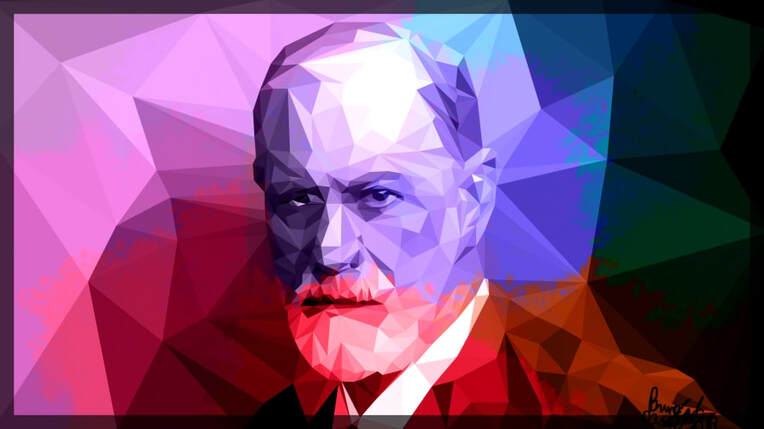
Sigmund Freud’s theories about the psyche had a devastating effect on the science and philosophy of his time. Both were based on Rationalism, a philosophy which championed the merits of the intellect and conscious mind.
Rationalists believe that every mystery confronting humanity will one day be demystified and solved. No matter what puzzles nature throws at us, it is only a matter of time before human beings triumph and lay bare the workings of the cosmos. Get emotion, passion and woolly-thinking out of the way and forge ahead. Mystery be damned!
In other words, as far as most Rationalists are concerned, there are no ultimate mysteries. With patience and scientific diligence, rational man is eventually bound to unearth the ultimate truths about reality. It’s the ultimate destiny of man, the rational animal.
Man himself as the possessor of all things, as the unquestionable conqueror and master of all nature as if he had created it himself. But this sense of possession and power is only too often combined with a remarkable lack of responsibility and realization of the right to life of other creatures. Man’s domination is too often a prostitution of nature rather than its legitimate use – Seyyed Hossein Nasr
In the nineteenth and early twentieth centuries – when Rationalism ruled the world – most Europeans eagerly put their faith in science, pragmatism and materialist philosophy. They also put their faith firmly in the mighty institutions of learning.
However, the whole house of cards came tumbling down after Freud’s analysis of the “unconscious,” proved that man was by no means in total charge of his thoughts and behavior. It was the ultimate conclusion of Kant’s skepticism. What is it to know the answers to every metaphysical problem plaguing us, and still know next to nothing about the being asking questions and seeking answers? Who is this being? What does the thinker know about his own mind and thinking process? Obviously, said Kant, we know very little about ourselves.
Freud agreed and, with the earlier sage in mind, set himself the great task of looking deeply into the mind of the being who questions reality. After all, Hegel may have been correct when he emphasized that all human questioning ultimately serves a single purpose – Self-knowledge.
At bottom there is but one subject of study…the mind. All other subjects may be reduced to that; all other studies bring us back to this study – Henry Amiel
But, given that Self-understanding is the key to all acts of thinking, what does man know about himself? Why did it take until Kant’s time for man to position himself at the center of interest? Why is the study of man and his remarkable faculties so recent?
And, as Kant asked, is it even possible for a person to attain complete Self-transparency? According to Freud, and the psychoanalysts, the answer is firmly and irrevocably – No!
It was a declaration that shook the world to its foundations.
Despite the shock value, however, it was not a new discovery by any means. Previous sages had remarked on the limitlessness of being. The soul of man is too deep to be wholly encompassed and fathomed, said Heraclitus, years before Plato. German mystics, idealists and romantics echoed the same refrain. Freud provisionally agreed, but argued that a measure of peace is brought to the soul by emptying the so-called “unconscious” of its dark unsavory content. Bringing what is hidden to light reduces neurotic tendencies, thereby allowing consciousness to be governed more by reason than wild passion.
For Freud self-knowledge means that man becomes conscious of what is unconscious; this is a most difficult process, because it encounters the energy of resistance by which the unconscious is defended against the attempt to make it conscious – Erich Fromm
Hardline Rationalists weren’t convinced. Their response to Freud’s ambivalence was simply why? What gets in the way of full conscious lucidity? Freud answered in words reminiscent of Nietzsche. The mind itself gets in the way. Consciousness is the most complex thing there is, and a great deal of its workings lie in darkness. Even if one absurdly insists on reducing mind to brain-function, the same fact remains.
Attempts to pull back or penetrate the great veil between conscious and unconscious hemispheres only lead to further entanglement, paradox and confusion. Sad to say, reason isn’t much help. What a mind wishes to keep hidden from itself, remains hidden. Very perplexing to be sure.
Freud could not altogether abandon the tenets of Rationalism. Hence, many of the criticisms against him are not as straightforward as they appear. It cannot be denied that he often conceded the difficulties, and was always ready to address the limitations of his practice.
Unhappy with one technique, he wasn’t adverse to changing his approach entirely. He went from conversation to free-association to dream-analysis, in an attempt to arrive at a satisfactory understanding about what the deeper recesses of one’s mind want to communiate through the ego’s defences. At the heart of Freud’s practique is the desire to overcome man’s regrettable penchant for self-deception.
In subsequent writings, Freud conceded that analyzing the content of a person’s subconscious is largely a matter of interpretation. The process is complicated by the fact that a censor is constantly at work within consciousness, inhibiting direct access to deeper recesses of the psyche.
It was apparent to Freud that most people are content to carry on living without knowing too much about themselves. They are quite content to exist in a state of evasion and self-deception. In many cases, clients sought out a therapist not to help them unearth the truth about themselves, but to help them prevent that truth arising to disturb the flow of their mediocre lives.
For such a client, therapy is deemed successful if it readjusts them to soceity’s standards and wins them the approval of others. As far as Freud and his followers were concerned, the intention of most clients is to exhange legitimate suffering for neurotic misery. When the therapist attempts to draw their attention to this foible, and counsels a reversal, the client cancels further sessions and never returns.
Okay, so you’re advising me to be “authentic”…I’ll have to think about it and get back to you…
Freudianism revealed how the vast majority of people recoil from expressions of legitimate emotion. By avoiding legitimate despair they silence the voice of the conscience, becomng wooden pseudo-selves in the process. It wouldn’t be much of a problem if the predicament was confined to one or two neurotics. However, as Erich Fromm, Karen Horney, Arno Gruen, Viktor Frankl, and others point out, the whole of society has become neurotic in just this way and for the same reasons. Existentialists say if you wish to know what it means to live “inauthentically,” just take a good look at people in urbanized settings. It’s all there in plain view.
On a practical level, when we inquire into what prevents a healthy move toward psychic wholeness, we find that problems start from the very first session.
For example, when a client recalls a dream, and when a therapist attempts to interpret it, they do so in a wide-awake state. They have no way of telling if a recollection of a dream-sequence or image is not a matter of egregious distortion. Indeed, we have no reason to trust the conscious mind’s recollection of dream content. Impressions from the unconscious come to us by way of the ego, which has the power to censor content as well as to drastically tweak content allegedly remembered.
Messages conveyed by the conscious mind may not necessarily be identical to those actually emanating from one’s deeper being. After all, asked Freud, why are dream-images scrambled? Why are they not delivered in a clear, straightforward manner? What part of our mind is resistant to information transmitted by another part, and what does this internal discord means for every other facet of our life? What does it portend for society as a whole?
Self-knowledge in Freud’s sense is not an intellectual process alone…It is not only knowledge by the brain, but also knowledge by the heart – Erich Fromm
This is the reason, thought Freud, that analysts are required. They act on behalf of the dreamer’s true Self. At least that is the presumption.
Another pesky factor compromising open discourse between hemispheres involves what Freud called “repression.” Regardless of the strength and prowess of one’s intellect, there exists content below the limen of consciousness of which we have no awareness. This remains the case regardless of one’s IQ and force of will. Prince or pauper, genius or madman, the puzzling fact remains.
Freud’s descriptions of the unconscious confirm that even the most rational no-nonsense person is plagued with subconscious factors inaccessable to the will. For Freudians, man is certainly at war with himself, and in no position to think of himself as capable of being, intellectually or morally, a force for good in the world. It’s just more self-deceptiveness.
Many questions arise as to the whole premise and veracity of Psychotherapy. Its greatest critics asked how therapy can be effective if the client is little more than a duplicitous malingerer? Early on in his medical career, Freud saw for himself that most mental patients incarcerated in sanitoriums actually wanted to be there, and had few serious complaints. However, even if a client genuinely requires help, how can a therapist really know what makes him tick? Is therapy a kind of drive-in “car-wash” for the psyche? Worse! Is it simply a reprise of the age-old “priest-sinner” dynamic endemic to dogmatic religion? Is the consulting room just a modern-day confessional?
Man is the creature who must constantly overcome himself in order to live fully – Friedrich Nietzsche
It was soon realized that talk about nonconscious urges, instincts, drives, compulsions, complexes and syndromes, etc, compromised the central precepts of science, technology and Rationalist philosophy. What was to be done about it?
Not much, it seems.
Rationalists were forced to concede defeat. If parts of the psyche had the power to contradict, thwart and overthrow the reason and intellect, then no villain could be wholly held accountable for his immoral actions, no matter how diabolical. In fact, a raving psychopathic murderer could, instead of blaming the “Devil,” could now simply blame his unconscious mind, saying that it had a will of its own. According to the Freudians, he’d be quite correct.
Such a premise was, of course, strenuously resisted. Freudianism was deemed by many to be transgressive and iconoclastic.
.
People often say that this or that person has not yet found himself. But the self is not something one finds; it is something one creates – Thomas Szasz
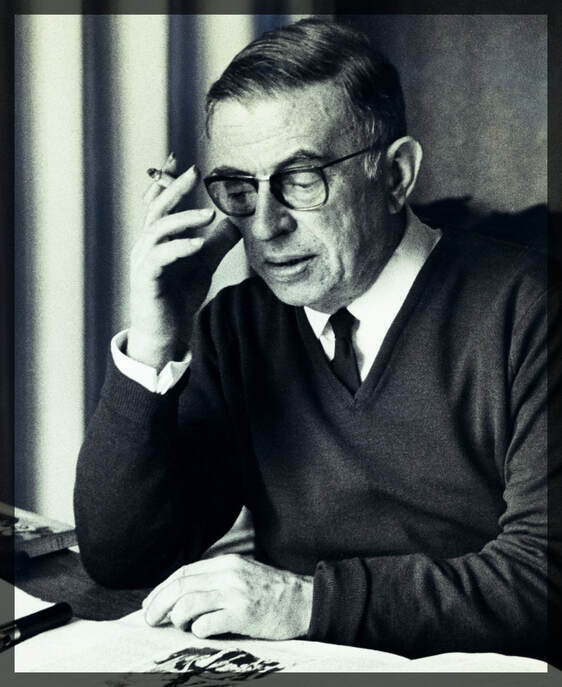
Existentialist philosopher Jean-Paul Sartre was particularly worried about Freudianism. Certainly, he thought, it left a convenient escape-hatch open for immoral types who could, with scientific sanction, deny responsibility for any and all moral infractions and crimes.
A thief isn’t necessarily guilty of any actual crime because he suffers from kleptomania, brought on by childhood deprivation. A sexual-sadist is motivated by repressed fantasies that just come to him, against his will. What’s the problem?
Ted Bundy was addicted to pornography, so he’s not really guilty of mass-murder. He tried to resist the urges rising up from the dark recesses of his subconscious, but his will was too weak. Poor man! What’s the point of punishing him? Although motivated by internal urges, he is the victim.
Jeffrey Dahmer murdered, dismembered, cooked and ate innocent unsuspecting humans because his basic need for company and nurturement hadn’t been sufficiently satisfied by early caregivers. Wasn’t he victimized long before he broke the law?
Likewise, the demagogue who massacres millions in the name of God or a political cause, surely means well. He acts according to the instruction of an “inner voice” he takes for that of God. He suffers from megalomania or a messiah-complex. We’re bound to blame the complex, not the man.
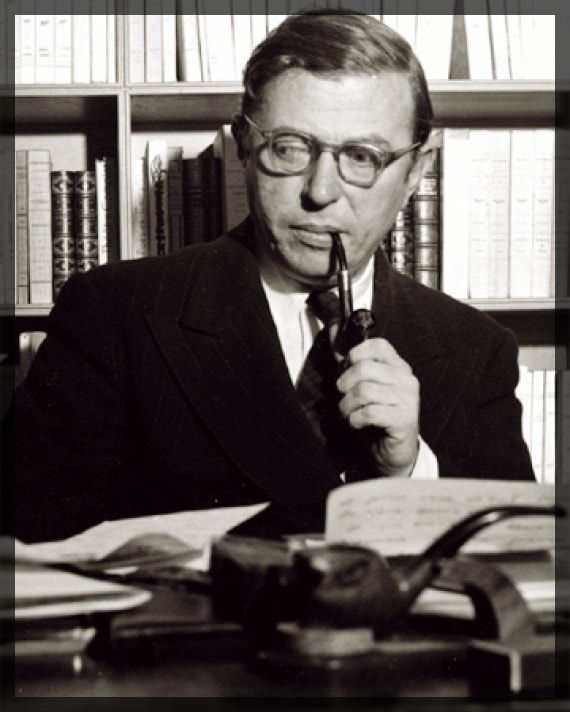
French Existentialist Jean-Paul Sartre (1905-1980), was deeply troubled by the precepts of Psychoanalysis. Was Freud responding to a basic need in man that he somehow overlooked? Do not most people wish for someone to absolve them of blame, and isn’t that what religion brought to humanity? Is the psychoanalyst the replacement for the black-robed priest? The warnings went out from Sartre, Otto Rank, Karl Kraus and Thomas Szasz. Is man destined to never stand on his own feet without stabilizers? Nietzsche demanded that man find out what he is without the supporting pillars of science and religion. However, what if man doesn’t like what he finds? What if he replaces old supports with new ones? Is self-deception the order of the day, the very essence of ego-consciousness?
Man is fully responsible for his nature and his choices – Jean-Paul Sartre
Sartre trembled at this new development, saying that because of Freud’s discoveries, man now had the perfect way out. Humanity’s all-important moral-compass had just been uninstalled. Any sense of responsibility is rendered null and void. Man himself, as a conscious moral entity need not stand trial for anything. Morality was merely a social custom or convention, not based in anything rational and fundamental.
This breakdown in moral sensibility allows moderns to shift blame to a cocktail of unseen drives, urges, instincts and compulsions. Irrational man is able to blame anything and everything except himself. It’s so wonderful, and just what the world needs.
Sartre believed that Freudianism and psychoanalysis in general allowed an immoral person to live in “bad faith” with himself. Forget infractions and crimes against others, and guilt arising from it. Now an immoral person can act immorally without feeling guilt of any kind. Some therapist says he’s not to blame for his evil thoughts and actions, it is his “parents” who must be singled out and accused. After all, how could a barely conscious infant be held responsible for conditions at home? Fault can hardly be attributed to him.
Moral philosophers like Sartre came to fear for the future. What happens if society buys into the new view? What happens to the justice-system – to courts, juries, sentencing and punishment? More importantly, what happens to human contrition and conscience?
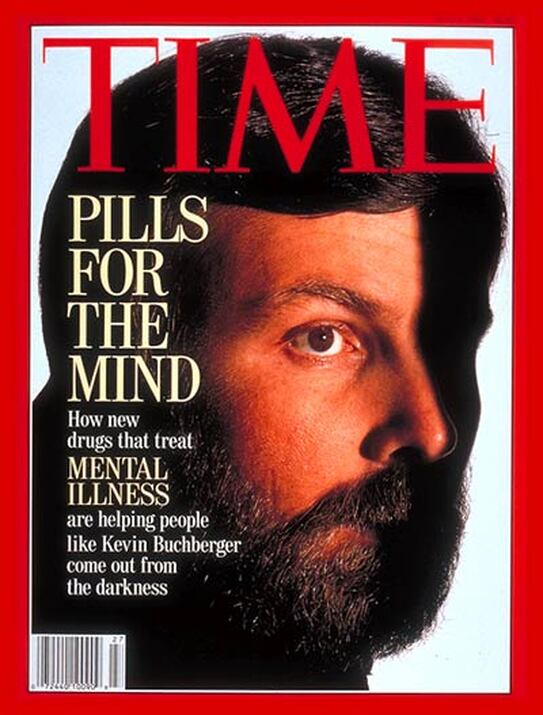
It means that instead of being handed over to prison-services, a criminal is handed over to psychiatrists whose answer to everything is medication. In their minds you are not criminal or deviant, you’re sick in the head. You have a broken mind in the same way as you might have a broken arm. You have a disease of the mind in the same way as you can have brain-disease. You can, therefore, be mended. A few pills later and you’ll be as good as new. Calming tranquilizers and customized pharmaceuticals are what you need, not jail-time and punishment.
Marx said that religion was the opiate of the people. In the United States today, opiates are the religion of the people – Thomas Szasz
The deviant personality type need fear no longer. Guilt is a matter for lawyers, judges and courts, not conscience. Everyone and everything stands accused except the perpetrator. Society has decided that they are the victim. Of course, as Sartre emphasized, those offering forgiveness may be in need of it themselves. The society that easily forgives evil may be evil itself, and in need of absolution for its own crimes. In short, only immoral people are eager to forgive others. They secretly hope to receive it in return. In any case, Big Pharma has taken charge. Diseases of the mind are treated like any other malignancy. Immorality is now a matter of biological corruption. As Thomas Szasz, R. D. Laing and others warned, soon the medicated people – suffering from and addicted to artificial happiness – will lose all sense of Being. Unable to stand as individuals without science and religion, they choose Happy-Pills to keep going. The inauthentic life must be decorated, at all costs, and my shame and guilt for living inauthentically must be anaesthesized, come what may. Critics and criminologists warn that a great many heinous crimes are committed by people addicted to doctor prescribed anti-depressants and anti-psychotic drugs. They’re met with deaf ears. Why not? Given the present state of decay, it’s likely that the would-be critic of society is dependent on medication himself, or will be in the near future. Critical mass is just around the corner. By hook or by crook, the System wins. (Here for more…)
Everything has been figured out, except how to live – Jean-Paul Sartre
Of course, now that the nightmare is upon us, we know the Existentialists were correct to worry about the future. Perhaps this is the reason why some Existentialist thinkers tended to look fondly on Christian values. But even for atheists like Sartre, there simply must be a moral-compass if people and their civilizations are to survive and sanely progress. Take it away, and men living in Bad Faith will soon be found in every walk of life. We’ll be at the mercy of a completely inauthentic society.
What good is a justice-system if humanity as a whole loses the internal voice of conscience? Beinghood is lost, as one robotically lives as the “perfect” citizen. What passes for morality and authenticity is merely cheap trendy emulation. Every value and virtue is a matter of parody, every individual merely a pseudo- or counterfeit-self? What a farce.
According to Sartre, if a broken soul in this condition suffers from anxiety, then anxiety is a damn good thing. Tell us more about it. Such a creature should find himself plagued with “disorders,” because he is existentially disordered. Good thing there’s still a conscience calling from deep down below, making a mockery of the mockery. Thanks be that it prevents fools settling into a cosy life of lies. Bring on the despair, said Kierkegaard, Sartre, Camus, and other Existentialists. It’s the only thing standing in the way of a person’s total committment to falsity and immersion in the mass. Angst is actually one’s savior. Cherish it, bow before it, and never call it bad names again.
How come you don’t recognize your greatest friend and comforter when it comes to visit? As far as the great Existentialists were concerned, your despair and anxiety are the only counselors and therapists you need. (Here for more…)
In the broken state, man certainly finds it difficult to survive, function and progress. Okay, along comes psychology and psychiatry with a bag of tricks – the endless theories, surveys, tests, pie-charts and prescriptions. Men in white-coats chase the demons away and quell your alarming bouts of anxiety. What a relief. Dial-a-shrink and the Prozac smile signals you’re safely back in a superlit, air-conditioned bubble of artificial happiness.
For Existentialists normalization to an inauthentic lifestyle is not to be seen as a good thing. It’s perverse and unsustainable. The thing to do – to secure man as a moral being – is to make sure he preserves his internal moral-compass. Authentic man should need no external authority to tell right from wrong. Sure, in early years we benefit from some steadying action, in the form of social standards and advice from wise elders, but on no account should this be the extent of our moral sensibility. Morality must not be allowed to degenerate into mere parody and social convention.
Freud warned that without external prohibitions man is sure to return to a bestial state. Sartre feared in a different way. Might it not be society that bestializes its citizens? Might not society demand conformity and docility? Might it not rob man of innate sensibilities?
For Sartre, the loss of an internal moral-compass must be addressed. Society must not facilitate man’s capacity for self-deception or condone his evasion of personal responsibility. To become fully “human,” each person must remain free to make as many mistakes as they are capable of. A person must be radically free to reap the consequences of his actions, and must learn to think and act without external impositions from churches, schools, hospitals, think-tanks, media, experts and other people.
Once the voice of conscience wanes, for any reason, there can be no substance to human existence. There can be no higher thought and aspiration. If I cannot judge what is right and wrong within myself, I soon cannot tell what is right and wrong in every other area of life. I find myself morally-neutral, endorsing each and every atrocity committed by government. And if the average state-official is, existentially-speaking, an immoral being without conscience and empathy, how can good come of it?
If I allow myself to follow the dictates of such a creature, how am I doing good? Must I not fight tooth and nail, and with every fibre of my being, against such a rotten status quo? Conscience is not just a word in a dictionary. It’s an act.
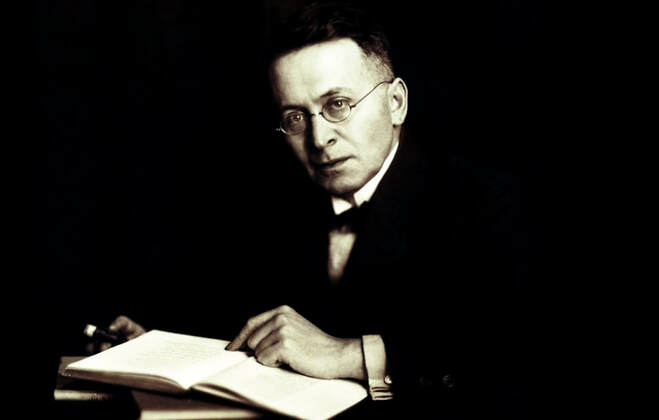
Author and critic Karl Kraus (1874-1936), was an early critic of Psychoanalysis.
…man must create his own essence. It is in throwing himself into the world, suffering there, struggling there, that he gradually defines himself – Jean-Paul Sartre
For Sartre, this is where we locate true irrationality and Bad Faith. It is not, therefore, as Freud held that man is primitive in his beginnings. Rather, it’s a case of man becoming existentially primitive and irrational courtesy of his morally-bankrupt culture.
Society becomes malignant without murmur of opposition. It cannot fathom what it does to itself. The Crowd has no sense of responsibility. That’s just for individuals, and they’re an extinct species.
Nowadays, immoral people are able to blame parents, peers, schools and culture for their moral turpitude. They can even blame their own minds. It’s not under their conscious control, so how can they be held responsible for evil thoughts and actions?
If I were given a pill, those evil tendencies might be removed forever. So get on with it. Rather than sentencing me to jail, for something I couldn’t help, get your asses into gear and manufacture a “cure.” Save me from myself, from my evil instincts and urges. That will make the world safe, and I’ll be all the happier for it. I want to be adjusted, normalized and politically-correct. I want to be like everybody else. I don’t want to be unmutal.
As the Existentialists predicted, society listened and quickly answered the call of those living in Bad Faith. As Thomas Szasz warned, we are now witnessing the billion-dollar funded “medicalization of everyday life.”
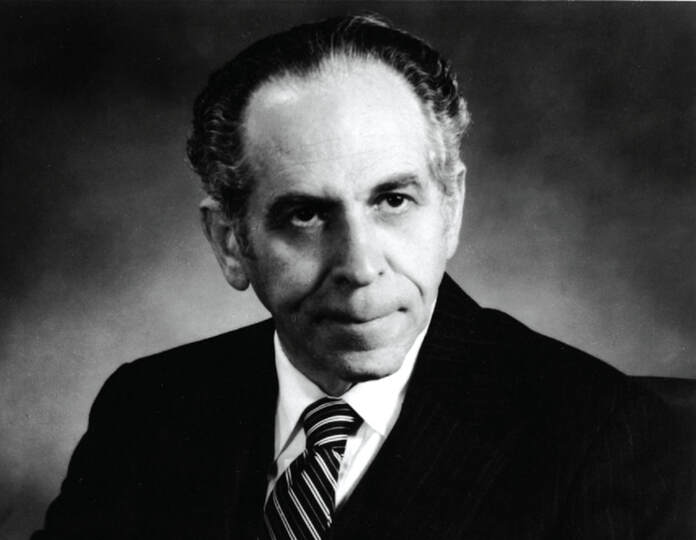
Hungarian libertarian psychologist Thomas Szasz (1920-2012). The author of dozens of books, his masterworks include The Myth of Mental Illness, The Manufacture of Madness and The Medicalization of Everyday Life. Inspired by Karl Kraus, he was a vehement critic of Freud and Psychoanalysis. However, he also reminded his readers of those who used the precepts of psychoanalysis to dodge personal responsibility. Freud can be faulted, Szasz contended, but what of those seeking him out, the never-ending queue of malingerers desperate to find an authority-figure to absolve them of their “sins?” Are they not the world’s foremost problem?
The man who can no longer tell that evil is evil, finds it increasingly difficult to tell that good is good – Ayn Rand
As Sartre foresaw, we now inhabit a culture in which no one is to blame for any evil act. Nothing is anyone’s fault. As Freud said, no one is in complete control over their thoughts and actions. Right! Is that the perfect escape-mechanism for the immoral man? He’s not born rational and isn’t part of any truly rational society. That’s purely skin-deep and illusory.
It might even be that controlling myself – my bestial instincts – is the irrational thing. After all, as Freud states, these antisocial instincts are natural. They’re part of my original disposition. The continuing repression of natural feelings confirms that I’m a being in conflict. Society, then, is charged with the role of “helping” me in the fight against myself. Society must make me a “better person.” I’m no expert.
As we see, society’s leaders have taken up the gauntlet, and very much intend turning us into better citizens.
To give Freud his due, he was concerned about the manner in which man’s true nature is repressed. In his final book on the subject of psychology, Civilization and its Discontents, he mused about society’s pathogenic role. However, he was loath to go as far as Sartre and the Existentialists. The latter wondered about what was bound to be lost to man by acculturation. By heeding society’s standards, might not a man lose touch with his conscience? Might he not function as the perfect citizen, and by doing so become less of a “being?”
Might such a bloodless creature, given a position of power, not react with great dislike to an authentic man, should he encounter one? Might he not detest his very presence and strive to rid the world of him? What kind of society do we inherit ruled over by tyrants of this kind? What if such machine-men establish all-powerful institutions which continue to purge society of authentic types? Did not Plato, Socrates, Seneca, Circero, and a dozen other sages of antiquity warn us about this?
The problem certainly worried Freud. However, it haunted Sartre. What good is the culture emptied of its great men and women, who find themselves unable to express themselves? What good is the society that stabilizes itself by making sure dissenters and critics are censored and condemned?
What if a corrupt conformist society decides that every dissenter is to be labeled irrational, antisocial and bestial?
Worse! What if, in some bizarre fashion-statement, with society’s blessing, the most inauthentic type recasts himself as an authentic type? What if in this state of self-delusion he sets himself up as judge and jury over one and all?
Under the hands of Freud the Age of Reason collapsed. Nevertheless, Freud and psychoanalysis came under a blistering attack from Rank, Sartre, Kraus, Szasz, and a few other thinkers. However, at the end of the day, Freud was, like many other thinkers, intent on explaining the greatest mystery of all – consciousness. Can he be accused of maliciously presenting man as an essentially antisocial “bestial” creature? If man is compulsively self-deceptive, is it Freud’s fault? Are Sartre’s criticisms worthy, well-founded and productive or somewhat nigggerdly and frivilous? Freud would simply have yawned, diagnosing Sartre, or any such critic of Psychoanalysis, as an outer-directed type whose ego-identity depends on a lack of introspection. French philosophers and school teachers can be extroverts, adverse to looking within in a genuine way. Therapy acts like a mirror, but does not force you to look into it. Not everyone likes what they see. Hence their hostility toward the mirror.
Among Freud’s most important discoveries is the realization that the underlying cause of psychological disturbance is our fear of self-knowledge: information which when consciously recognized induces us to feel weak, incompetent, ashamed, and unworthy – leading to self-hatred – Carl Goldberg
Which returns us to a central concern for Sartre – the problem of self-deception.
Let’s go back to Freud and his devastating effect on Rationalism, and play devil’s advocate for a minuite.
What if the entire Freudian perspective on man’s origins is based on Freud’s own acts of self-deception? Is psychoanalysis really based on anything true?
A critic might say that if I want, I can say absolutely anything about consciousness. This is because I am a conscious being speaking about myself. Although it’s a marvellous oddity that consciousness is self-reflexive, and able to pass judgment on itself, there’s no reason why any statement made by mind about mind is to be taken as factual and true.
We did not live in the ancient past, and know nothing about what consciousness was like back then. What we think we know is based mostly on surmise and conjecture. Therefore, we are not to imagine that statements made about the nature of primitive man are true. Nor are we to imagine that any statement about mind, as we find it today, is true. We might be dealing with purely temporary circumstances and judgments, or with complete falsity. Fortunately, Freud knew this all too well.
Of course, given that this is the case, it’s not just Freud who comes under the hammer. Every thinker and expert is hoisted by the same petard. Every theory and viewpoint is similarly compromised.
Sartre made it simple. Almost everything humans think and do is based in self-deception. The strange thing is that Freud wholeheartedly believed the same thing.
Wasn’t it predictable that our penchant for self-deception would lead us to accept the doctrines of a new breed of experts in political and medical fields? How could anything we see today come about from any other source except self-deception? But how many of us care to investigate this crucial phenomenon? We’re too busy doubting Freud’s motives.
Even if a thinker’s critiques of previous traditions and certainties are essentially correct, we’re not out of the woods. As Freud knew, all growth involves a process. The psyche is no exception. One starts at a point of ignorance or innocence and moves toward greater maturity and understanding. But regress to a state of primitivism is also possible. Regrettably, sometimes in history it is the rule.
Exposing a previous fallacy – like Rationalism – doesn’t automatically mean we’re any further ahead in terms of the mysteries of consciousness. All we’ve really discovered is another instance of self-deception. It’s a process that can go on forever.
Indeed, it is a process that has continued through time. We’re always convincing ourselves that “progress” is being made when all we’re doing is finally fessing-up to previous acts of self-deception.
As said, it took millennia for man to position himself, as a thinking being, at the center of attention. If progress has been made, in terms of understanding the mysteries of consciousness, it’s been slow. Every new insight and development has been resisted and doubted.
Until now man has been up against Nature. From now he will be up against his own nature – Dennis Gabor
No doubt inspired by Fyodor Dostoevsky and Franz Kafka, Sartre expressed his philosophy in fictional form. His novel Nausea (1938) is better known and more widely read than his academic work. Fellow Existentialists, who also favored fictional renderings, were Gabriel Marcel, Albert Camus and Simone de Beauvoir. Camus’ The Stranger is a popular novel featuring Existentialist themes.
…the vast majority of people in our culture are well adjusted because they have given up the battle for independence – Erich Fromm
Sartre’s form of Existentialism involves confronting man with his endless acts of Bad Faith. Only when we are able to spot our acts of self-deception – and understand the reasons for them – can we claim to operate as authentic beings.
Is this why, in today’s necrophilous culture, one is forbidden to judge, criticize and call out evil? Is this the cause of Political-Correctness? Has the man of Bad Faith assumed control of civilization?
Sartre saw this type – the hater and defiler of freedom – as the truly “bestial” being who loathes the company of authentic men. Under his intolerant reign the independent free-thinker must not be allowed to survive. He who confronts his fellows with their acts of self-deception must be condemned and ostracized. He must be labeled an Outsider and banished to the madhouse or the nether, where he can do no harm.
Welcome to Plant of the Month, a new series featuring a perennial plant rooted in my garden and some tips and tricks I’ve learned about making it a star.
For the inaugural plant of the month, I chose one of my favorites, fall anemones.
Part of the ranunculus or buttercup family, anemones include more than 120 species that bloom in spring, summer, and autumn.
The fall or Japanese/Chinese anemones come in shades of pink, rose, and white with single or double-saucer-shaped flowers and are a whimsical addition to the garden when so many other perennials are fading for the season.
Perfect for the cottage or woodland garden, fall anemones are often sold in late summer in garden centers. With a reputation for blooming for up to eight weeks, it’s impossible to resist this September wonder!
Plant Hardiness
Most varieties of fall anemone (anemone hupehensis and anemone x hybrida) are hardy to at least zone 5 (-29°C), with some varieties such as Honorine Jobert even hardier to zones 3 and 4 (-35°C to -40°C).
In a rainstorm and at night, the petals of a fall anemone will close and nod down to protect the bloom; that’s pretty amazing if you ask me. They do not care about wind as long as they are tied up or staked.
Light and Soil
Fall anemones prefer sun or part shade and moist, well-draining soil. Make this plant happy by adding a top layer of mulch or compost to insulate its roots and prevent water from evaporating on hot summer days.
Disease and Pest-Resistant
Aphids, slugs, deer, rabbits, and squirrels ignore anemones. Fall anemones are also resistant to powdery mildew and black spot.
Pollinators Love It
This is one of my favorite reasons for having fall anemones in the garden. Bees compete with butterflies and even hummingbirds for a good swig of the plant’s nectar. The more pollinators in the garden, the better for the planet.
Drawbacks: Containers and Size
There are a few things to be cautious about regarding fall anemones.
In my experience, they don’t do well in containers. Anemones have an extensive root system and are spread by rhizomes, with some bigger varieties sending out new shoots up to a meter away from the parent plant. They will quickly feel confined in a container and won’t produce as many blooms.
This spreading habit causes many varieties to grow up to two and a half meters tall and spread just as far. I like the bigger types, especially the white fall anemone. To keep the plant from overtaking the garden, I continually pull the new shoots that spring out of the ground throughout the growing season.
However, there are dwarf varieties, such as Little Princess, with a growing habit of 60 cm tall and wide. These are perfect for small planter boxes on a patio.
Whatever variety of fall anemone you choose, I hope you fall in love with this September star. See you next month as we grow and garden together!
The US Department of Health and Human Services (HHS) recommended that cannabis be moved from a Schedule I to a Schedule III listing. While the decision is with the US DEA, many are hopeful it will come to fruition, although the DEA rejected a call to do so in 2016. The recommendation from HHS came at the request of Biden to look into the issue (archived link to WaPo article).
The greenhouse in Niagara-on-the-Lake that Tweed once occupied appears to have been sold, reports Thorold Today. Canopy closed the location in 2021, and it had previously been listed online for $32 million.
An online website that lists property transfers shows the greenhouse sold for $21,800,000 in May to a company that grows mushrooms, but neither the realtor nor Canopy Growth responded to calls or emails from local media to confirm.
MJBiz shared a report that says cannabis exports from Canada increased in the 2022-23 fiscal year, with $160 million shipped overseas—a 50 percent increase compared to 2021-22’s $107 million.
On that note, Decibel Cannabis announced that it had entered into a supply agreement to provide dried medical cannabis flower to 4C LABS, a healthcare, technology, and pharmaceutical company in the United Kingdom and Channel Islands. The three-year agreement is expected to see its first shipment by year’s end, with minimum purchase commitments and exclusivity over certain genetics and the QWEST brand in the UK.
Entourage Health announced its financial results for the three and six months ended June 30, 2023. The Company reported second quarter total revenue of $13.37 million, and net revenue of $10.17 million and a loss of $9.6 million. Entourage offers six cannabis brands on its medical platform: Color Cannabis, Saturday, Starseed, Syndicate, Royal City, and Mary’s Medicinals.
MTL Cannabis Corp. also posted a net revenue of $12,763,787 and gross profit of $3,274,781 for their Q1 2024 results.
MTL is the parent company of Montréal Medical Cannabis Inc., an LP in Quebec, Abba Medix Corp., an LP in Ontario, IsoCanMed Inc., an LP in Québec, and Canada House Clinics Inc., with clinics across Canada that work directly with primary care teams to provide specialized cannabinoid therapy services to patients.
Research and other International Cannabis News
MediPharm Labs’ subsidiary Harvest Medicine published a study in the American Journal of Endocannabinoid Medicine on medical cannabis’ impacts on anxiety and depression outcomes in fibromyalgia patients, in which 75 percent of patients saw a significant decrease in their self-reported illness severity. The study also reported reductions in depression and anxiety scores. Details on the study can be viewed on the American Journal of Endocannabinoids Website.
“We are delighted to announce that our partnership with Miracle Valley has cleared UK customs and marks the launch of our first own-branded strains of Canadian THC-dominant cannabis to the UK market,” said Mamedica CEO and founder Jon Robson in a press release.
Researchers at the University of Auckland in New Zealand say they have found a sustainable solution to help tackle the medicinal cannabis industry’s waste problem. In collaboration with medical cannabis producerGreenlab and support from the New Zealand government, the researchers are developing processes that will help protect the environment by transforming cannabis waste into valuable resources such as biofertilizer.
Greenlab sells white label cannabis products by Canada’s Valens Company and Mile High Labs UK, and also sells products in Australia and lists Valens and Canadian-based MediPharm Labs as “Extraction Affiliates” on their website. The company also signed an R&D agreement in 2021 with a Canadian cannabis company Purple Farm Genetics to develop unique cultivars through breeding.
As the summer season winds down, so do the blooms of many of our favorite flowers in the garden. As a gardener, your work is never done, and many of us have made notes over the growing season about what needs to be divided and moved to new homes before next year. It’s time to put those plans into action!
Wild and Free
If you have an established garden, you might have large clusters of unruly flowers begging to be divided.
Plants like coreopsis, bee balm, echinacea, Shasta daisies, daylilies, hostas, and Liatris spread throughout a space quickly, their clusters growing bigger and bigger by the season. Sometimes, they outgrow the garden, and some varieties fare better if split into smaller clumps.
So when the blooms start to fade, grab your spade!
Simple Division
You can divide in the spring or the fall; I prefer the latter because it gives plants time to settle into their new homes and ensures they’ll be ready to bloom come spring.
Dividing plants is simple, and although you might worry about killing them, perennials are hardy and can handle the process.
Let’s say you’re dividing a hosta:
Dig the entire root ball out of the ground.
Take a spade or a garden knife and split the hosta into twos, threes, or fours, depending on its original size.
Plant the divisions into the ground and add some water if needed.
Next summer, these divisions will look like mature plants!
If you’re dividing large clumps of flowers, you don’t need to dig the entire bunch of blooms out of the ground first. Check the base of the plant and dig out a healthy chunk from the parent plant.
Plant Sale!
If you don’t have enough room for divisions, consider giving them away to friends or family or selling them in the community for an affordable price. I’ve recently been filling my gardens with plants purchased cheaply from people in my neighborhood. Just be sure they’re not full of chemicals before you buy! You can also organize a plant swap with others to add more variety to your garden space.
Whatever you end up doing, don’t fear dividing your plants! Your garden will look a little neater and bigger, and your plants will be healthier and more vibrant.
Have you ever felt so far away from your life you didn’t know where the ‘on switch’ was?! Funny how things grow in the ‘wrong’ direction to more we try to cover up the painful truths all of us have chosen to experience through this life.
A bad relationship, too many cream puffs, foolish job choices and outrageous balms of intoxicants that harm more than help in the short to long run.
Any alive have fallen prey to dishonest thoughts, tricky moods and above all, unintended results from chasing love down that ‘wrong alley’. Only to find that cat had teeth and your feet have stepped into more than one stinky, sticky pile of promise.
My life has certainly taken some turns for the terrible, and I’ve been like everyone else at times denying the very stains on my tunic…calling them decorations and not what they were…poor maps leading to swamps and not the warm waters of celebration I was hoping for.
Two videos here, me in both, life as it was on my horrible, yet wonderful, path to today and how those ‘wrong paths’ can bring the gold of loving freedom your way too…and all we need do is admit to the fools, having been fooled, we were. As for me, I need to be careful all of my times to assure I don’t fall for that easy road paved with ‘fool’s gold’.
Enjoy, I know I did, even through the almost unendurable pain, shame, detox and delusions. Cheers Lorenzo
One of the biggest realizations I’ve had and hard-hitting truth I had to face and accept over the years was that not everyone is “ready” to wake up, nor will there be a collective awakening anytime soon, for there are vastly different levels of being and soul potential among 8+ billion people on this planet and that there is also nothing wrong with it in light of the evolution of consciousness.
We are all one, but we’re not all the same. As the esoteric axiom states: “There is no such thing as equality in the entire universe.”
No one can be awakened by another, nor can anyone force another to “wake up.” Free will needs to be respected, even if it is the “free will” to stay asleep (dreaming to be awake). You can only “give” to the ones who “ask” sincerely and spread some seeds of awareness. Some may blossom, some won’t.
Moreover, the ones of us who are sincerely engaged in the awakening process and truth-seeking know that it is far from easy for a true awakening goes way beyond any intellectual/external understanding of the Matrix, which usually ends up externalizing all evil – a trap in itself.
It takes inner struggle, conscious suffering, effort, integrity, self-responsibility, radical self-honesty, and sincerity with patience and humility to cross the threshold out of the ego slumber of the false/conditioned/wounded personality to awaken and free oneself from the entropic forces of the matrix which also work through us.
It’s not what most New Age/corrupted spiritual teachings and motivational self-help advocates talk about who promise you health, wealth, love, and bliss. It’s not a “mindset” or about “being the best you can be.”
“Awakening” is also not about self-actualization, chasing dreams, seeking pleasure, and fulfilling desires, nor is it simply about being an “individual” or a self-improvement program (which most often tried to improve the false self) but becoming INDIVIDUATED (big difference).
The former is still a slave to the ego personality with all its desires; the latter has become a vessel for God and merged personal will with Divine Will, acting our God’s Will beyond ego gratification.
As Bud Harris wrote in ‘Becoming Whole’:
“It is much more than firming up, losing weight, having more positive thoughts, or solving problems and getting on with your life. Individuation is not self-actualization. The mythologist Joseph Campbell noted that self-actualization is for people with nothing better to do—people who don’t know their personal myth or deeper purpose in life.”
But no steps can be skipped. Many of us still need to work on becoming an individual, separating ourselves from the consensus of the masses and past attachments, and even exhausting all personality-based desires before the soul makes the call, takes charge, and embarks toward the path of individuation.
And there is nothing wrong with it, either. The path is just the path unique to each of us. But there are detours, distractions, and sometimes dead-ends, as well as many temptations that test the seeker.
Most often, emotional “high” experiences are mistaken for “enlightenment” or “love,” yet it is merely another dream, mistaking an overriding emotional center for higher states of consciousness, and the ego always likes to hijack these experiences for its own agenda.
Moreover and most importantly, before we can “wake up,” we need to admit and truly SEE how asleep we are, realizing our mechanical, conditioned way of thinking, feeling, and doing (which is also influenced by our unconscious shadow, trauma, and wounding) under the illusion of control and “free will” with various (occult) forces working through us, moving and manipulating us like puppets on strings.
It’s what Gurdjieff called coming face to face with the “horror of the situation,”…..which then leads to the necessary disillusionment, the shamanic descent into the underworld in order to engage in the Great Work to be reborn in the true Self.
























Recent Comments