Oaksterdam University Executive Chancellor Dale Sky Jones was a guest on Branding Bud Live Episode #47 on November 2, 2023. The show, co-hosted by David Paleschuck and Adriana Hemans, airs every Thursday at 11 am PST / 2 pm EST on LinkedIn Live.
This episode was about Cannabis Activism.
From advocating for social justice, promoting access to medical treatment, challenging stigma and misconceptions, or pushing for legislative reforms, these are just a few forms of cannabis activism.
The number of stores and the amount of cannabis sold in BC has continued to increase while the price of cannabis products continues to drop.
Dried flower and pre-rolls combined still dominate sales, but inhalable extracts, especially infused pre-rolls and vape carts, continue to eat into their market share. Consumers are also continuing the shift to larger volume dried flower offerings, while 3.5 and 7-gram SKUs remain the most popular overall.
The BC LDB’s newest quarterly report for 2023, covering July, August, and September, shows a 40 percent year-over-year increase in wholesale grams, for a record of 33,879,347 grams and a 24 percent increase in wholesale sales for a total of $137,126,714.
The price of cannabis again dropped to its lowest ever, at $4.05 a gram for all cannabis product categories and $3.33 a gram for dried flower. There were 490 stores, an increase from 452 in the same quarter in 2022, and 483 at the end of the first quarter of 2023.
Chart via LDB.com
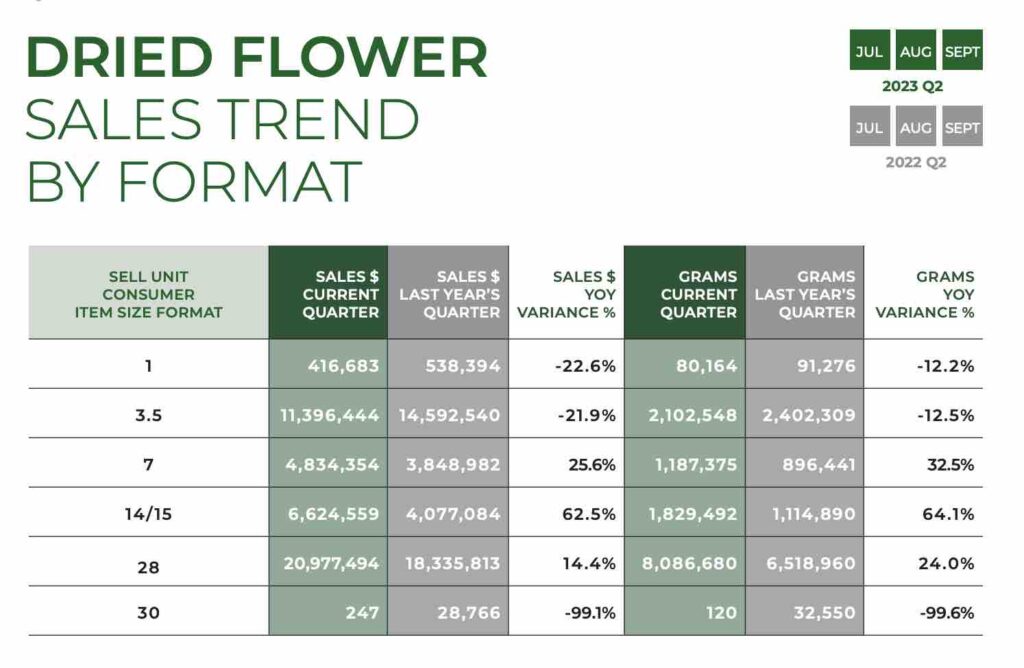
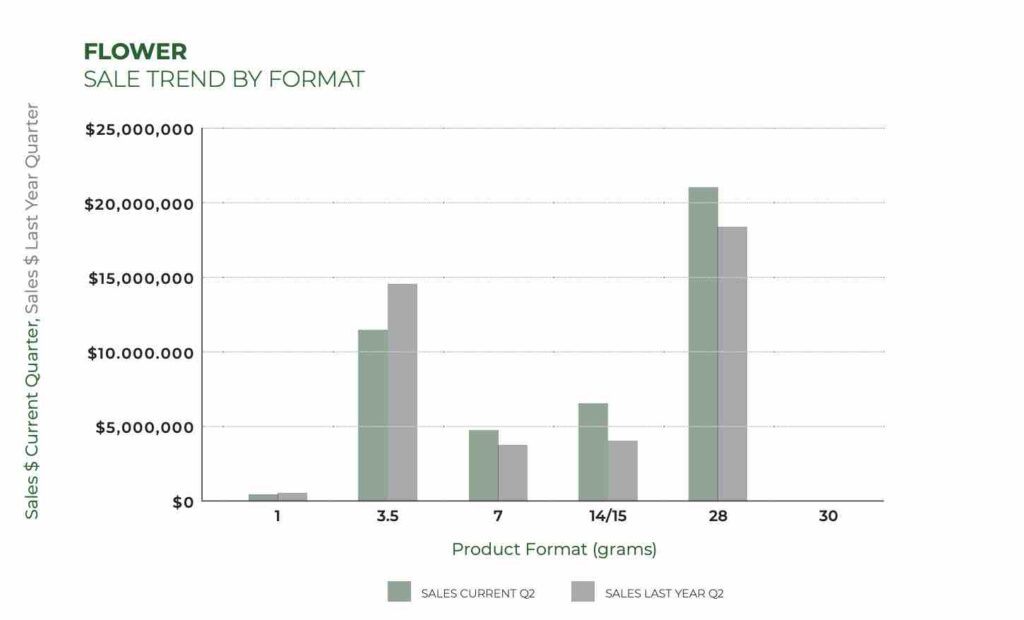
Following trends in previous quarters, single grams and eighths selling at more than $5 a gram saw significant declines in year-over-year sales as consumers continued to shift purchasing habits to higher-value and larger volume SKUs like 7, 14, 28, and (a handful of) 30 gram.
Reversing a trend in the previous quarter, though, consumers are showing an interest in paying more than $5 a gram in these larger volume SKUs. In Q1 2023, sales for 7 and 14 gram SKUs were down 46 percent, and 14 percent year-over-year, respectively, but were up 15 and 18 percent this quarter. This can relate to consumer preference or to product availability.
via LDB.com
While eighths and 28-gram SKUs were still the most popular overall, the less expensive 7, 14, and 28-gram offerings saw the most significant increase in sales compared to Q1 2023 and, where applicable, Q2 2022. (Some SKUs were not available one year ago).
As in Q1 2023, inhalable extracts sales outpaced dried flower sales (excluding non-infused pre-rolls) at $46 million compared to $44 million. ($42 million and $41 million Q1). While flower sales year-over-year were up just under seven percent and four percent in units, inhalable extracts—dominated by vape pens and infused pre-rolls—grew nearly 58 percent in sales and 68 percent in units sold.
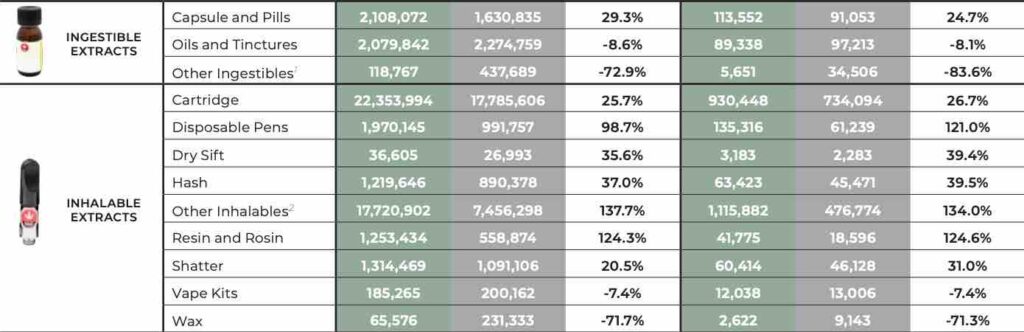
Cartridges and infused pre-rolls dominate the inhalable extracts category, with 48.5 percent and 38.4 percent of sales, while products like shatter, resin and rosin, and Hash were each under three percent of sales. Still, these latter categories saw significant year-over-year and quarterly growth as the product category became more competitive.
Pre-rolls (non-infused) came third in sales at $31.7 million, a 20 percent increase year-over-year and a 19 percent increase in units.
via LDB.com
Sales of cannabis edibles and beverages came in far behind with $7.4 and $2.7 in sales, respectively. For edibles, this represented a 17 percent increase in sales year-over-year and a 24 percent increase in units sold. Beverages saw a 40 percent increase in both dollar sales and units sold.
Topical sales increased 26 percent year-over-year to $748,087 and 29 percent in units sold. Sales of cannabis seeds declined 25 percent to $12,929, a decrease of units sold compared to the same quarter last year of 24 percent.
Sales of ingestible extracts, which includes products Health Canada declared non-compliant earlier this year, saw declines of about one percent in sales and six percent in units sold. The category still had $4.3 million in sales. The decline was driven by a 73% year-over-year decline in the sale of the types of lozenges and other products Health Canada deemed non-compliant and an eight percent decrease in oils and tinctures, but was buoyed by a 29 percent increase in capsules and pills.
Overall, the province gained three retail stores since the previous quarter and 38 since the same quarter last year. The largest market in BC, the Greater Vancouver area, had 140 stores in this most recent quarter, up three from Q1 2023 and up from 113 in Q2 2022.
The second largest retail market, Vancouver Island, has 121 stores, a decrease from 123 in Q2 2022. The third largest region, the BC Interior, saw an increase in the number of retail cannabis stores, from 161 in Q2 2022 to 168 in the same quarter in 2023, and an increase of three stores from Q1 2023. The number of stores in Northern BC increased from 58 in Q2 2022 to 64 in the most current quarter, up from 61 in this year’s previous quarter.
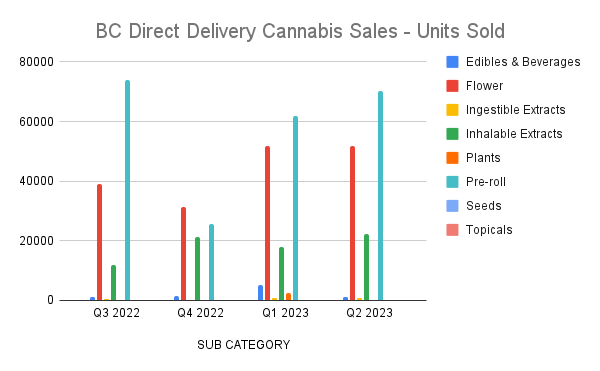
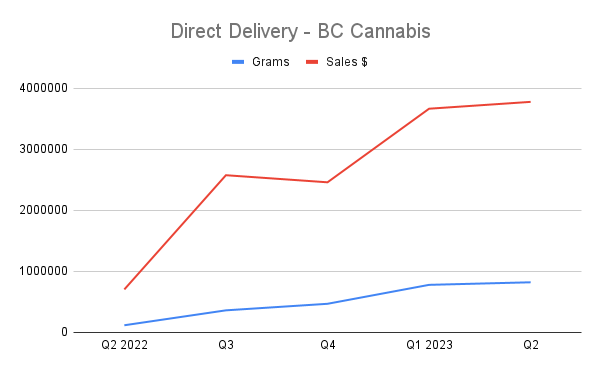
Figure prior to Q3 2022 were not reported in units sold
The amount of cannabis sold through the program—limited to small-scale BC producers and therefore a fraction of total provincial sales by design—continues to grow, although this could potentially be reaching a plateau as sales in the last two quarters were relatively steady.
While the program is popular among retailers and producers taking part, many of the small producers the program was built to assist say the baked in provincial fees make it challenging.
Despite the costs to sell into the program—which not only include added logistics to handle multiple deliveries, but still come with a 15% “proprietary fee” to the province—the cost per gram sold in the program continues to decline. This is good for consumers, but not good for producers or retailers who hope the program can act as a lifeline.
The average price per gram of cannabis sold in the program is just $4, while the average price of all cannabis products sold through the program is $4.60 a gram.
The amount of dried cannabis flower sold through direct delivery stayed about the same compared to Q1 2023 while edibles and beverages declined significantly and inhalable extracts grew.
Oaksterdam Certification Courses that qualify for the program include:
Oaksterdam University programs are ideal for legacy operators who must ensure regulatory compliance and industry best practices, which are vital if anyone is coming into compliance or planning to enter the legal cannabis industry. This is exclusively for full-time residents of the U.S. Virgin Islands.
Oaksterdam is excited to partner with individuals along their journey in commercial cannabis operations.
“There is something terribly wrong with this country, isn’t there? Cruelty and injustice, intolerance and oppression. And where once you had the freedom to object, to think and speak as you saw fit, you now have censors and systems of surveillance coercing your conformity and soliciting your submission. How did this happen? Who’s to blame?”— V for Vendetta
Set in the year 2020, V for Vendetta (written and produced by the Wachowskis) provides an eerie glimpse into a parallel universe in which a government-engineered virus wreaks havoc on the world. Capitalizing on the people’s fear, a totalitarian government comes to power that knows all, sees all, controls everything and promises safety and security above all.
Concentration camps (jails, private prisons and detention facilities) have been established to house political prisoners and others deemed to be enemies of the state. Executions of undesirables (extremists, troublemakers and the like) are common, while other enemies of the state are made to “disappear.” Populist uprisings and protests are met with extreme force. The television networks are controlled by the government with the purpose of perpetuating the regime. And most of the population is hooked into an entertainment mode and are clueless.
With Vendetta, whose imagery borrows heavily from Nazi Germany’s Third Reich and George Orwell’s 1984, we come full circle. The corporate state in V conducts mass surveillance on its citizens, helped along by closed-circuit televisions. Also, London is under yellow-coded curfew alerts, similar to the American government’s color-coded Homeland Security Advisory System.
Sounds painfully familiar, doesn’t it?
As director James McTeighe observed about the tyrannical regime in V for Vendetta, “It really showed what can happen when society is ruled by government, rather than the government being run as a voice of the people. I don’t think it’s such a big leap to say things like that can happen when leaders stop listening to the people.”
Clearly, those we appointed to represent our interests have stopped following the Constitution and listening to the American people.
What will it take for the government to start listening to the people again?
In V for Vendetta, as in my novel The Erik Blair Diaries, the subtext is that authoritarian regimes—through a vicious cycle of manipulation, oppression and fear-mongering—foment violence, manufacture crises, and breed terrorists, thereby giving rise to a recurring cycle of blowback and violence.
Only when the government itself becomes synonymous with the terrorism wreaking havoc in their lives do the people to finally mobilize and stand up to the government’s tyranny.
V, a bold, charismatic freedom fighter, urges the British people to rise up and resist the government. In Vendetta, V the film’s masked crusader blows up the seat of government on November 5, Guy Fawkes Day, while in Erik Blair, freedom fighters plot to unmask the Deep State.
Acts of desperation and outright anarchy are what happens when a parasitical government muzzles the citizenry, fences them in, herds them, brands them, whips them into submission, forces them to ante up the sweat of their brows while giving them little in return, and then provides them with little to no outlet for voicing their discontent: people get desperate, citizens lose hope, and lawful, nonviolent resistance gives way to unlawful, violent resistance.
This way lies madness.
Then again, madness may be unavoidable unless we can wrest back control over our runaway government starting at the local level.
It is time to recalibrate the government.
For years now, we have suffered the injustices, cruelties, corruption and abuse of an entrenched government bureaucracy that has no regard for the Constitution or the rights of the citizenry.
By “government,” I’m not referring to the farce that is the highly partisan, two-party, bureaucracy of the Republicans and Democrats. Rather, I’m referring to “government” with a capital “G,” the entrenched Deep State that is unaffected by elections, unaltered by populist movements, and has set itself beyond the reach of the law.
We are overdue for a systemic check on the government’s overreaches and power grabs.
We have lingered too long in this strange twilight zone where ego trumps justice, propaganda perverts truth, and imperial presidents—empowered to indulge their authoritarian tendencies by legalistic courts, corrupt legislatures and a disinterested, distracted populace—rule by fiat rather than by the rule of law.
The COVID-19 pandemic provided the government with the perfect excuse to lay claim to a long laundry list of terrifying lockdown powers (at both the federal and state level) that override the Constitution: the ability to suspend the Constitution, indefinitely detain American citizens, bypass the courts, quarantine whole communities or segments of the population, override the First Amendment by outlawing religious gatherings and assemblies of more than a few people, shut down entire industries and manipulate the economy, muzzle dissidents, reshape financial markets, create a digital currency (and thus further restrict the use of cash), determine who should live or die, and impose health mandates on large segments of the population.
Crises tend to bring out the authoritarian tendencies in government.
That’s no surprise: power corrupts, and absolute power corrupts absolutely.
Where we find ourselves now is in the unenviable position of needing to rein in all three branches of government—the Executive, the Judicial, and the Legislative—that have exceeded their authority and grown drunk on power.
This is exactly the kind of concentrated, absolute power the founders attempted to guard against by establishing a system of checks of balances that separate and shares power between three co-equal branches: the executive, the legislative and the judiciary.
“The system of checks and balances that the Framers envisioned now lacks effective checks and is no longer in balance,” concludes law professor William P. Marshall. “The implications of this are serious. The Framers designed a system of separation of powers to combat government excess and abuse and to curb incompetence. They also believed that, in the absence of an effective separation-of-powers structure, such ills would inevitably follow. Unfortunately, however, power once taken is not easily surrendered.”
Unadulterated power in any branch of government is a menace to freedom.
There’s no point debating which political party would be more dangerous with these powers.
The fact that any individual—or branch of government—of any political persuasion is empowered to act like a dictator is danger enough.
So, what we can do to wrest back control over a runaway government and an imperial presidency?
It won’t be easy.
We are the unwitting victims of a system so corrupt that those who stand up for the rule of law and aspire to transparency in government are in the minority.
This corruption is so vast it spans all branches of government: from the power-hungry agencies under the executive branch and the corporate puppets within the legislative branch to a judiciary that is, more often than not, elitist and biased towards government entities and corporations.
We are ruled by an elite class of individuals who are completely out of touch with the travails of the average American.
We are viewed as relatively expendable in the eyes of government: faceless numbers of individuals who serve one purpose, which is to keep the government machine running through our labor and our tax dollars. Those in power aren’t losing any sleep over the indignities we are being made to suffer or the possible risks to our health. All they seem to care about are power and control.
We are being made to suffer countless abuses at the government’s hands.
We have little protection against standing armies (domestic and military), invasive surveillance, marauding SWAT teams, an overwhelming government arsenal of assault vehicles and firepower, and a barrage of laws that criminalize everything from vegetable gardens to lemonade stands.
In the name of national security, we’re being subjected to government agencies such as the NSA, FBI and others listening in on our phone calls, reading our mail, monitoring our emails, and carrying out warrantless “black bag” searches of our homes. Adding to the abuse, we have to deal with surveillance cameras mounted on street corners and in traffic lights, weather satellites co-opted for use as spy cameras from space, and thermal sensory imaging devices that can detect heat and movement through the walls of our homes.
That doesn’t even begin to touch on the many ways in which our Fourth Amendment rights are trampled upon by militarized police and SWAT teams empowered to act as laws unto themselves.
In other words, freedom—or what’s left of it—is threatened from every direction.
The predators of the police state are wreaking havoc on our freedoms, our communities, and our lives. The government doesn’t listen to the citizenry, it refuses to abide by the Constitution, which is our rule of law, and it treats the citizenry as a source of funding and little else. Police officers are shooting unarmed citizens and their household pets. Government agents—including local police—are being armed to the teeth and encouraged to act like soldiers on a battlefield. Bloated government agencies are fleecing taxpayers. Government technicians are spying on our emails and phone calls. Government contractors are making a killing by waging endless wars abroad.
In other words, the American police state is alive and well and flourishing.
Nothing has changed, and nothing will change unless we insist on it.
How to do this? It’s not rocket science.
There is no 10-step plan. If there were a 10-step plan, however, the first step would be as follows: turn off the televisions, tune out the politicians, and do your part to stand up for freedom principles in your own communities.
Stand up for your own rights, of course, but more importantly, stand up for the rights of those with whom you might disagree. Defend freedom at all costs. Defend justice at all costs. Make no exceptions based on race, religion, creed, politics, immigration status, sexual orientation, etc. Vote like Americans, for a change, not Republicans or Democrats.
Most of all, use your power—and there is power in our numbers—to nullify anything and everything the government does that undermines the freedom principles on which this nation was founded.
Don’t play semantics. Don’t justify. Don’t politicize it. If it carries even a whiff of tyranny, oppose it. Demand that your representatives in government cut you a better deal, one that abides by the Constitution and doesn’t just attempt to sidestep it.
Recently, the National Institutes of Health posted a funding opportunity notice stating that it sought an eligible body to operate a new center for marijuana and cannabinoid research via a cooperative agreement. The centralized cannabis research center would be designed to help researchers overcome barriers to studying cannabis amid federal prohibition. This is in addition to allowing scientists to generate more scientific evidence across various research domains in clinical and basic research.
Addressing barriers in cannabis research has been a priority for many federal health agencies as researchers continue to be subjected to costly and taxing registration processes in order to access marijuana for research. This is primarily because of the drug’s current status under the Controlled Substances Act.
The NIH noted that ultimately, the research center could facilitate advancements in research through interactions among experts in relevant clinical, commercial, regulatory and basic science areas, both within the research center itself and jointly with other researchers that possess diverse expertise and research backgrounds.
The NIH also outlined central components of the center’s objectives, including research standards, research support and regulatory guidance. On the regulatory front, the center would be charged with organizing meetings with the DEA and/or FDA to obtain updates on regulatory information, among other tasks. On the research standards front, the center would be responsible for the development of research metrics and standards that enhance the rigor of chemical analysis of complex marijuana products to improve research reproducibility, among other functions.
With regard to research support, the research center could identify and circulate early career reviewer opportunities under the NIH, administer seed funding and use social media to transmit scientific information, among other functions. Agencies under the NIH that will occupy supportive roles in the center’s work include the National Center for Complementary and Integrative Health, the National Cancer Institute, the National Institute on Aging and the National Institute on Drug Abuse.
Interested parties must elaborate how they propose to achieve the stipulated objectives, which involve the creation of a clearing house for existing research guidance, developing best practices, organizing meetings with the FDA and the DEA, standardizing research methodologies, circulating relevant scientific literature on marijuana and apportioning seed funding to support research initiatives.
Institutions that are invited to submit applications include nonprofit organizations, universities and local and federal government agencies, among others. The deadline for letters of intent is March 16, 2023, which is also when applications will start being accepted.
If this new research facility works as intended, cannabis industry actors such as Green Thumb Industries Inc. (CSE: GTII) (OTCQX: GTBIF) could sooner or later see a decrease in some of the hurdles they face in studying marijuana.
About CNW420
CNW420 spotlights the latest developments in the rapidly evolving cannabis industry through the release of two informative articles each business day. Our concise, informative content serves as a gateway for investors interested in the legalized cannabis sector and provides updates on how regulatory developments may impact financial markets. Articles are released each business day at 4:20 a.m. and 4:20 p.m. Eastern – our tribute to the time synonymous with cannabis culture. If marijuana and the burgeoning industry surrounding it are on your radar, CNW420 is for you! Check back daily to stay up-to-date on the latest milestones in the fast -changing world of cannabis.
To receive SMS alerts from CNW, text CANNABIS to 844-397-5787 (U.S. Mobile Phones Only)
Please see full terms of use and disclaimers on the CannabisNewsWire website applicable to all content provided by CNW, wherever published or re-published: https://www.CannabisNewsWire.com/Disclaimer
Scientists from the American Chemical Society have identified previously undiscovered cannabis compounds that they say are actually responsible for marijuana’s unique flavors. For the longest time, the conventional knowledge has been that chemical compounds called terpenes create the distinctive aromas of different cannabis strains. Marijuana is estimated to contain close to 400 terpenes, but researchers have discovered only around 200 and studied more than a dozen.
Outside of the cannabis plant, there are more than 20,000 known terpenes, which create the unique flavors and aromas of flowers, herbs, fruits and vegetables. As such, the assumption was that terpenes were also responsible for the aromas produced by various marijuana strains. However, the recent American Chemical Society study challenged conventional knowledge through the discovery of previously unknown compounds and raised questions surrounding the true source of marijuana’s varied and unique flavors.
The study involved a research team from cannabis testing and extraction companies. The researchers wrote that the role of terpenes in cannabis aroma variety seemed to be blown out of proportion. Terpenes account for an estimated 1% to 4% of a cured cannabis flower’s total mass, the researchers said, and while the terpenes contribute to the plant’s overall smell, they don’t play a major role in creating the “peculiar aromatic attributes” of different marijuana varieties.
According to the researchers, most of the aromatic information for various cannabis strains comes from flavorants, a group of chemicals encompasses compounds, including alcohol and esters. The researchers say they discovered various “nonterpenoid compounds” upon analyzing 31 samples of ice hash rosin.
They specifically noted a novel group of tropical volatile sulfur compounds (VSCs) that significantly contribute to the strong aroma of tropical fruits such as citrus as well as a highly aromatic compound called skatole (3-methylindole). Flavorants are also largely responsible for exotic scents in Gelato, Skittles, Runts and Apple Fritters.
TJ Martin, the research & development VC of Abstrax, an extraction company, says the research team found a clear connection between previously undiscovered cannabis compounds and the plant’s notoriously pungent aromas. The team found that although terpenes played a role in producing marijuana aromas, they weren’t essential in the differentiation of aromas in various cannabis strains.
Terpenes are often used to differentiate different cannabis varieties, but Abstrax CEO and cofounder Max Coby notes that this often results in inaccurate classifications. Max says the research team’s discovery will play a significant role in the validation of marijuana authenticity as well as the accurate classification of different marijuana varieties.
It wouldn’t be surprising if major marijuana companies such as Curaleaf Holdings Inc. (CSE: CURA) (OTCQX: CURLF) provide the detailed flavoring profiles of their future products in order to differentiate their offerings from other products on the market.
About CNW420
CNW420 spotlights the latest developments in the rapidly evolving cannabis industry through the release of two informative articles each business day. Our concise, informative content serves as a gateway for investors interested in the legalized cannabis sector and provides updates on how regulatory developments may impact financial markets. Articles are released each business day at 4:20 a.m. and 4:20 p.m. Eastern – our tribute to the time synonymous with cannabis culture. If marijuana and the burgeoning industry surrounding it are on your radar, CNW420 is for you! Check back daily to stay up-to-date on the latest milestones in the fast -changing world of cannabis.
To receive SMS alerts from CNW, text CANNABIS to 844-397-5787 (U.S. Mobile Phones Only)
Please see full terms of use and disclaimers on the CannabisNewsWire website applicable to all content provided by CNW, wherever published or re-published: https://www.CannabisNewsWire.com/Disclaimer
Supporters of a campaign to legalize psychedelics in Massachusetts believe they have gathered enough signatures to compel legislators to consider their initiative. If this is not successful, the group plans to put the psychedelics legalization measure on next year’s ballot.
This move comes less than two months after the group, called Massachusetts for Mental Health Options, started its petition. The campaign, which is backed by New Approach, has revealed that it has verified more than 75,000 signatures from registered voters in the state. This milestone comes weeks after activists decided to pursue one of the pair of psychedelic initiatives the office of the state’s attorney general cleared in September.
The campaign chose the measure that would provide adults with an option to cultivate psychedelics at home. The measure in question, titled the Natural Psychedelic Substances Act, would also establish a regulatory framework for supervised and lawful access to psychedelics at approved facilities.
While the measure’s passage would also legalize the gifting and possession of psychedelics such as ayahuasca and psilocybin, it would not allow for commercial retail sales of the substances.
Under the resolution, individuals aged 21 years and older would be allowed to legally share psychedelics of certain amounts, including a gram of psilocybin, 18 grams of nonpeyote mescaline, a gram of DMT, a gram of psilocin and 30 grams of ibogaine.
Additionally, a psychedelic substances advisory board would be created to conduct research on and make recommendations to the Cannabis Control Commission about issues such as facilitator training, public health, regulations, traditional use of psychedelics, affordable and equitable access, and future regulations, which could include potential additions to the list of legal substances. Furthermore, psychedelics bought at approved facilities would have a 15% excise tax imposed on them.
During an interview last week, New Approach spokesperson Jared Moffat revealed that the campaign had suspended signature collection for the time being to allow for easier verification of the petitions submitted. If it’s confirmed that enough signatures have been gathered, the next step will be to submit them to the office of the secretary of state before Dec. 6, 2023. Following formal verification by state officials, the initiative will be forwarded to legislators who will decide on whether to propose a substitute, enact the reform or decline to act.
If legislators choose not to legalize psychedelic substances by May 1, 2024, activists will have until July 3, 2024, to turn in about 12,500 additional signatures that will allow the measure to be included on the November 2024 ballot.
These advocacy efforts are no doubt leveraging the scientific data coming from numerous psychedelics startups such as Mind Medicine Inc. (NASDAQ: MNMD) (NEO: MMED) (DE: MMQ) regarding the therapeutic potential of various psychedelic substances.
About PsychedelicNewsWire
PsychedelicNewsWire (“PNW”) is a specialized communications platform with a focus on all aspects of psychedelics and the latest developments and advances in the psychedelics sector. It is one of 60+ brands within the Dynamic Brand Portfolio @ IBN that delivers: (1) access to a vast network of wire solutions via InvestorWire to efficiently and effectively reach a myriad of target markets, demographics and diverse industries; (2) article and editorial syndication to 5,000+ outlets; (3) enhanced press release enhancement to ensure maximum impact; (4) social media distribution via IBN to millions of social media followers; and (5) a full array of tailored corporate communications solutions. With broad reach and a seasoned team of contributing journalists and writers, PNW is uniquely positioned to best serve private and public companies that want to reach a wide audience of investors, influencers, consumers, journalists and the general public. By cutting through the overload of information in today’s market, PNW brings its clients unparalleled recognition and brand awareness. PNW is where breaking news, insightful content and actionable information converge.
To receive SMS alerts from PsychedelicNewsWire, text “Groovy” to 21000 (U.S. Mobile Phones Only)
Please see full terms of use and disclaimers on the PsychedelicNewsWire website applicable to all content provided by PNW, wherever published or re-published: https://www.PsychedelicNewsWire.com/Disclaimer
AgTech, conservationists and multiple levels of government are sounding the alarm about the importance of soil health. In fact, the U.S. House Committee on Agriculture held a hearing last fall on the very subject. Stakeholders from across the agriculture and conservation sectors convened to discuss the latest research and initiatives on facilitating soil health. Due to federal prohibition, cannabis operators were not included in that conversation — but they should definitely be paying attention.
One particular cultivation practice, hydroponic growing, promotes soil health by entirely removing soil from the equation. Hydroponics utilize inert growing media in place of soil and reduce water and pesticide use compared to soil-based systems.
A hydroponic grow, whether the crop is tomatoes or cannabis, requires only water, a container, nutrients, anchors, light sources and alternative growing media like stone wool.
While hydroponics is still an evolving methodology in commercial vegetable production, the use of inert growing media for hydroponics has been well-developed in the cannabis sector. For growers that keep costs and public sentiment top of mind, hydroponics are here to assist.
Advertisement
Water conservation
The energy and water usage of cannabis has become a well-documented concern as state regulatory programs mature. Documenting usage and investing in technologies that can grow more with less are paramount to reducing the footprint of this emerging industry.
Substrates like stone wool that absorb predictable amounts of inputs like fertilizer and water can save on utility expenditures in the short term. They may also protect against adverse regulatory shifts in the long term if governments mandate reduced use of inputs like fertilizer and water.
If and when Congress, and subsequently federal agencies, expand regulatory oversight to cannabis, the federal government could be compelled to implement water restrictions to address environmental issues commonly associated with cannabis cultivation. To understand the potential consequences, look at protests by Dutch farmers in 2022 over new emissions standards that forced radical changes in a tight timeframe.
Indeed, soil health is intricately connected to other sustainability concerns like water quality. Not only are non-particulate substrates growing in popularity, so are water reclamation and filtration systems. Many legal states are already offering cannabis growers rebates on more efficient systems such as LED lights, incentivizing a shift away from the hot, energy-hungry HIDs that have long been an industry staple.
It stands to reason that both water and soil health will join energy efficiency as regulatory priorities.
Sustainably sourced
Another, more topical benefit to inert substrates such as stone wool is that, because they’re typically made of processed basalt, they entirely bypass the matter of soil purity. There is no soil in hydroponic substrates to contaminate a consumable crop — and likewise, the environmental impacts are greatly lessened with this type of growing media.
Further, with growing federal concerns about the levels of heavy metals and “forever chemicals” called PFAS contaminating ecosystems and causing adverse health effects, agricultural commodity producers have little time to waste. A study by Healthy Babies, Bright Futures (HBBF) found that 94% of tested baby foods, family meals, and homemade purees had “detectable amounts of one or more heavy metals.”
While organic shopping cannot guarantee lower exposure to these chemicals, foods grown hydroponically could limit exposure to heavy metals and PFAS in soil since they do not appear in the materials used to produce stone wool.
As the agriculture and cannabis industries and consumer advocates continue to examine methods of growing, the demand for alternative sustainability measures in these industries will increase—particularly in drought-riddled Western states and states with newly legalized cannabis markets.
Proactivity about soil health equates to proactivity about building a greener cannabis industry overall.
A greener cannabis industry protects producers’ success and longevity. Investing in growing techniques that prioritize soil health means investing in public health, too. Proactively upgrading to more sustainable equipment selections sooner rather than later is one way cannabis producers can protect their bottom line while researchers and regulators determine best practices for the future of soil health.
Madison Walker is Head of Public Affairs for North America at Grodan, a global leader in precision growing solutions and inventor of stone wool cultivation. She is responsible for the development and implementation of Good Manufacturing Practices and Good Production Practices protocols for the United States, Canada, and International markets.
To learn more about how our leading-edge products contribute to a more sustainable agricultural industry, see our blog and podcast.
(Globe Newswire) Toronto — Avicanna Inc., a biopharmaceutical company focused on the development, manufacturing, and commercialization of plant-derived cannabinoid-based products, invites interested parties to participate in a conference call with Aras Azadian, chief executive officer, and also Phil Cardella, chief financial officer where Mr. Azadian and Mr. Cardella will discuss the company’s third quarter 2023 financial results.
The company will file Third Quarter 2023 financial results after the close of market on November 14, 2023 and will host an earnings call at 8:30 am ET on November 15, 2023. Interested parties may join the earnings call by logging onto the following link https://www.bigmarker.com/avicanna/Earnings-Call.













Recent Comments