

High Tide Restructures $8.9 Million of Outstanding Secured Debt
Pure Life Healthcare Management Announces Acquisition of Revolution Medical Cannabis Clinic

Health Canada still says cannabis intended to be consumed as food is not an extract
Health Canada says it is currently in the “redetermination process” regarding its initial ruling on Edison Jolts from Organigram, following the recent announcement by the New Brunswick producer that it was re-releasing the products into several provincial markets.
In early January 2023, following the release of several “ingestible/edible extracts” by a handful of cannabis producers, Health Canada sent a notice to producers highlighting their concerns with these products. Companies had until May 31, 2023, to cease sales and distribution.
Organigram challenged this ruling in March, filing for a judicial review of Health Canada’s decision to require an end to sales of ingestible extracts that exceed the federal 10mg THC packaging limit.
The filing, posted March 31, 2023, as Organigram Inc. v. Minister of Health et al., falls under Section 18.1 Application for Judicial Review. Judicial review is a process by which the courts can ensure that the decisions of administrative bodies like Health Canada are fair, reasonable, and lawful.
In August, that application for judicial review of the ruling was approved. Organigram had also hoped to see Health Canada’s order quashed or set aside, but the court required Health Canada to determine that Edison Jolts lozenges are a cannabis extract and do not constitute edible cannabis under the Regulations.
While cannabis edibles are limited to 10mg THC per package, extracts are limited to 1000 mg THC per package.
In an email to StratCann, Health Canada maintains that it considers any product intended to be consumed as food cannot be considered an extract.

“Edible cannabis is cannabis that is intended to be consumed in the same way as food and is excluded from the definition of a cannabis extract,” wrote a media representative of the federal health authority.
“Health Canada is continuing to assess edibles and extracts in accordance with the promotion statement that we issued to federal licence holders in March of this year. The factors for determining whether a cannabis product is correctly classified remain the same.
“The department has identified a number of edible cannabis products marketed as cannabis extract products and is working with licence holders to resolve these issues. We continue to communicate with licence holders to make sure they understand the federal rules relating to edible cannabis and cannabis extracts.”
In late October, Organigram announced they were re-releasing their Edison Jolts into a handful of provincial markets, pending Health Canada’s new determination.
“Health Canada has acknowledged that it accepts the decision of the court, and that it considers its initial classification decision on JOLTS to be void. As such, pending the final redetermination by Health Canada, Organigram has reinstated the commercialization of JOLTS,” a representative with Organigram told StratCann via email.
“Organigram remains of the view that Edison JOLTS are properly classified as a cannabis extract.”
The products, the spokesperson says, are being sold in New Brunswick now, and Organigram expects Jolts to be in retail stores in Manitoba, Saskatchewan, and Ontario soon.
There Is No Legitimate Role for any Government or Rule
There Is No Legitimate Role for any Government or Rule
By: Gary D. Barnett
“Government is for slaves; free men govern themselves.”
~ Albert Parsons, Autobiography
Recently I wrote about a “World Gone Mad,” and I now understand that my title was a gross understatement. Madness indicates psychotic behavior, but what is going on today, while most assuredly psychotic, is also intentional, completely planned, and being implemented with full consciousness by evil forces. To make matters worse, the pathetic masses are taking sides, fomenting hate, supporting their chosen masters, and tearing apart all that is right; thus allowing this insane tyranny and carnage to continue unabated. If one was to step aside, and take stock of this insanity, he would at once be faced with the reality of the heinous agendas being pursued, but few are willing to take that step. Most all continue to look toward the complicit and abhorrent State to save them from the premeditated and monstrous policies being pursued by all governments at the behest of their controlling overlords.
Religion has always been a control mechanism used to subdue the crowd, so it is no surprise that the worship of the State by its subjects is reverent in nature. The State and the church throughout time have acted as one; both seeking compliant and devoted followers. This was the plot all along, as history will certainly support. This is why the ruling class through its controlled government, has always been the people’s church, and the government agents have always sought to be seen as gods by the collective hordes of votaries. All power seekers have to destroy the idea of individualism, self-sufficiency, critical thinking, and independent sovereignty, in order to be seen as superior to the members of the dependent herd. This tenet is mandatory for rule of one over another to exist, and it has been accomplished throughout time.
One of the main goals of government is to place itself and its illegitimate authority above all others in ‘society,’ thereby eliminating the possibility of critical scrutiny or prosecution from immoral and illegal acts. Government does not only rule, they make and enforce all the ‘laws,’ laws that are meant only for the lowly people, not for those in power. Many of those who pretend to be anti-state, will preach that all in government should be held to the same standard as the plebiscites, but they completely disregard reality. Government always and forever protects itself at all costs by controlling every aspect of what is referred to as law and ‘justice.’ Government controls the Executive, (king) the Congress, the courts, including what is referred to as the “Supreme Court,” the police, the military, and all aspects of total regulation of people and commerce. Those involved in this fraud will rarely if ever be investigated, or held to account for criminal activity, because they own and control all the judicial systems.
Asking for the State to police itself is ludicrous beyond sanity. One cannot be charged for investigating, or prosecuting himself, so the oligarchs are safe in their separation from the common man. Those who scream for the government to investigate or police itself, to set up commissions to find truth, to limit its power voluntarily, to prosecute and punish its members for crimes, or to abide by some ridiculous constitution that they alone drafted, are utter fools who have not the ability to think clearly, or apply any logic, reason, or honesty concerning these matters. They should be ignored, laughed at, and abandoned by any thinking individual.
What this boils down to concerning the State is this:
Most everything is a lie.
Most everything is propaganda.
Most everything detrimental is planned in advance, and intentionally executed.
Many if not most evil acts are false flags.
Most everything is criminal.
Most every action and adverse event is purposely staged and a scam.
The State is most assuredly nothing more than organized crime bent on total power, monopoly, and control.
Because of governments, we have perpetual war, and the so-called ‘exceptional’ U.S., has warred aggressively for approximately 93% of its existence, likely more, and has been responsible for the deaths of tens if not hundreds of millions of innocent people. Today alone, governments, mostly western governments, along with Zionist Israel, are plotting to commit genocide and world war in order to advance the globalist agenda of one world governance. We have had the fake ‘covid’ scam that has led to unbelievable deadly consequences, including the lockdown of humanity, poisonous, and in many cases, fatal bioweapon injections, economic destruction, insane inflation, and complete loss of freedom. There are intentionally structured wars in Syria, Ukraine, most of the Middle East, and around the world, all due to the existence of governments and rule. Famine, poverty, rioting, property confiscation and destruction, forced mass immigration meant only to divide and harm, and the perversion and murder of children worldwide is rampant.
Because of government and rule, hell on earth has consumed all our lives. It is impossible to ignore, but most continue to hide from the truth, while looking for answers from those very criminals and scum in power who have caused all the horror and terror that exists in this world today. Most are watching and accepting the genocide of two million innocents in Palestine; in many cases, urging it to continue due to supporting the warmongering nations responsible for all the conflict in the first place. The weak, immoral, and pathetic attitude of the great unwashed majority who make up the bulk of general populations, is a testament to the failure of mankind. How incredibly pitiful a sight is this, as it forces any decent sentient being to cringe at the loss of all that is right and good.
The all-consuming evil in this world is in full view, but blindness on a grand scale has infected this collective horde of soulless masses to such an extent, as to render them unsuitable in any pursuit of moral relevance.
There is no legitimate role for any government or rule of one over another. There has never been any proper government, as all government is based on lies, thievery, monopoly of force, and murder. All government consists of the lowest form of human. All government is unnecessary. Without government, wars would be virtually non-existent, global or world war would be impossible, and peace among men would likely be the norm. Any existence of government or rule negates any possibility of freedom, therefore the natural free state of man can never exist in the presence of authoritative dominance. It should be obvious that no good whatsoever can come from government, but evil is always guaranteed in any state of rule.
“The State is, and always has been, the great single enemy of the human race, its liberty, happiness, and progress.”
~ Murray Rothbard
Copyright © 2023 GaryDBarnett.com
Permission to reprint in whole or in part is gladly granted, provided full credit is given

Stop Wearing Your Wishbone Where Your Backbone Should Be

www.self-inflictedphilosophy.com
Stop Wearing Your Wishbone
Where Your Backbone Should Be
by Gary Z. McGee
“We are anxiety-ridden animals. Our minds are continually active, fabricating an anxious, usually self-preoccupied, often falsifying veil which partially conceals our world.” ~Iris Murdoch
1.) Unfuck the world by unfucking yourself:
“Hidden deep within our subconscious mind is a rubbish-heap as well as a treasure-house.” ~W. H. Myers
Bypass the rubbish-heap and embrace the treasure-house. Begin by unfucking yourself. Unfucking yourself is as easy as discovering what is unhealthy and what is healthy, and then proactively engaging the latter while untangling the stranglehold of the former. Yeah, maybe not so easy.
So, what is healthy and what is unhealthy? I mean, who decides that? Well, we decide that, because Nature doesn’t really “decide.” But, and here’s the rub, nature is the determining factor as to whether our opinion will be valid or not. You can have the opinion that gravity won’t apply to you if you step off a cliff, but nature will prove that opinion invalid, and with a quickness.
The same applies to all things, to a greater or lesser degree. If you are of the opinion that the rule-of-three doesn’t apply to you, for example – you have three minutes to oxygenate, three days to hydrate, and three weeks to eat before you’re on death’s door – then you will pay the price because nature proves that breaking this universal law makes your opinion invalid.
This also applies to unfucking yourself. Unfuck yourself by abiding by universal laws (the golden rule, the non-aggression principle, the seventh-generation principle, and many other logical and reasonable principles) so as not to get fucked when those universal laws prove your opinions or actions invalid. Or worse, when those invalid opinions and actions lead to harming your kids and future grandkids because you didn’t have the balls to stop wearing your wishbone where your backbone should have been.
2.) Reconcile with, and then initiate, your shadow:
“The desire for safety stands against every great and noble enterprise.” ~Tacitus
Shadow-work is soul-work. Don’t let anybody tell you otherwise. Shadow-work is to soul initiation as the cocoon is to the butterfly. In both cases there is annihilation. In the latter case the caterpillar is being annihilated. In the former case the uninitiated ego is being annihilated. In both cases a more enlightened version emerges. Shadow-work is the necessary –yet extremely uncomfortable, painful, uncertain, and risky– task of transforming the uninitiated ego into an initiated ego; into an individuated ego initiated by Soul, with the potential to further enlighten itself into self-actualization and self-transcendence (soul-craft).
But first things first: shadow reconciliation. There are many ways to achieve this: mindfulness meditation, deep solitude (eco-melting), self-interrogation tactics, cathartic art that transforms pain into love, and many more strategies. Don’t limit yourself. Use your imagination. Use lucid visualization.
Imagine grabbing your shadow by the throat and then whispering sweet, compassionate, loving nothings into his (or her) ear. Put him in a chokehold of tough love and give him a noogie. I mean take that fucker into the dirt, deep down into the muck and mire of your soul. Pin him down with –tender, yet ruthless; playful, yet fierce– loving kindness that breaks Fear’s hold over you both. Then bare witness as you both rise up as powerful allies rather than mortal enemies.
Or you could just keep your shadow as your enemy and fear as your master. Just keep going through the motions of being a scared shitless human with neither the courage nor the wherewithal for self-overcoming. But, coward beware, that will just keep your wishbone entrenched in that place where your backbone should be. A proactive backbone will always trump a prayer-giving wishbone. And when that backbone is empowered by shadow-work? Watch out! A true force of nature is at hand.
3.) Take comfort, safety, and security in moderation:
“Once we realize the extraordinary power we have to compose our lives, we’ll move from passive, conditioned thinking to being co-creators of our fate.” ~Jason Silva
Forget comfort; stretch your zone. Forget safety, risky endeavors are more fun. Forget security; there are adventures to be had that only dangerous freedom can allow. Just remember to regroup with comfort, security, and safety further down the line. Then repeat. Health is almost always cyclical.
Let the trailblazer be. Someone clinging to the safety, security, and comfort of the shore will be too worried about things going badly. The person clinging to the shore, praying for rescue or a hero to save them, is the same person wearing their wishbone where their backbone should be. If you want to continue being that person, fine. Just stay out of the way of the adventurers, the ones mad with passion and hungry for new seas and new shores. If you’re not willing to be proactive and engaged with living life to the fullest and making things better, then at least step aside and don’t impede those who are willing. Even better, cheer them on.
If, however, you want to continue using your backbone instead of your wishbone, then take comfort, security, and safety in moderation. Don’t completely abandon them, mind you. We all need a healthy, comfortable, secure, and safe place to lick our wounds from time to time. Just don’t remain there. Challenge yourself. Kick your pampered and overly domesticated inner procrastinator in the ass. Get out there and prove to the world that your backbone is robust and ready to stretch some comfort zones, and your wishbone is right where it should be—broken in good humor and gratitude over a thanksgiving dinner.
4.) Don’t give in to the Mr. Smith Effect (The Matrix):
“You have to understand. Most people are not ready to be unplugged. And many of them are so inured, so hopelessly dependent on the system, that they will fight to protect it.” ~Morpheus, The Matrix
Ignorance can be dangerous, and willful ignorance is doubly so. But the thing about ignorance is that the ignorant person doesn’t even know that he/she is ignorant. They are stuck in a double-bind of cultural conditioning and political propaganda, high on their privilege and indoctrinated belief systems, and unable to even see a reason why they should question anything at all, let alone their own perception of things. As the Indian Proverb states, “You can’t wake a person who is pretending to be asleep.” They will just keep pretending they are sleeping while the rest of the world slowly wakes up.
One way to counter the cognitive dissonance that emerges when our unhealthy and invalid worldview is challenged by a controversial, yet healthier and valid, worldview is to tell ourselves is to question the answers and then question the mold that created those answers. Come up with better questions rather than protecting entrenched answers –unless those answers are valid and justified by universal laws. As Nietzsche proclaimed, “The snake which cannot cast its skin must die. As well the minds which are prevented from changing their opinions; they cease to be mind.”
Or, you can continue clinging to your hand-me-down faith, your spoon-fed beliefs, your parochial “answers” grown uncouth and untenable through the passage of time. You can continue facilitating the man-machine that’s systematically committing ecocide. You can continue your knee-jerk transformation into a sycophantic puppet for one-dimensional partisan politics. Just remember: You will just be further imbedding your wishbone where your backbone should be.
5.) Speak truth to power:
“Those in power rule by force, and the sooner we break ourselves of illusions to the contrary, the sooner we can at least begin to make reasonable decisions about whether, when, and how we are going to resist.” ~Derrick Jensen
Un-wishbone yourself by re-backboning yourself. It begins with strategic disobedience. It ends with drawing a line in the sand and defying Goliath with David-like courage. This can be done through civil disobedience, political satire, insurgent art, non-violent resistance, defiantly scathing articles, even guerrilla gardening. Use your imagination.
Speaking truth to power is making a declaration of interdependence in the face of entrenched power constructs. It’s counting coup on authority. It’s becoming a social leveling mechanism par excellence.
Lest we give into the insanity that arises from entrenched power, we must remain self-empowered individuals seeking self-mastery through sound leadership, rather than self-inured individuals blindly following a chain of obedience that just keeps corrupt power entrenched. As Albert Camus suggested, “It is the job of thinking people not to be on the side of the executioners.” And then to go beyond and teach others (the docile and complacent wish-boners) how not to be on the side of the executioners.
All we need is courage and hope. Courage to speak for a healthy world, and hope that people will choose to be healthy. But courage must come first. Backbone first, wishbone second. Having a backbone is leading by robust and healthy example despite the weak and unhealthy crowd. Then it’s going one step further and teaching that crowd how to be strong and healthy by showing them how to stop wearing their wishbone where their backbone should be.
Image source:
About the Author: Gary Z McGee, a former Navy Intelligence Specialist turned philosopher, is the author of Birthday Suit of God and The Looking Glass Man. His works are inspired by the great philosophers of the ages and his wide-awake view of the modern world.
This article (Stop Wearing Your Wishbone Where Your Backbone Should Be) was originally created and published by The Mind Unleashed and is re-printed here (retitled) under a Creative Commons license with attribution to Gary Z McGee and themindunleashed.com. It may be re-posted freely with proper attribution, author bio, and this statement of copyright.
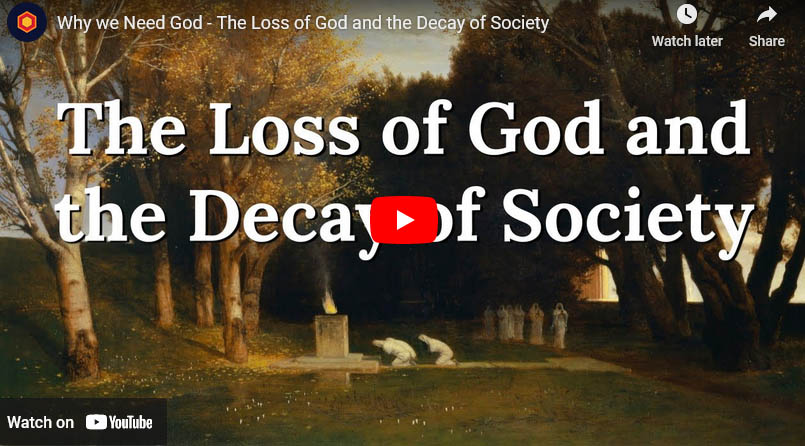
Do we Need God? – The Loss of God and the Decay of Society
[embedded content]
Do we Need God?
– The Loss of God and the Decay of Society
The following is a transcript of this video.
“Over half a century ago, while I was still a child, I recall hearing a number of older people offer the following explanation for the great disasters that had befallen Russia [in the 20th century]: ‘Men have forgotten God; that’s why all this has happened.’”
Aleksandr Solzhenitsyn, 1983 Templeton Address
Is secularization a sign of social progress? Is belief in God a superstition that is no longer warranted in a civilization as advanced as ours? In this video we explore the phenomenon of religion, the concept of God, and whether a religious revival could heal many of the ills that plague modern society.
The five major religions of history, be it Hinduism, Judaism, Buddhism, Christianity, or Islam, all have lifespans that far exceed any secular social movement, dynasty, empire, or state. Religion has played an important role in every society we know of, and even though its popularity waxes and wanes, the majority of men and women from all time periods and across all regions of the globe, have believed in some form of god and practiced some form of religion. But what is religion?
Religion is a multifaceted phenomenon, but at its essence it is the attempt to connect man with the divine. Religious rituals, forms of worship, ceremonies, moral codes, and belief systems help bring us into harmony with the supernatural. One can find religious thinkers, from both East and West, in agreement on this point. The great Indian Hindu monk Swami Vivekananda said that:
“The end of all religions is the realizing of God in the soul. That is the one universal religion. If there is one universal truth in all religions, I place it here – in realizing God. Ideals and methods may differ, but that is the central point.”
Swami Vivekananda, The Complete Works of Swami Vivekananda Volume 1
William James in his series of lectures The Varieties of Religious Experience, echoes this point:
“. . .one might say that [religion] consists of the belief that there is an unseen order, and that our supreme good lies in harmoniously adjusting ourselves thereto.”
This definition leads to a more fundamental question: What is the divine, the supernatural, the sacred, or what in the West is typically called God? In most languages the word god can be used in two different senses, often differentiated by a lower case ‘g’ and upper case ‘G’. The lower-case god is a divine being who inhabits the universe and rules over it. Some religions claim that there is only one such being, others claim that there are multiple. Some believe that this being is omnipotent, omniscient, and full of love, others have conceived these gods as possessing flaws and capable of evil. The idea of god as a divine being, is fraught with difficulties and pushes many in the direction of atheism. For where is this all-mighty being or beings? What evidence do we have for their existence? And is belief in such a being not just a superstition on the same level as belief in fairies, witches, or demons?
There is, however, another conception of God, the capital-G conception, which better aligns with many of history’s major religious traditions, be it Judaism, Christianity, Islam, Hinduism, Sikhism, as well as some forms of paganism. To understand the upper-case ‘G’ conception of God we will start with a question that Iain McGilchrist puts forth in his book The Matter With Things:
“How does it come about that there is a process, or motion, or a point in time, at all – now or ever?”
McGilchrist is not asking a question of cause and effect. He is not asking: What physical processes set the universe in motion? He is asking a more fundamental question. Why is there anything at all? Why is there something, rather than nothing? And as McGilchrist explains:
“The answer to this question is of an altogether different order, and must lie on a plane different from, and deeper than, everything else. The question cannot be answered in terms of a physical entity or process, because that already presupposes what we are questioning – why there are physical entities and processes. The proper object of this question is that which underwrites, timelessly and eternally, whatever is: in other words, the ground of Being.”
The ground of all Being is a mysterious phenomenon. It is beyond our powers of rationalization, and it is the height of folly to claim that we can know its ultimate nature. Our language is too limited and our powers of conceptualization too restricted to fully grasp this phenomenon – hence why those who speak about it are often forced to use symbols, images, parables, and myths. But as incomprehensible as it may be, men and women of all ages have been drawn toward it, and to communicate with others their awe and wonder regarding this phenomenon, a word to represent it has been required, and as McGilchrist writes:
“What we need is a word unlike any other, not defined in terms of anything else. . .This is no doubt why in every great tradition of thought – and perhaps beyond that, in every language of every people – there is such [a word]. It holds the place for a power that underwrites the existence of everything – the ground of Being. . .”
The word for the ground of Being has differed across cultures. The Hindus call it Brahman, Heraclitus called it Logos, Hebrews refer to it as YHWH, Lao-Tzu called it Tao, in Zen it is Ri, Arabic people call it Allah, while in the West, it is typically called God with a capital G. Or as David Bentley Hart writes in The Experience of God:
“To speak of “God” properly . . . is to speak of the one infinite source of all that is: eternal, omniscient, omnipotent, omnipresent, uncreated, uncaused, perfectly transcendent of all things and for that very reason absolutely immanent to all things. God so understood. . .is not a “being,” at least not in the way that a tree, shoemaker, or a [lowercase] god is a being; he is not one more object in the inventory of things that are, or any sort of discrete object at all. Rather, all things that exist receive their being continuously from him, who is the infinite wellspring of all that is, in whom all things live and move and have their being.”
Or as the fifth-century mystic and Christian theologian Dionysius the Areopagite put it:
“[God] is the cause of being for all, but is itself nonbeing, for it is beyond all being.”
Dionysius the Areopagite, The Divine Names
If God is conceptualized in this manner, then what is the purpose of religion? Why not just accept that the mystery of Being will forever remain mysterious and move one? Because as Hart explains:
“All [the major religious traditions] agree . . . that God can genuinely be known: that is. . .intimately encountered [and] directly experienced with a fullness surpassing mere conceptual comprehension.”
The rituals of religions, be it meditation, prayer, time spent in solitude or absorbed in beauty, reading sacred texts, attending holy places, participating in religious ceremonies, or reciting chants, hymns, or mantras, are the devices that help bring us into harmony with God. At its most effective, therefore, religion is an active pursuit and it consists of more than the mere acceptance of dogmas or the shallow professions of faith. Or as Karen Armstrong explains:
“Religion is a practical discipline, and its insights are not derived from abstract speculation but from spiritual exercises and a dedicated lifestyle. Without such practice, it is impossible to understand the truth of its doctrines.”
Or as Vivekananda said:
“Religion cannot be swallowed in the form of a pill. It requires hard and constant practice.”
Swami Vivekananda, The Complete Works of Swami Vivekananda Volume 1
This raises an important question: In order to connect with God do we need to adhere to the rituals of an organized religion? Or can we devise our own set of practices? In Varieties of Religious Experience William James provides examples of individuals who spurred all established religions, went their own way, and cultivated a connection with the divine – but these cases are rare. Most people are better served by turning to the traditions of an established religion, as these traditions, for thousands of years, have proved effective in cultivating the disposition of awe and wonder that facilitates the experience of God. Or as McGilchrist explains:
“I cannot possibly penetrate to the core of the enigma of life by my own efforts. Nor can I wilfully invent myths or rituals without their being trivial and empty. This is why we have traditions of art, philosophy and, above all, religion.”
It does not follow, however, that one must become a strict adherent of any specific church, creed, or sect to make use of its rituals, practices, or forms of worship. For many organized religions have become corrupted by social trends and stunted in their development by a literalist interpretation of scripture, and so a full-scale adoption of any specific organized religion may impede our religious aspirations and thwart our ability to live a fulfilling life. Vivekananda, in recognizing the corruption of organized religion, recommended an eclectic approach to connecting with God. We should study the traditions of various religions, take part in their practices, and adopt the aspects of these religions that help move us in the direction of God, or as Vivekananda said:
“If you want to be religious, enter not the gate of any organized religions. They do a hundred times more evil than good, because they stop the growth of each one’s individual development. Study everything, but keep your own seat firm. If you take my advice, do not put your neck into the trap. The moment they try to put their noose on you, get your neck out and go somewhere else. As the bee culling honey from many flowers remains free, not bound by any flower. . . Religion is only between you and your God, and no third person must come between you.”
Swami Vivekananda, The Complete Works of Swami Vivekananda Volume 1
A dedicated religious practice, when successful, leads to the religious experience, wherein one feels they have established some sort of connection with the divine. These experiences are of a profound nature, and as McGilchrist writes:
“[The religious experience] allows us to acknowledge that there is something way before, behind, above, and beyond our selves; that that something is not inert or remote, but ‘speaks’ to us and calls to us to respond, and that we feel the need to do so with seriousness, reverence and gratitude. And that is what gives meaning to life. In short, creation and the mystery of what lies behind it become sacred; and the disposition that sees it thus is what is meant by a religious disposition. It is a disposition that perceives depth.
While the precise quality of the religious experience is indescribable, its effects can be reported. The religious experience engenders feelings of harmony with all other beings and the universe at large. It promotes compassion, trust, and peace of mind, and imbues life with a sense of meaning and purpose. Or as Carl Jung writes:
“No matter what the world thinks about religious experience, the one who has it possesses a great treasure, a thing that has become for him a source of life, meaning, and beauty, and that has given a new splendor to the world and to mankind. He has pistis and peace. Where is the criterion by which you could say…that such an experience is not valid?”
The religious experience also acts as a means of salvation for a broken life, as such experiences tend to reveal that there is much more to the universe than the rational mind can conceive of, and the experiencer learns that he or she shares in this more. Or as James writes of the individual who has a religious experience:
“He becomes conscious that his higher part is conterminous and continuous with a MORE of the same quality, which is operative in the universe outside of him, and which he can keep in working touch with, and in a fashion get on board of and save himself when all his lower being has gone to pieces in the wreck.”
Jung went as far as to suggest that unless a religion can generate the religious experience, its value is limited, or as he wrote:
“The teaching of the past, for example, of St. Paul or Jesus, can be edifying, but in itself does nothing. . .Unless there is a personal religious experience nothing happens.”
Carl Jung, Conversation with E. A. Bennet, 7 July 1959, Meetings with Jung
Having identified the essence of religion, explored the mystery of God, and examined the religious experience, we are now ready to take up the question as to whether a decline in religion is individually and socially destructive and whether more people cultivating a religious disposition can help heal many of the ills of the modern day.
In Volume 11 of his Collected Works, Carl Jung wrote:
“The more unconscious we are of the religious problem. . .the greater the danger of our putting the divine germ within us to some ridiculous or demonical use, puffing ourselves up with it instead of remaining conscious that we are no more than the stable in which the Lord is born.”
In the late 19th century, Friedrich Nietzsche wrote that God is dead. Christianity was in decline, many were moving in the direction of atheism, and science and the state were replacing religion as society’s organizing principles. As faith in God declined, nihilism, or the conviction that life is meaningless, would rise, according to Nietzsche. For religion was the primary source of life’s meaning and, in most societies, it shaped the values people strived for and the way they structured their lives. But nihilism did not spread to the degree Nietzsche prophesized, as most people find it far too difficult to live absent the belief in something bigger than their meagre selves. Instead, many flocked towards new gods, gods that were not divine but man-made and this trend has continued into the modern day and is responsible for many of our social ills, or as George Steiner put it:
“. . .the political and philosophic history of the West during the past 150 years can be understood as a series of attempts – more or less conscious, more or less systematic, more or less violent – to fill the central emptiness left by the erosion of theology.”
George Steiner, Massey Lectures in 1974
Instead of worshiping the God that transcends the finite world and which grounds all of existence, many of us worship ideologies, our nation, politicians, celebrities, athletes, sports teams, consumer goods, drugs, or the sexual act, or we treat technology or science as new gods and believe that their advance will usher in a utopia and perhaps even grant us immortality.
These ideologies, social movements, and ways of life consume their adherents with the same power as a religion and as Iain McGilchrist explains they “. . .may be savagely anti-religious, . . . may postulate a world without God and may deny an afterlife, but [their] structure, aspirations, [and] claims on the believer, are profoundly religious in strategy. . .”
But as man is flawed, so too are all variations of man-made gods. A politician elevated to the position of a deity, will be corrupted by power. If we worship drugs, sex, or consumer goods, we become their slave. If we believe an ideology has the power to remake the world and the nature of man, we are more likely to create a totalitarian hell on earth. A society devoid a connection to the divine, is a society ripe for destruction by false idols and perhaps the most dangerous of these idols is the State:
“In order to free the…State…from every wholesome restriction, all socio-political movements tending in this direction invariably try to cut the ground from under religion. For, in order to turn the individual into a function of the State, his dependence on anything else must be taken from him.”
For a society to be free and for men and women to flourish all man-made gods must perish, and there is no better way to accomplish this feat than an authentic religious revival. When men and women acknowledge their roots in a divine God, and when they orient their lives in pursuit of a harmonious connection with God, they do not unconsciously fall victim to inferior secular alternatives. Or as Jung writes:
““Principalities and powers” are always with us; we have no need to create them even if we could. It is merely incumbent on us to choose the master we wish to serve, so that his service shall be our safeguard against being mastered by the “other” whom we have not chosen. We do not create “God,” we choose him.”
Another factor contributing to society’s sickness is a tendency to view social and political issues through a utilitarian lens. Utilitarians believe that the best social policy is the one that produces the greatest good for the greatest number of people. The utilitarian, in other words, does not view the individual as possessing an innate worth, but instead as a resource to be used, or even sacrificed, to attain their vision of the greater good. Utilitarianism is a corrupt form of morality and the willingness to coerce and harm a minority, for the benefit of a majority, is indicative of a disturbed mind, or as McGilchrist writes:
“The tendency to adopt a calculating and utilitarian approach in judging moral issues is more marked in those with reduced aversion to harming others, lower trait empathy, higher psychoticism. . .and greater Machiavellianism. It is also characteristic of the moral thinking of psychopaths. . .”
Religion, and the connection to God that it promotes, gives rise to a moral sensibility that counters the pathology of utilitarianism. For a primary effect of the religious experience is a feeling of harmony with, and connection to, humanity at large and all other life forms. The religious experience helps us to see other people as ends in and of themselves, not as tools, or resources, to be exploited for selfish purposes or political gain. And as McGilchrist explains, the religious experience induces:
“. . .a humility before the greatness of the cosmos. . .compassion for others and ourselves [and] reverence towards the living world. . .”
A morality rooted in humility, compassion, and reverence, is the type of morality that can help fix the degenerate state of modern society, or as McGilchrist explains:
“When our society generally held with religion, we might indeed have committed many of the same wrongs; but power-seeking, selfishness, self-promotion, narcissism and entitlement, neglect of duty, dishonesty, ruthlessness, greed, and lust were never condoned or actively and openly encouraged in the way they sometimes are now. . .we have lost all shame. And that can’t help but make a difference to how we behave. Pride and arrogance, believing we know it all, are the opposite of the religious disposition of humility, reverence and compassion.”
While religion can improve the morality of those who strive to connect to God, a problem remains: There are a lot of corrupt and pathological individuals in positions of power. We cannot expect these individuals to turn toward God, nor will they abdicate their power voluntarily. To cure society requires more than just good people, it requires good people who are willing to stand up to, and defeat, corrupt authority. Religion can help accomplish this end as it is one of the most effective means of healing the diseases of despair that have turned so many people into passive and apathetic cowards.
“The evidence is that religious belief has a dramatic positive impact on both psychological and physical health, certainly comparable with, if not superior to, most ‘lifestyle’ changes known to modern medicine. . .”
Whether one is an addict, a neurotic, a depressive, or overly anxious, religion can help. For thousands of years religious practices have provided ways and means of dealing with the trials and tribulations of life. Jung went as far as to call religions ‘mental pharmacies’.
“Religious ideas and convictions from the beginning of history have the aspect of the mental pharmakon [pharmacy]. They represent the world of wholeness in which fragments can be gathered and put together again. Such a cure cannot be effected by pills and injections.”
Carl Jung, Letter to Father David, 11 February 1961
Or as he put it in Volume 14 of his Collected Works:
“The great religions are psychotherapeutic systems that give a foothold to all those who cannot stand by themselves. . .”
One of the ways in which religion helps cure the mind is through its capacity to generate meaning. When we strive for the divine our life is granted structure and purpose and when we attain the religious experience it feels deeply meaningful, or as McGilchrist writes:
“There is something much too small about a world in which we are isolated from the divine. . .one that has no place for the sacred, we ourselves loom, imaginatively, far too large. . .At the same time we see ourselves conceptually as diminished, because as soon as we pan out, we see ourselves dwindle to a pointless speck in a barren cosmos. A religious cast of mind sets the human being and human life in the widest context, reminding us of our duties to one another, and to the natural world that is our home. . .The world becomes ensouled. And we have a place in it once more.”
When we feel our life is meaningful, and when no longer plagued by the burden of anxiety, depression, or addiction, our capacity and willingness to stand up to the forces that are destroying society will be heightened. We will no longer sit passively by, locked in our cowardice, worshipping false idols, as we watch evil and degeneracy spread throughout society. Instead, firmly rooted in the divine we will possess the courage to resist corrupt authority and to act as a force of good in the world. Or as Jung put it:
“The individual who is not anchored in God can offer no resistance on his own resources to the physical and moral blandishments of the world. For this he needs the evidence of inner, transcendent experience which alone can protect him from the otherwise inevitable submersion in the mass.”
Art Used in this Video

420 with CNW — City Data Shows Denver Has Collected $500M in Cannabis Taxes

According to recent city data, Denver has reached a new cannabis milestone: since 2010, tax income from recreational and medical cannabis has exceeded $500 million. While Colorado celebrates exceeding $15 billion in cannabis sales since legalization, Denver’s report highlights the substantial tax dollars generated locally, supporting various public programs and services.
For more than a decade, Denver has added an impressive $501,538,144 to its coffers through marijuana tax revenue. The city has already collected around $33 million in marijuana taxes this year alone.
The revenue stems from various sources, including medical and retail marijuana sales tax, affordable housing tax, retail special tax, state share-back and cannabis business licensing fees. These revenues can be attributed to approximately $5.7 billion in cannabis sales since 2010, with the figure for 2023 standing at just more than $300 million as of August 2023.
Consequently, Denver has played a significant role in Colorado’s broader cannabis economy, which has earned more than $2.5 billion in taxes since recreational cannabis legalization in 2014.
According to city officials, Denver has used $61.7 million of its marijuana revenue to fund affordable housing, $30 million for services for the homeless, $27 million for education, $10 million for investments in small businesses and $4 million to address the opioid crisis.
Colorado became the first state to begin selling recreational marijuana after voters approved a legalization issue on the ballot in 2012. Sales reached a peak of more than $2.2 billion in 2021, but since then, sales have decreased, essentially leveling off during the last two years. Denver’s experience has also been consistent with that general trend.
A different Denver analysis released earlier this year showed that the city’s marijuana laws have significantly shrunk the extent of the black market, with law enforcement in 2022 processing a record low quantity of illegal cannabis.
Meanwhile, Governor Jared Polis, a vocal advocate for legalization, has been working to strengthen the existing cannabis industry while advocating for federal reforms. He recently commended President Joe Biden for his administration’s recommendation to reschedule cannabis but emphasized the need for further action to address concerns related to federal enforcement, marijuana banking, immigration and criminal justice reform.
In May, the governor approved legislation establishing restrictions for substances such as ayahuasca and psilocybin. Since then, he has called on lawmakers to take action to enable him to grant mass pardons for individuals with past convictions related to psychedelics. In June, Polis also ratified a bill authorizing the sale of marijuana online. The change became operative in August of this year. Additionally, he has supported legislation that will strengthen the state’s restrictions against marijuana use for working professionals, essentially codifying an executive order he made the previous year.
These benefits that the city of Denver is enjoying are being replicated in some form in other jurisdictions and countries where licensed marijuana companies such as Cronos Group Inc. (NASDAQ: CRON) (TSX: CRON) have been given leeway to serve customers interested in cannabis for recreational or medical use.
About CNW420
CNW420 spotlights the latest developments in the rapidly evolving cannabis industry through the release of two informative articles each business day. Our concise, informative content serves as a gateway for investors interested in the legalized cannabis sector and provides updates on how regulatory developments may impact financial markets. Articles are released each business day at 4:20 a.m. and 4:20 p.m. Eastern – our tribute to the time synonymous with cannabis culture. If marijuana and the burgeoning industry surrounding it are on your radar, CNW420 is for you! Check back daily to stay up-to-date on the latest milestones in the fast -changing world of cannabis.
To receive SMS alerts from CNW, text CANNABIS to 844-397-5787 (U.S. Mobile Phones Only)
For more information, please visit https://www.CannabisNewsWire.com
Please see full terms of use and disclaimers on the CannabisNewsWire website applicable to all content provided by CNW, wherever published or re-published: https://www.CannabisNewsWire.com/Disclaimer
CannabisNewsWire
Denver, CO
www.CannabisNewsWire.com
303.498.7722 Office
Editor@CannabisNewsWire.com
CannabisNewsWire is powered by IBN
420 with CNW — Study Concludes Set and Setting Impact Mental Health Benefits of Cannabis
A recently published study shows that engaging in yoga after using cannabis can lead to improved mystical experiences and mindfulness. The study suggests that the surrounding environment and activities can significantly influence a person’s cannabis experience. The study, which forms part of a psychology dissertation submitted at the University of British Columbia, was intended to investigate how contextual factors during marijuana consumption impact overall well-being.
Study author Sarah Elizabeth A. Daniels stated that when using psychoactive substances intended for mental-health treatment, researchers frequently take into account contextual factors outside the direct effects of the drug, such as one’s behavior, mindset and setting. These factors are known to have a substantial impact on therapeutic outcomes, a principle well-recognized in psychedelic research but less so in the context of therapeutic marijuana use. The study’s findings suggest that, similar to psychedelics, the concept of “set & setting” during marijuana use may profoundly influence the therapeutic benefits of the drug.
To assess how context affects the marijuana experience, Daniels conducted a study with 47 participants who self-administered cannabis on two separate occasions, one week apart. In one session, the subjects practiced yoga, and in the other, they took part in their routine activities, which often involved doing housework, eating, socializing or watching TV. The subjects were evaluated on measures including state effect, mystical experience, as well as state mindfulness.
The results showed a significant increase in mystical experiences and mindfulness when participants practiced yoga while using cannabis. On the other hand, there wasn’t a noticeable difference in the participants’ mood and emotional states between the two sessions.
The study findings have potential implications for enhancing the therapeutic use of cannabis as well as recommendations for clinical practice. Daniels pointed out that providing specific behavioral guidelines and psychoeducation on the role of set & setting may be beneficial. The study further suggested that the altered state of consciousness experienced while using cannabis should not be disregarded as it holds significant therapeutic value.
The U.S. government has previously acknowledged the consciousness-changing potential of hallucinogens as a significant side effect, which led to research into pharmaceutical products that mimic their effects without hallucinations. Meanwhile, the combination of yoga plus marijuana has been a long-standing practice within the marijuana community, with classes offering this pairing emerging as early as the initial stages of state-level legalization. These activities have often been praised anecdotally for their benefits.
The findings of this study can help marijuana industry players, such as Aurora Cannabis Inc. (NASDAQ: ACB) (TSX: ACB), to find novel ways in which to position their products in a way that shows customers how best they can get maximum benefits while using those products for different purposes.
About CNW420
CNW420 spotlights the latest developments in the rapidly evolving cannabis industry through the release of two informative articles each business day. Our concise, informative content serves as a gateway for investors interested in the legalized cannabis sector and provides updates on how regulatory developments may impact financial markets. Articles are released each business day at 4:20 a.m. and 4:20 p.m. Eastern – our tribute to the time synonymous with cannabis culture. If marijuana and the burgeoning industry surrounding it are on your radar, CNW420 is for you! Check back daily to stay up-to-date on the latest milestones in the fast -changing world of cannabis.
To receive SMS alerts from CNW, text CANNABIS to 844-397-5787 (U.S. Mobile Phones Only)
For more information, please visit https://www.CannabisNewsWire.com
Please see full terms of use and disclaimers on the CannabisNewsWire website applicable to all content provided by CNW, wherever published or re-published: https://www.CannabisNewsWire.com/Disclaimer
CannabisNewsWire
Denver, CO
www.CannabisNewsWire.com
303.498.7722 Office
Editor@CannabisNewsWire.com
CannabisNewsWire is powered by IBN

Which Flower Essences Do You Need?
Which Flower Essences Do You Need?
by Dr. Brent W. Davis
• FlorAlive® Founder • Inventor of the UNCUT Flower™ Extraction Process
The development of the FlorAlive® UNCUT Flower™ essences has occurred in a remarkable way that repeatedly suggests a Higher Source is directing the manner and the order in which the flowers are discovered and are brought forth as remedies. It is interesting to note the order in which the remedies were discovered.
I was guided to a pristine, moist hollow on my herb farm to prepare the first FlorAlive™ essence, made from Giant Chickweed. The flower looks like a pretty little star, and has a great energy and spirit to it. So I named the remedy Star Spirit Flower. When this first essence was ready to decant from the extraction vessel, the bulb broke on the pipette used for gathering the essence. I had to use mouth suction on the pipette to draw up the flower essence. At the end of the procedure I mistakenly drew up quite a bit of the essence into my mouth, and had to discard that pipette full. Later that evening I began what I can only describe as a 3 day frenzy of cleaning, organizing, and paperwork that had been overlooked for months. When all the work was done I sat back in sort of a daze to ponder what on earth could have caused me to have so much energy and to overcome procrastination. I remembered the mouthful of Star Spirit Flower and wondered if it could possibly be the source of the fury for organizing. I began reflex checking of the remedy on patients in my practice the next week, and soon found that it had a major indication for overcoming procrastination.
When we want to recover our health we have to tackle making changes that might be uncomfortable or that we might tend to put off. Perhaps a very good place to start the process of healing is with Star Spirit Flower if we have any tendencies toward procrastination or disorganization.
The next remedy that was discovered was Blue Eyed Grass. I had worked with this herb for many years, using it according to the indications of the Indian tribes of the Great Lakes region. They applied it as a general tonic and blood cleanser. I always loved the small plant with an Iris-like flower. Once I prepared it, I began checking it routinely on my patients and found that those who suffered emotional or physical abuse were very much aided by this flower. Abuse syndrome is enormously prevalent, and a high percentage of the general population benefits from clearing that from their life, and removing stored memories of it from their subconscious mind (which this essence helps.)
One day, I was walking on my farm (now the FlorAlive Sanctuary and Practitioner Certification Center) and right across from the greenhouse something called out to me asking for my attention. I stopped in my tracks to sense where the pulling was coming from, and to my left I noticed beautiful fuchsia-colored flowers. I drew close and began to admire a particular one of the flowers and suddenly, in the center of the small flower, appeared the face of a woman who was a close friend. She had been quite disabled by the loss of a relationship with her true love that had ended. It seemed that the flower had sensed through me her need, and was letting me know it could help her. I prepared the remedy and the next week found that it had a strong affinity for my friend. Whenever strong senses of grief and loss would arise, she found that taking the flower essence which I now call Heartmend quickly relieved the pain. She attributes a great deal of the mending of her heart to this beautiful flower that God touched with such a special ability. The flower, by now, has helped several thousand people suffering from diverse conditions arising from loss of love.
The stories become more intriguing around each new flower essence that I am being guided to discover. They are involving many serendipitous events including dreams and visions directing me to remote areas that I would otherwise never encounter. They are stories told in a forthcoming book I am writing.
Maquilina, one of the most powerful and benevolent of all flowers (a main ingredient of ReviveAll™), lives at 15,000 feet beside a glacier in a remote Andean mountain valley. It is beneficial for virtually everyone because a link to Divine Intelligence dwells powerfully in this flower. It removes a sense of defeat and hopelessness.
The remaining order of discovery in the early essences is:
Wild Iris
Tulip Poplar
May Apple
Pink Lady Slipper
Manzo
White Ginger
Madame Fate
On the home page of FlorAlive.com, under the heading of Single Essences, there is a concise description of the properties of each of the FlorAlive™ flower essences. The combination essence, Revive All™, has enormously broad applications and benefits most people. It is the first step in the Abundant Life Program, which in just 4 months can produce a huge evolution of consciousness.
For a more precise determination of specific flower essence need, I am available for phone consultation by advance appointment when my schedule permits. To find out more about this option, on homepage click: https://floralive.com/?aff=24

Use Code: TheNewNOW for 11% Off
Recent Comments