Last week, California Governor Gavin Newsom signed a resolution that would allow healthcare professionals in the state of California to prescribe MDMA, psilocybin and any other drugs classified under Schedule I to patients if and when the drugs were approved by the FDA for an exemption or reclassified to a lower schedule. The recently signed measure states that physicians, pharmacists or other authorized individuals who hold healing arts licenses and prescribe or dispense these drugs in accordance with federal regulations would be considered as acting in compliance with state law that governed the aforementioned acts.
Currently, drugs classified under Schedule I of the Controlled Substances Act include heroin, marijuana, LSD, peyote, MDMA and methaqualone. Drugs under this classification are said to have a high potential for abuse and have no accepted medical use.
However, recent research has proven that psychedelic substances hold therapeutic potential that could benefit patients suffering from a number of mental-health conditions. For instance, researchers have found that in comparison to treatment using a placebo, MDMA-assisted therapy was more effective in treating post-traumatic stress disorder. This particular study was carried out by the Multidisciplinary Association of Psychedelic Studies, a nonprofit organization that raises understanding and awareness of psychedelic drugs.
The organization’s president, Rick Doblin, put out a statement recently noting that its latest trial results put MDMA on track for possible approval by the Food and Drug Administration by as early as 2024.
Separately, scientists have found that psilocybin could be useful in treating severe depression, anxiety, PTSD and One study, whose results were published three months ago, determined that psilocybin was as effective in the treatment of depression as a commonly prescribed SSRI, escitalopram. There’s also evidence that this psychedelic could also be useful in the treatment of eating disorders, cluster headaches and even chronic pain.
The state of Oregon was the first in the country to legalize psilocybin-assisted therapy earlier this year. The state of Colorado is now the latest addition to the group, having recently decriminalized psilocybin. Last week, city officials in Maine also voted to decriminalize a number of psychedelic plant drugs, psilocybin included.
Given the moves being made at the local and state levels to further the movement to decriminalize psychedelics, its not wrong to hope that at some point the federal government may follow suit.
At the moment, however, embracing the legalization of psychedelic drugs at the federal level remains a fairly remote possibility. This newly signed law has minimal direct impact because it hinges on federal regulatory action, and so industry companies such as atai Life Sciences N.V. (NASDAQ: ATAI) are likely to view it as no more than a preemptive measure intended to allow California to move fast once any federal psychedelics reforms are enacted.
About PsychedelicNewsWire
PsychedelicNewsWire (“PNW”) is a specialized communications platform with a focus on all aspects of psychedelics and the latest developments and advances in the psychedelics sector. It is one of 60+ brands within the Dynamic Brand Portfolio @ IBN that delivers: (1) access to a vast network of wire solutions via InvestorWire to efficiently and effectively reach a myriad of target markets, demographics and diverse industries; (2) article and editorial syndication to 5,000+ outlets; (3) enhanced press release enhancement to ensure maximum impact; (4) social media distribution via IBN to millions of social media followers; and (5) a full array of tailored corporate communications solutions. With broad reach and a seasoned team of contributing journalists and writers, PNW is uniquely positioned to best serve private and public companies that want to reach a wide audience of investors, influencers, consumers, journalists and the general public. By cutting through the overload of information in today’s market, PNW brings its clients unparalleled recognition and brand awareness. PNW is where breaking news, insightful content and actionable information converge.
To receive SMS alerts from PsychedelicNewsWire, text “Groovy” to 21000 (U.S. Mobile Phones Only)
Please see full terms of use and disclaimers on the PsychedelicNewsWire website applicable to all content provided by PNW, wherever published or re-published: https://www.PsychedelicNewsWire.com/Disclaimer
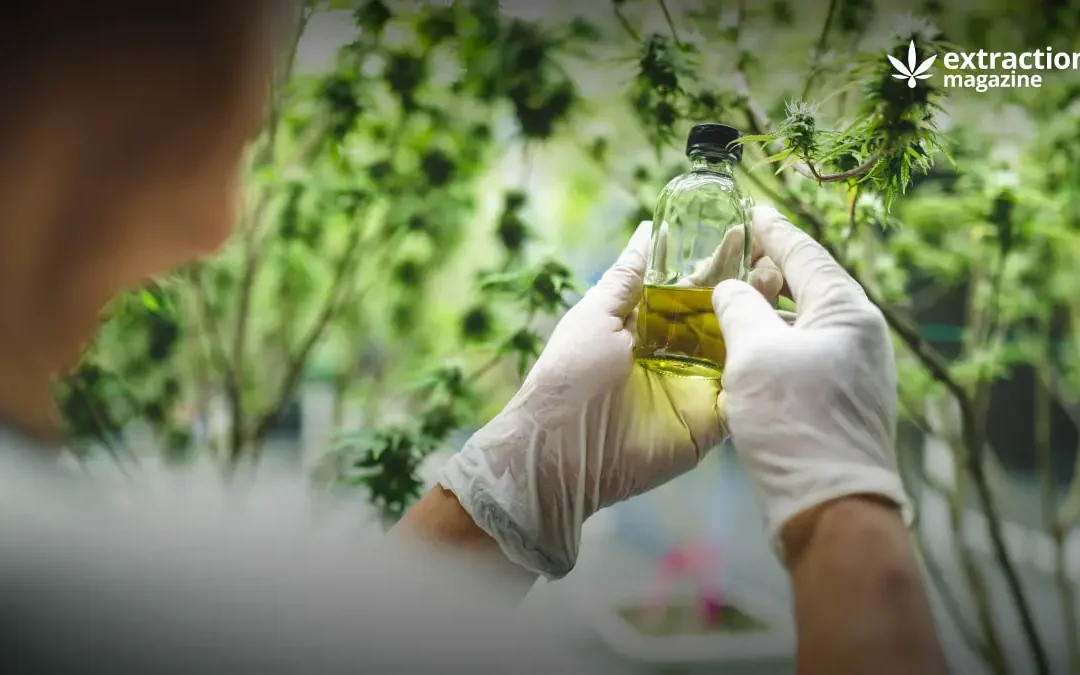
The evolving landscape of cannabinoid research and product development has seen a significant shift toward the combination of two primary compounds, cannabidiol (CBD) and tetrahydrocannabinol (THC). These two cannabis derived constituents have been increasingly combined in different ratios to create novel extracts offering an array of therapeutic benefits. The surge in the popularity of these combined extracts is largely attributable to the synergistic potential that CBD and THC present when used in tandem.
Across the market, an assortment of extract products featuring different CBD:THC ratios are readily available, catering to diverse consumer needs and preferences. Ratios range from 1:1, where CBD and THC are present in equal proportions, to more skewed ratios like 10:1 or 20:1 CBD:THC, and even 20:1 THC:CBD. These different cannabinoid mixes allow consumers and researchers to explore the distinct effects and potential benefits of each combination, thereby driving the trend of CBD and THC extraction.
Benefits of Extracts Combining CBD and THC
There are many potential benefits for extracts combining CBD and THC. One significant development in this area involves the combined use of CBD and THC for the treatment of Alzheimer’s disease (AD). This approach is founded on the synergistic effect which enhances the collective therapeutic potential of both cannabinoids.
Alzheimer’s disease, a debilitating neurodegenerative condition marked by cognitive decline and behavioral impairment, currently lacks a cure. The treatments approved so far have not demonstrated any notable success in halting or slowing the progression of this disease. [1]
A recent scientific review published in the Frontiers in Neuroscience provides a comprehensive analysis of the current evidence supporting the efficacy of multi-cannabinoid formulations for AD therapy.
The study highlights the role of the endocannabinoid system (ECS), which is affected in AD, suggesting that cannabinoids, including CBD and THC, could offer potential solutions. The researchers propose that a multi-cannabinoid strategy, such as whole-plant cannabis extracts or specific CBD:THC combinations, may be more effective compared to treatments involving isolated cannabinoids.
The research concludes by affirming the viability of multi-cannabinoid combination treatment strategies for AD. The combined application of CBD and THC extracts presents a promising avenue in the quest for more effective AD interventions and suggests the need for studying the different effects of various CBD:THC ratios for other medical conditions.
Can CBD Reduce The Effects of THC?
A prevailing myth within the cannabis market suggests that CBD can counteract or reduce the psychoactive effects of THC. However, a newly published study in the Addiction journal challenges this widely held belief. [2]
The study employs a randomized, double-blind, placebo-controlled, crossover methodology to investigate the acute effects of cannabis with and without CBD in both adults and adolescents. The focus on two different age groups is significant as it provides insights into how these compounds might interact across different stages of human development.
The researchers administered vaporized cannabis containing THC, with or without CBD, to the participants. They then monitored a range of outcomes, including cognitive function, psychotomimetic symptoms, heart rate, blood pressure, and plasma cannabinoid concentrations. The study’s comprehensive approach ensures a thorough evaluation of the potential impacts of cannabis use, particularly about the presence or absence of CBD.
Contrary to the popular belief that CBD can mitigate the psychoactive effects of THC, the study’s findings suggest otherwise. Regardless of whether CBD was present, THC was found to induce psychotomimetic symptoms in both adults and adolescents. CBD did not appear to alter the cardiovascular effects of THC.
These results challenge the notion that CBD can neutralize the effects of THC if inhaled. Nevertheless significant modulation of THC’s acute effects may require pre-dosing with larger oral or intravenous administration. [2] Moreover stronger THC-induced psychotomimetic effects may be necessary before the protective effect of CBD is observed. [2]
This compelling research underscores the importance of continued scientific exploration to dispel misconceptions and deepen our understanding of these complex plant compounds.
Current trends in the market reflect a growing demand for both combined and isolated cannabinoid extracts. Given the ongoing legalization efforts and increasing societal acceptance of cannabis, coupled with the rising demand for THC specifically, these trends show no signs of slowing down.
As our understanding of these plant compounds deepens, the demand for both combined and isolated cannabinoid extracts will likely continue to grow, offering substantial opportunities for extractors.
This presents a unique opportunity for extractors who can cater to these diverse consumer needs by producing a range of extract products. Whether it’s a balanced 1:1 CBD:THC ratio, a skewed ratio like 20:1, or an extract containing isolated cannabinoids, there’s room for all these cannabis extract types in the market.
References:
Coles, M. Et al. Therapeutic properties of multi-cannabinoid treatment strategies for Alzheimer’s disease. Frontiers in Neuroscience. 2022; 16: 962922.https://www.ncbi.nlm.nih.gov/pmc/articles/PMC9479694/ Times Cited: 5 Journal Impact Factor: 4.3
Lawn, W. Et al. The acute effects of cannabis with and without cannabidiol in adults and adolescents: A randomised, double-blind, placebo-controlled, crossover experiment. Addiction. 2023. Volume 118, Issue 7 P 1282-1294.https://onlinelibrary.wiley.com/doi/full/10.1111/add.16154 Times Cited: 1 Journal Impact Factor: 6.34
California legislators have approved a series of marijuana-related bills in their just-concluded session. The bills cover various aspects of the industry and have garnered significant attention, particularly from industry professionals. During the session, several cannabis-related laws were introduced, including one that was designed to safeguard workers who use marijuana in traditional office settings.
Governor Gavin Newsom has until Oct. 14, 2023, to either reject or sign the measures.
Three bills have taken center stage in discussions among California’s cannabis industry insiders, those addressing issues related to social equity, labeling and consumption lounges restrictions.
SB 51, which seeks to rectify historical injustices by extending the provisional license program of the cannabis control department, has garnered support, particularly from social-equity licensees and applicants. The measure allows retail-equity licensees and applicants to receive or renew temporary licenses for up to five years under certain conditions, allowing businesses to remain in compliance while working toward permanent annual permits.
The transition to annual state licenses has proven challenging, especially in Los Angeles, where many social-equity cannabis businesses are struggling due to real estate hurdles and capital shortages. SB 51 aims to provide relief to more than 300 applicants across the state, spanning areas such as San Jose, San Diego and Long Beach.
AB 374 has also been seen as a potential victory for cannabis retailers. The legislation would permit California cannabis shops to operate conventional kitchens and host events. It promises operational changes and new revenue streams while serving as a model for other states struggling with consumption lounge regulations. The law would take effect on Jan. 1, 2024, pending the governor’s approval, but it would apply only in jurisdictions that permit consumption lounges.
Unlike the other two measures, AB 1207 has encountered strong opposition within the industry. The bill introduces new restrictions on product packaging and labeling, including bans on various designs and images that might appeal to persons under 21 years of age.
The measure carries significant implications for brands and manufacturers, particularly minority-led and small enterprises that use packaging to highlight their unique identities and stories. AB 1207 has successfully passed through both legislative chambers and now awaits the governor’s signature.
Despite consistent industry demands, tax relief for the marijuana sector has once again failed to gain traction during this legislative session. SB 512, which aimed to eliminate double taxation imposed by the state and local jurisdictions, failed to progress beyond committee stages.
For global-focused companies such as Cronos Group Inc. (NASDAQ: CRON) (TSX: CRON), the evolving regulatory landscape in California is of great interest since the developments there can cascade to other U.S. states and jurisdictions around the world, impacting the trajectory of the industry.
About CNW420
CNW420 spotlights the latest developments in the rapidly evolving cannabis industry through the release of two informative articles each business day. Our concise, informative content serves as a gateway for investors interested in the legalized cannabis sector and provides updates on how regulatory developments may impact financial markets. Articles are released each business day at 4:20 a.m. and 4:20 p.m. Eastern – our tribute to the time synonymous with cannabis culture. If marijuana and the burgeoning industry surrounding it are on your radar, CNW420 is for you! Check back daily to stay up-to-date on the latest milestones in the fast -changing world of cannabis.
To receive SMS alerts from CNW, text CANNABIS to 844-397-5787 (U.S. Mobile Phones Only)
Please see full terms of use and disclaimers on the CannabisNewsWire website applicable to all content provided by CNW, wherever published or re-published: https://www.CannabisNewsWire.com/Disclaimer
“Community is present when we are in relation with our soul.”
Conditioned to Artificiality
Society is not a community. It is an engineered system designed to produce human reactivity, employing multiple control mechanisms to extract our personal power. Our personal power is universality. It is sourced from the relativity between our soul and the universe. This is why institutional entities and organizations do not encourage or empower guidance or practices in universality. Under the guises of civilization, industry and technology, our social environment is being converted into a virtual reality. As are we. In this new era, the greatest threat to the evolution of our collective consciousness is artificiality.
Sacrificial Existence
Social reality is a complex matrix of spiritual, emotional, mental and physical traumatization. It happens to us every day in many ways, more than we can comprehend. When we conform to society, we sacrifice our relativity with our soul and the universe, repress our emotionality and fully integrate ourselves into the mind and body. The extent of our conformity yields the degree of our “success.” As we endeavor to climb the social ladder of prominence, we sever our connection with our heart, intuition and soul. Every day, we casually commit acts of treason upon our being. With each personal transgression against our soul, we drift closer to enslavement and further from freedom.
Socialization of Egocentricity
We all have an ego. Therefore, we are all egotistical. This is inevitable. Our initial interests and priorities are for ourselves and our immediate family. Beyond these domains, we show little to no regard. We do not express the universal awareness to the social impacts of our egocentric lifestyles. We justify it with a necessity for survival, and “patriotize” it is an essential strategy to provide a better life for our children. But are we? Or is it that we simply sacrifice our universal purpose, as we concede to social conformity? Socialization is a badge of honor we wield to defend our egocentricity at the cost of our universality.
Instinctual Imprisonment
Once we have allowed social conditioning to segregate us from our heart, soul and the universe, our mind highjacks our universal energy to govern our body. Our encounters with sense-based reality activate our mental endorphins to habituate us with dependency upon simulated, external gratification. We are initiated into reactivity, tethered to an engineered illusion. Over time, our egocentric observations and perspectives transmute this fantasy into delusion. Millions of social stimuli program our senses to receive synthetic intelligence, imprisoning us into instinctual existence. We establish our enslavement in artificiality with our selective encounters in social reality.
“Communication in unity is the heart of community.”
The Commune Paradox
Whether a community is local, global, religious, or spiritual, there is always codependency, control, conflict, dysfunction, manipulation, politics and powerplays. When a group of people assemble who exhibit egocentricity, it is only a matter of time until there is a breakdown in relatedness. Some even attempt to recycle the “commune” paradigm to foster community; offering a patchwork of activities, events, rituals and traditions to attract the greatest number of followers. Community is not about the quantity of people, rather the quality of its relations. All who stand to profit financially are the furthest from the spirit of communion.
Soul Reunion
Society separates us from our soul. Reuniting with our essence is experienced in the resonance of conscious emotionality. The heart is the center of our being. It aligns us with our intuition and soul. Community originates from our soul’s relativity with the universe. Being related with universality is essential in communal experiences. The fullest we experience ourselves, the best we experience others. When we embody this omnidimensionality, we accept, appreciate and understand the unique expression each person brings with their contribution.
The Art of Transcendance
Our soul is empowered by the universe. Its energy resonates with a unique vibrational frequency; transmitting universality through our intuition, into the centers of our being and empowering our heart. Our heart center is an omnidimensional sphere of energy expressing our universality. This energetic torus evolves and expands six feet and beyond our being. Its expression is defined by the nature of our focus and intention. Our mind is merely an instrument, translating universality into human expression for the purposes of embodiment, relativity and understanding. Its momentum empowers our physicality.
Embodying Unity
Unity is to become one. There is a vital distinction between the ideology and reality of “unity.” Social interaction is primarily a peripheral encounter, reliant upon what transpires around us instead of who we are within. Community is empowered by the relation between our soul and the universe. Our universal nature is to synergize with our soul. The purpose of community is to embody the unity between our soul and the universe as an expression of being. In our being, we convey the resonance of universal relativity. When we center ourselves in the flow of universality, we express the energy of unity empowering community.
The “Unity” of Community
Equilibrium is essential when empowering community. There is a unique, energetic flow expressed with every contribution from each member. Society’s hierarchical paradigm is contrary to the universal empowerment of community. In a circle, there are no leaders. Simply, unique beings who share their universality to the best of their ability. Our purpose is to transcend the social reality designed to enslave us into physicality. The energetic shift is giving us the opportunity to experience relativity in its universal expression. The shift is each person embodying their unique energetic flow, collectively.
“Communion with the universe is the soul of community.”
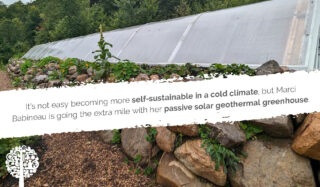
Last August, we were screwing down the 14’x3′ sheets of double-ply PVC to the metal frame of the 60-foot greenhouse we were building on the mountainside. It was pouring rain. Once we’d finished screwing down the last sheet, we stood dripping inside the cocooned greenhouse listening to the pounding clatter. Standing on the sunken floor below the new roof, we felt we might finish building it before the snow came.
Extending The Growing Season
We had decided, for better or worse, to build a Greenhouse in the Snow Canada greenhouse last summer. Russ Finch, a retired-postal-worker-turned-market-gardener, engineered it for growing citrus in Nebraska. We were interested in a nine-month growing season. I had written to Russ a few years hence, asking if they shipped to Canada. It seemed complicated. But some folks in BC bought a franchise, and buying it became easier.
Breaking Ground
The construction began in late April 2022. Our neighbor Eric and his Kubota began to dig an 8’x4’x60′ long trench on the upper terrace of our hillside, just south of the butternut orchard. Because our orchards are planted on the mountainous terraces of the Canadian Shield, we were immediately treated to some huge rocks that the Kubota could barely strain from the earth. We had been encouraged to do an engineering site assessment by our friends in BC. Naively, I imagined it to be a technicality. It couldn’t have possibly articulated the boulder count. Over the following weeks, Eric continued digging a circular trench that was 10 feet deep and 250 feet long for the geothermal tubes. Ultimately, he had extracted enough large rocks to build the two terraces that secure the greenhouse to the mountainside.
After digging the greenhouse footprint and the trench, they began to fill with water. The words “engineering assessment” rang in my ears. However, it occurred to us that we might be able to drain the greenhouse into some wells at the west end.
We dug these as deeply as possible. The two well cylinders sit on a large rock sheet that runs the entire terrace’s width. This geologic wonder means that much of the water from the mountainside passes through the wells (and sometimes into the overflow). They have enabled us to water from inside the greenhouse the entire growing season.
At this point, there was still a lot of work to do, including:
Digging and placing the footings;
Building retaining walls for the front and back inside beds;
Installing the metal super-structure, the north-facing insulated metal wall, and the south-facing PVC;
Creating the back and front rock and soil berms;
Building the east and west ends;
Filling the beds with compost;
Installing the blower for the geothermal system.
Planting
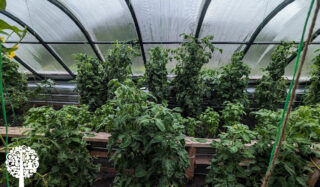
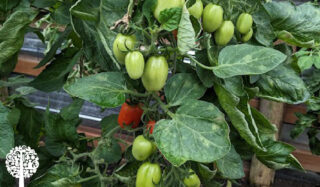
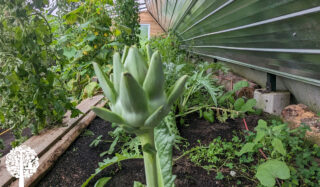
By September, I’d planted 100 experimental tomato plants on the greenhouse floor. With the two ends open, it was a brute of a hoop house with no airflow concerns. The tomatoes grew like savages. I transplanted some artichokes to overwinter and began seeding greens. A ginger plant that had lived in a pot for 12 years was planted inside. A friend asked me to overwinter her fig trees.
Hot House
Once the ends were built in late September, we began to experience the intense heat-up when the sun shone. The thermometers would bounce to 50°C unless we left the door and windows at the ends open. The tomatoes stressed, and the ginger jumped. But, by mid-October, the sun had fallen so low along the horizon that it was only hitting the back bed directly. The nights were cold, and I still had not assembled and installed the blower. These conditions did not make a happy tomato! They packed it in by mid-November, and the green tomatoes came down to the house for ripening.
Low-Tech, High Yield
The plan was to keep the winter growing as low-tech as possible: no heating or grow lights. The ginger, figs and artichokes would have to tough it out. And they did, though the figs were less than impressed.
The idea of passive geothermal is that the air temperature ten feet down maintains a steady state of 15°C. Blowing that air through the tubes should bring up the temperature in the greenhouse when it is -20°C or -30°C outside. They suggested that the slower air movement through the tubes would heat it better, but the airflow was undetectable with the blower on the lower setting. The plan remains to rewire it to medium this winter.
An Early Start
This year, I got started in the greenhouse in March. Deep snow was all around. Despite the overcast spring, cabbage, peas, and kohlrabi seeds sprouted by the beginning of April. The greens that had muscled through the winter were properly thinned. Once the cabbages were up, I felt invincible, so I went on and planted my flowers, including marigolds, sunflowers and calendula. Everything could be planted directly into the beds, then transplanted into pots to establish individual root systems and harden off.
By mid-April, the Mediterranean friends could be seeded: tomatoes, peppers, eggplant, and basil, with cucumbers and luffa representing the cucurbits and okra of the African subcontinent. As I moved the flowers, cabbage, and greens to pots, I moved the heat lovers into their summer homes. I had so much success with the tomato seeds-to-plants that I had a surplus to donate to the local elementary school. Next spring, I will prepare for a neighborhood plant sale.
My biggest first-year greenhouse growing takeaways were:
1. Seed germination times were not earlier in the season but took less time and grew faster.
2. The angle of the winter sun was the biggest impediment to winter growing.
3. Plant fewer plants. A single greenhouse plant will have three or four times the output of a plant living outside in similar conditions. For instance, I planted the cucumbers in regular spacing. I placed the little plants behind two 4-foot-tall slanted trellises. Within a month, they had topped the trellises and had begun to latch onto the training strings of the two nearby tomatoes. In mid-July, one of the groups of cucumber vines collapsed under its weight. The excessive vines had shaded its produce so that the fruit withered and the harvest was greatly reduced.
4. Interplanting is not a winner. Airflow must be respected. It would be cool to grow watermelon and cantaloupe on the floors of the beds (beneath the tomatoes and peppers) to maximize production. But soon, these vines were growing up and over everything, then mildewing, so they had to be added to the compost pile.
It Was Worth It All
Last summer, I spent considerable time wondering why I had dragged my family into such building shenanigans for a bit of veg. This summer, I can hardly imagine growing many things we like to eat without the greenhouse. It will be years before it is more than a happy experiment, but fingers crossed for lemons in 2024!
Let there be light! It’s no secret that plants need sunlight for photosynthesis, which isn’t always evident when growing indoors. With cooler months ahead in many parts of the world, we are turning our plant-loving energy to grow rooms, windowsills, and countertops. Room illumination is critical to the success of a plant, whether it be edible or ornamental. As we transition from the great outdoors to the inside of our homes, offer your plants the best with our 5 Cool Ways To Light Up Your Indoor Growing Space.
Choose Windows Wisely
If you’re fortunate enough to have many windows in your home, select your growing space wisely. Avoid placing plants in windows with large trees or shrubs blocking sunlight from entering. Lisa Eldred Steinkopf, author of Grow In The Dark: How To Choose and Care for Low-Light Houseplants, recommends keeping the direction the window faces in mind as well. Many plants love east windows because they get soft, cool light first thing in the morning. She says African violets, ferns, and begonias will love an east-facing placement. West windows offer high heat levels, so cacti, succulents, and snake plants will thrive there. South-facing windows get the most sun throughout the day, so placing plants with high light needs in front of them is best. North windows are always deprived of direct sunlight, so find another option or offer supplemental lighting if it’s your only window. Don’t forget about skylights! Eldred Steinkopf refers to them as the fifth exposure and says they’re great for growing a wide variety of heat and light-loving plants.
Cleaning Windows
We hate to add more chores to your list, but window cleaning is essential to anyone who loves houseplants or countertop gardens (and a tidy home). Between smog, dirt, rain, your kid’s fingerprints, and the dog’s wet nose, a lot of nastiness builds up on window glass, reducing the light that shines into the house. The fall is an excellent time to give your windows a thorough cleaning, inside and out, especially if moving outdoor plants inside. They’ll need all the light they can get! While at it, wash your screens of all the dust and pollen they’ve collected over the summer. Eldred Steinkopf recommends removing screens in the fall and storing them somewhere throughout the winter. She says screens can block light coming into a home by 30%, even when clean! After you’ve finished cleaning your windows, wipe your plants down too. The dust and pet hair that settles on their leaves means light can’t efficiently reach their cells.
Mirror, Mirror on the Wall
Do you want to admire yourself and make your space feel larger while illuminating your plants (three for one!)? Hang some mirrors! Many of us underestimate how much light mirrors can add to a room. Placing them across from windows allows houseplants or countertop kitchen gardens to feel warmth and access light from every direction, which helps them avoid phototropism. Plants suffering from phototropism lean directly toward the light source, frequently a window. Adding mirrors to the wall space around them will help them grow symmetrically. While we’re on the subject of walls, we’re not a decor magazine, but lighter paint colors have better reflective qualities and can help illuminate your growing space too.
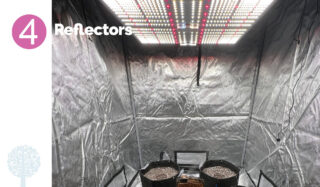
Reflectors
Like hanging mirrors to help reflect light onto your plants, you can also purchase reflectors for your indoor growing needs. Easy to find and affordable, reflectors redirect the light from your source, bouncing it back toward the plants in your space. The result is more intense and concentrated lighting. Reflectors are ideal if you’re growing high-value plant varieties that need a lot of light and warmth, like orchids, tomatoes, or eggplants. Better yet, if needed, you can position the reflectors to concentrate the light on only one or two plants. They work especially well in grow tents and dedicated grow rooms.
LEDs for the Win
If you want to boost your indoor growing game, invest in good-quality LEDs for your space. LED lighting is a top seller in many grow shops because they’re energy-efficient and produce little heat, so they can be placed very close to the plant canopy. They deliver PAR directly to plants and have excellent PPF and PPFD levels. With their long lifespan and the fact that they’re easy to customize according to your plant’s needs, LED lighting is a must for serious growers looking for excellent yields from their indoor garden. Of course, LEDs may not be the best decor choice for your living room. If you have plants with lower lighting needs, placing them under a simple table lamp might give them all the illumination they need to thrive and brighten the room.
Grow Up’s second Victoria trade show received some media coverage, with local mediaspeaking to Grow Up’s Randy Rowe, Marshall Anselmo of Nature’s Gate (a micro on the island), Terra Maibach of cannabis store Violet Wild Cannabis Co, and Paul Dhillon from Adastra. (Oh, and StratCann won Grow Up’s award for Online Cannabis News Source. Thanks to everyone who voted for us!)
The Municipality of Powassan, ON, has finally decided to let cannabis stores operate in its community of 3,200 people. The town council recently voted 4-1 to allow the cannabis outlets into town, a reversal of the 2018 vote when council members voted 3-2 to block their entry.
The OCS launched its educational campaign, Trailblazers, featuring licensed producers and authorized retailers. Trailblazers runs in two flights, beginning in October and again in February 2024, and includes placements across broadcast, social, and digital out-of-home channels.
The first featured Trailblazers are Andrew Ross – Ministry of Sativa, Raju Saini – Piffingtons, Niko Sosiak – Cannara BioTech, and Chris and Marty Johnston – Lune Rise Farms.
‘The locals blame the feds, the feds blame the locals. It’s just kickball, said neighbour Bill Wallace regarding a dispute over the warm smell of colitas at Carmel Cannabis in Ontario.
Canopy completed the previously announced sale of its Hershey Drive facility in Smiths Falls, Ontario, to Hershey Canada Inc., receiving about $53 million in cash.
Politico and other media outlets covered a recent study showing an increase in ER visits related in Canada to cannabis use, which concludes that the launch of products like concentrates and edibles were the main factor. The study correlates an increase in these visits beginning in January 2020, which became legal in October 2019. However, the researchers seem unaware that these products were not widespread until much later.
Tilray’sQ1 2024 financial results showed adjusted gross profits from cannabis sales were over USD$24 million in the three months ending August 31, 2023, down from just under $30 million in the same quarter in 2022.
Tilray says it is #1 in cannabis flower, oils, concentrates and THC Beverages, #2 in pre-rolls, #4 in vape, and in the top 10 in all other categories in Canada.
International
MJBiz reports that Australia’smedical cannabis program has been growing significantly in the last six months. Medical cannabis approvals through an Authorised Prescriber (AP) reached approximately 304,000 in the first half of 2023, up more than 120% over the same period last year when there were 137,000 AP approvals. This is due in part to the increasing number of authorized prescribers.
License defined: permission granted by an authority (as of a government or a business) to do some act or transaction which would be unlawful without such permission.
Onerous occupational licensing laws that force people to undergo thousands of hours of often redundant and gratuitous training to perform jobs like auctioneering, tree trimming, and hair styling. …licensing laws are the result of higher-skilled professionals seeking to protect their market share at the consumers’ expense.
Between 1875 and 1900, conventional medicine began passing license laws that granted national associations, such as The American Medical Association, (AMA), the right to oversee and regulate the practice of medicine, as well as collect heavy license fees. Government agencies, such as the Food & Drug Administration (FDA), do not apply regulations to treatment regimens or practices, only to products.
A cartel is an association of manufacturers or suppliers with the purpose of maintaining prices at a high level and restricting competition.
According to James Thorp, MD, author of a February 2022 study, Patient Betrayal, a medical cartel pushes the false narrative that the experimental COVID-19 therapy is safe and effective in pregnancy. In an April 2023 interview he says, “We have broken all the rules, The American Board of Obstetrics and Gynecology, The American Board of Medical Specialties, The American Board of Internal Medicine, The Federation of State Medical Boards, The American College of OBGYN, The Society for Maternal and Fetal medicine, the AMA…”
We especially, as obstetricians in maternal fetal medicine, have always been guided by that principle and that sacred, longstanding six-millenia golden rule of pregnancy… you never ever use an investigational drug, a new substance and a new drug, a new vaccine even, even if there’s a potential benefit. You don’t ever use a new substance in pregnancy. So we have broken all the rules. I’ve seen significant increases in problems, all types of problems, before pregnancy, extraordinarily abnormal menstrual periods, as well as during miscarriage during pregnancy. A lot of miscarriages in the first part of the pregnancy and fetal losses after 20 weeks. – Dr. James Thorp, April 2023, Shocking and Escalating COVID Vaccine Side Effects in Pregnant Women interview
At the same time, licensed medical doctors, under the direction of the American Medical Association, continue a crusade to criminalize unlicensed holistic practitioners for ‘practicing medicine without a license.’ Similarly, licensed naturopathic practitioners act like their medical counterparts, by enforcing licensure.
licensing laws raise prices for consumers by $1.93 billion each year and result in roughly 31,000 fewer jobs.
How A License Is Like A Vaccine
While licensed doctors agree to government-instituted medical mandates in order to hold a job, they agree to a system that legislates choice. As licensed medicine promotes conformity with a one-size-fits-all solution, humanity risks devolution.
Where a license is used as a shield to protect the medical industry, a vaccine is a shield that provides legal immunity to vaccine makers against lawsuits from vaccine damage.
Where a license replaces inherent rights with acquired rights and privileges, a vaccine usurps innate immunity for acquired immunity.
Where a license reflects a transfer of power from a free market (self-regulation) to a controlled-market (state-regulation), a vaccine reflects a transfer of power from self-healing to disease management.
Where a license is legal permission from an authority (i.e. State government, medical board) to do something that would otherwise be deemed unlawful, a vaccine is legal permission to inject toxins that would otherwise be deemed illegal to ingest.
Where a license is based on the theory of “standard of care,” a vaccine is based on the standard of “The Germ Theory of Disease.”
If vaccines work so well, then what do the vaccinated fear from the unvaccinated?
What Does Licensed Medicine Have To Fear?
Under the scope of the Medical Practice Act, a medical school graduate must first acquire a license before he or she can legally practice and use the title “MD,” “DO, “DC, “physician,” or “doctor.”
The license and board certification can be revoked, and physician subject to harsh disciplinary actions, if the medical board deems a doctor is “spreading misinformation (such as with COVID-19).” In his paper, Dr. James Thorp states:
A term of deception crafted by various cartel entities “misinformation” is used to label anything that would tend to create COVID-19 vaccine hesitancy. In other words, “misinformation” is used to discredit alternative views and seeks to prevent honest and truthful communication with a patient about the experimental gene therapy’s known and very real dangers.
Licensed medicine authorizes a doctor to regulate your body using standard medical protocols and bill you according to standard medical codes.
Licensed medicine means the State may claim ownership of your body. Parents can be blindsided by “medical kidnap” of children if officials determine you to be incompetent.
If the license works so well, what do licensed doctors fear from unlicensed healers?
Holistic Medicine Is Not Licensed Medicine
Holistic practitioners do not attend medical school. They do not practice licensed medicine. They do not prescribe, treat, or diagnose. They do not puncture the skin, and do not cut into the body. They do not suggest medical alternatives. They do not use standard medical protocols or bill using standard medical codes.
Holistic healers work with Nature’s tools such as herbs, sunshine, clean water, real food. They do not treat symptoms with FDA-approved synthetic drugs, but look for the cause and allow the body to heal itself. The holistic healer sees each individual as pure potential and unique in body, mind, and spirit. Individuality over Uniformity.
Both allopathic and holistic medicine are healing modalities on a spectrum of choice. Where allopathic medicine ends, holistic medicine begins. One does not encroach upon the other. One is an apple, the other an orange.
As has been the case since 1900, the practice of licensed medicine co-exists alongside unlicensed medicine because choice exists. One cannot legislate choice for another. As history shows, rulers do not eliminate choice through unjust laws. They only drive it underground.
In a free society, everyone has the right to give advice and the right to choose advice from allopaths, osteopaths, naturopaths, homeopaths, herbalists, and chiropractors.
Right To Be Left Alone
The right of privacy is a Constitutional right that means the right to personal autonomy, or the right to choose whether or not to engage in certain acts or have certain experiences. The right to privacy is written in the First, Third, Fourth, Fifth, Ninth, and Fourteenth Amendments to the Constitution.
The amendments to the Constitution include a general right to be left alone and to be protected from governmental interference. It also includes the freedom of the individual to make fundamental choices involving the individual, his or her family, and relationships with others, except where such choices prove to be harmful to others and possibly oneself.
Unfortunately, an absolute right to choose any “unorthodox” treatment has not always held up in court, with one exception:
[W]e see no reason why a patient should not be allowed to make an informed decision to go outside currently approved medical methods in search of an unconventional treatment. While a patient should be encouraged to exercise care for his own safety, we believe that an informed decision to avoid surgery and conventional chemotherapy is within the patient’s right “to determine what shall be done with his own body.
How to Preserve Choice?
According to a 2020 report, Americans spend $30 billion annually, out-of-pocket, on products and services ranging from nutritional supplements to yoga and chiropractic care. However, this number may be incorrect since it is lower than a 2009 survey, citing $34 billion spent by consumers out-of-pocket.
Why would the mainstream not report updated numbers, especially when a 2019 article states that more people are seeking natural alternatives to medications? Could it be related to a Forbes magazine report from 2019 showing that medical healthcare system waste hit $935 billion a year.
Consumers are not stupid. Support for more traditional medicines goes back to March 2000 when the Journal of Family Practice showed demand for more alternative healing options. Four reasons emerged as the basis for this: 1) Holism (whole person approach), 2) Empowerment, 3) Access, and 4) Legitimization. 1
The ability to heal is inherent. Self-healing is a birthright and thus, requires no license. Using free-will, each individual authorizes any practice over his own body, his private property, through consent or the withdrawal of consent.
People who seek to preserve choice and legitimize holistic medicine must stand up and speak out for that right. Each is responsible for her own body and her own health. When it comes to choice, the only freedom you have is the freedom you defend.
By legislating the choice to heal, do legislators practice medicine without a license?
The National Health Freedom Action is a non-profit organization working to protect choice in your State in order to access natural healing modalities, while also protecting the rights of practitioners, including Naturopathy, Herbalism, Homeopathy, and Ayurveda. Contact them if interested in learning more at www.nationalhealthfreedom.org/nhfa.
1. Barlett, B., L. Marchad, J. Scheder, and D. Applebaum, Bridging the Gap Between Conventional and Alternative Medicine, Journal of Family Practice 49, no. 3 (March 4, 2000): 234-9; available at: https://www.ncbi.nlm.nih.gov/pubmed/10735483 (accessed June 15, 2017).
























Recent Comments