(CNW) Smiths Falls, Ont. — Canopy Growth Corporation reminds its shareholders to vote ahead of the upcoming annual general and special meeting of shareholders to be held on September 25, 2023 at 1:00 pm (Eastern time). The board of directors of Canopy Growth unanimously recommends that the company’s shareholders vote “FOR” all proposals and “FOR” each director nominee.
Shareholders of record as of the close of business on August 3, 2023, and shareholders holding a legal proxy for the meeting, are eligible to vote at the meeting. At the meeting, shareholders are being asked to approve i) the election of directors, ii) the appointment of the auditors and independent registered public accounting firm for the fiscal year ending March 31, 2024 and to authorize the board to fix their remuneration, iii) the adoption of the company’s new equity incentive plan, iv) authorization to amend the articles of the company to consolidate the company’s issued and outstanding common shares, v) an advisory, non-binding vote on the compensation of the company’s named executive officers, and vi) the issuance of shares pursuant to certain outstanding convertible debentures in an amount that is in excess of 19.99 per cent and 25 per cent, as applicable, of the number of shares outstanding on the date of issuance of such debentures in accordance with applicable stock exchange rules, each such proposal as further described in the company’s proxy statement dated August 8, 2023.
Greater details and rationale for each of the proposals can be found in the Proxy Statement filed under the Company’s EDGAR and SEDAR+ profiles, and can also be found on the company’s website at www.canopygrowth.com/investors/investor-events/annual-general-and-special-meeting-2023/. Shareholders should read the proxy statement because it contains important information regarding the proposals.
Solicitation of Proxies
Canopy Growth has engaged Laurel Hill Advisory Group (Laurel Hill) to provide shareholder communication advisory and proxy solicitation services in connection with the solicitation of proxies from the company’s shareholders for the meeting. The company has agreed to pay Laurel Hill an aggregate fee of $35,000 for these services and certain out-of-pocket expenses.
Advertisement
If you have questions or need more information about the meeting, please contact Laurel Hill by telephone at 1-877-452-7184 toll-free in Canada or 416-304-0211 for international calls or by e‑mail at assistance@laurelhill.com.
The company may use Broadridge Financial Solutions Inc.’s QuickVote™ service to assist beneficial Canopy Growth shareholders with voting. Laurel Hill may contact certain beneficial Canopy Growth shareholders who have not objected to the company knowing who they are to conveniently obtain a vote directly over the telephone.
As the cannabis industry continues to progress, either holding fast as a drought-resistant cacti or behaving more like a voracious Venus flytrap, it’s important to celebrate the producers who are adapting to the shifting tides. This past July, Grow Opportunity ventured to wild rose country and toured two very different LPs – OGEN and Distinkt – showcasing the superior cultivation practices they hold in common.
The Calgary-based producers, while friendly competitors, have entirely different strategies spanning grow technique, marketing tactics, staffing and fields of influence. OGEN’s team of leaders, with their scientifically driven backgrounds coupled with their passion for growth, development and the industry at large, informs their culture-forward approach to operations. While Distinkt, now also expanding into psychedelics, prefers more of the legacy ethos when coming to market. Both approaches hold water, so to speak, though one in rock wool and the other in coco.
A cultivation room in bloom at OGEN. Photo: Luke Dickson, brand manager, OGEN
Getting to kn-OGEN
OGEN obtained their cultivation license in 2018 and underwent an expansion phase to increase their operations’ capacity. December 2019, they achieved occupancy and by mid 2020 they expanded their workforce from a dozen to over one hundred individuals, ramping up production and offering specially curated cultivars to the recreational market. Currently, OGEN distributes their products in Alberta, Manitoba, Saskatchewan, Ontario, New Brunswick and Newfoundland, while working to establish presence in provinces in which they are not yet active.
The LP also recently received its extraction license and formed a partnership with Simply Solventless, allowing them to offer a diverse range of products combining craft flower with Solventless’ bubble hash and live rosin. In general, the LP is keen to explore mutually beneficial partnerships catering to quality and consumer taste that is the hallmark of their brand.
Advertisement
The faces behind the flower are led by three passionate individuals who are invested and proficient in their areas of expertise: cultivation manager Justin “JC” Creencia, post cultivation manager Carson Stewart, and irrigation and environmental manager Baker. Joining the OGEN team near the beginning as technicians, these three have grown in their proficiency as leaders of an equally passionate cultivating team now tending the quality of cannabis they grow today.
Having experienced the technician’s highs and lows, the three managers work not only to maintain and increase the quality of OGEN’s flower but to increase the quality of life for their staff – the entire team prides themselves on a rotating phenohunt series within an indoor cultivation space of approximately 55,000 sq ft.
Their delicious, best-selling strain Peach Chauffeur #15 checks a lot of boxes and has been very well received in market. Velvet Apples #12 is another favourite, balancing both flavour and potency. While the guys at OGEN recognize the reality that “you can hurt yourself with too much variety,” says operations manager James Brophy, still the team is always on the lookout for something new with bag appeal.
OGEN also emphasizes smart marketing and a culture-forward approach. The thriving Calgary tourism industry enables the LP to position itself as a must-visit destination for local budtenders, enthusiasts and curious tourists with the goal of ending stigma against both the plant and the industry.
“I don’t think you need to be an expert to get excited about seeing how something is made,” says Luke Dickson, OGEN’s brand manager. “It is a staple part of some vacations to check out local breweries or wineries, like Heineken or Steam Whistle, without having to be a buff. That’s why we offer open tours that can be booked by anyone of legal age in Alberta. It helps to remove stigma and break down the barriers of education,” he says.
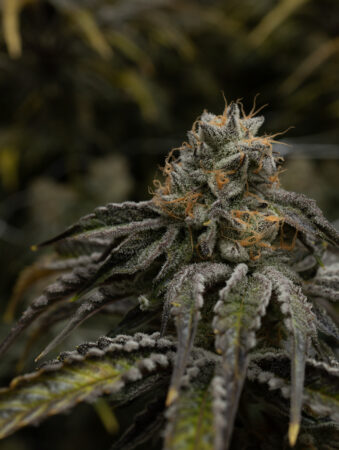
Dosi-GMO #6 cultivar. Photo: Luke Dickson, brand manager
Original techniques
With each province that Grow Opportunity visits, seeking cannabis stories to share nationwide, comes the search for differentiation. Whether it’s Manitoba’s intense UV and cool evenings, the water quality of the Pacific Northwest, Quebec’s affordable electricity or the agricultural fecundity of the Niagara region, each province boasts a unique cultivation quality regardless of whether crops are grown indoors or out.
For Alberta, cannabis growers take full advantage of the region’s drier climate and better humidity control compared to the regions with excess moisture. Post-harvest and drying processes can make or break a crop, so it’s possible that Alberta has a leg up in this department. At their indoor facility, the entire cultivation team takes pride in their work and their approach to testing, experimentation and hands on learning while incorporating lessons learned into their operations and business values.
“It’s so easy to cut corners in a lot of small ways, which leads to quality ultimately being compromised,” says Stewart. “We are always watching to make sure our crops are not dying a death by 1,000 cuts. Each area of production has to hold themselves to an extremely high standard.”
The cultivation process also consists of multiple harvests each week and the careful handling of plants to prevent quality degradation. During harvest, “each plant is carefully chopped, extricated from its neighbours and draped over racks for storage,” says Brophy. Rolling harvested plants down the halls on racks rather than carrying them by hand or dropping them into totes helps mitigate trichome damage. Before, during and after harvest, the sanitation team also plays a vital role at the LP by maintaining a sterile work environment. “They do a great job; this room is spotless when they’re done,” says Brophy. “All of this debris will be gone and that’s something that I think people don’t understand – every piece of plant material has to exit this room – it’s a daunting task when you first look at it. That amount of sanitation really is the cornerstone of everything that we do here.”
The sanitation team also helps during post-harvest in the curing process. Taking only a couple hours in the morning to complete a harvest and sanitize a room, the LP has quickly streamlined operations by employing knowledgeable people with good chemistry. “We’re familiar with how testing and experimentation goes on,” says Brophy. “Our QA has a master of chemistry. They’ve helped run all of those changes and experiments for us to really dial in consistency and quality; that’s the main driver for us.”
Though the managers had no previous cannabis experience, and each began with an entry-level position, they’ve all grown in the same way the company has – through research and hands on experience. “These guys have so much passion that they bring to the table,” says Dickson, “and none of this would have happened if they weren’t like that,” which is a fact that helps bolster the producer’s unique imprint on the Canadian cannabis space.
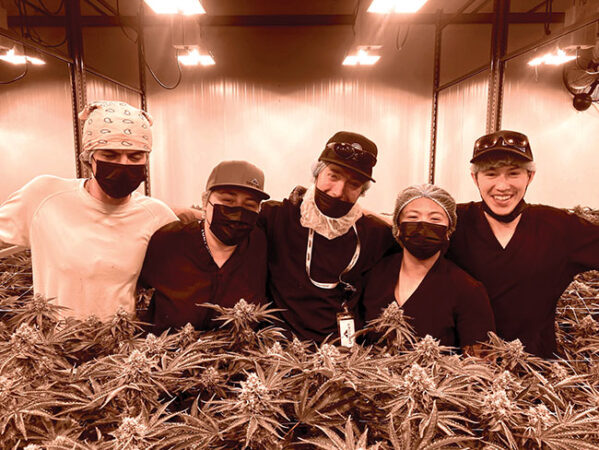
Distinkt Cannabis, left to right: Jacob Mauer, Bailey Osberg, Landon Grams, Joenica Garcia, Jacob D’eath
Demystifying DISTINKT
Mark Corrigan, founder and president of Distinkt Cannabis and previous golf pro founded the company in 2017 and received their production license in early 2021. With a total of 22 employees all who wear many hats, and a second location Distinkt 2 coming online in the coming months, the Calgary-based LP is poised for expansion when the time is right. Having a lean, versatile team “is the way to get through this nightmare price reduction, compression, but at some point, prices will have to go up,” says Corrigan. While the LP is looking to expand into psychedelics, mainly psilocybin production, they heed caution knowing “there’s no reason to be the first one to the party,” says Corrigan, who intends on waiting until he feels the market is viable.
The same is to be said with the live rosin category, though the entire rosin market in Alberta is only valued at $600,000. Distinkt will wait for an increase in consumer demand before exerting further time and resources into rosin production. Currently, the provinces that carry their products include Alberta, Yukon, Saskatchewan, Manitoba and Ontario.
The producer also grows their own phenohunted genetics and some of their own breeding as well. Corrigan sees this production technique as one of the markers for success, because “anything you bring to market, no one else is going to have.”
A tour of the LP revealed primarily the cultivation of Monaco Octane and Lemon Razz – a solid cultivar that continues to come in at 26-30 per cent THC and over three per cent terpenes.
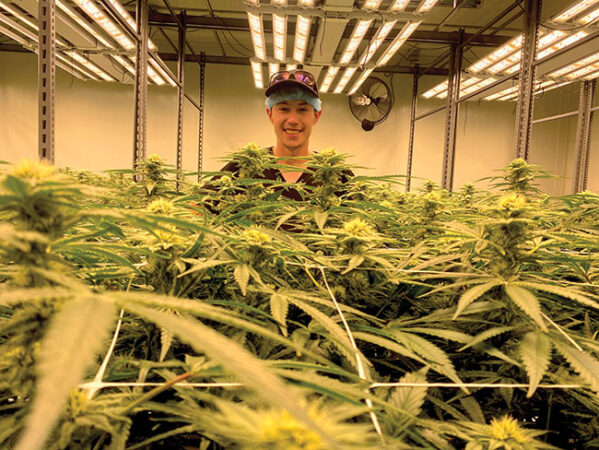
Jacob “JD” D’eath, head of cultivation at Distinkt Cannabis, amidst a room in flower.
DISTINKT cultivation
Head of cultivation, Jacob “JD” D’eath studied cannabis production at Olds College and was previously employed as a grower at OGEN. “Before that I grew black market and before that I worked at a garden centre,” he says. “One day I found a seed in my weed, so I bought a grow light and it snowballed from there.”
Within six grow rooms, D’eath experiments regularly, specifically surrounding defoliation variations and high-stress training of the canopy to increase both yield and quality. In a room of Lemon Razz one week into flower, D’eath demonstrates the training method he’s employed by bending and almost breaking the stem, which stunts the plants and makes the tissue harden up to create a more even canopy.
Corrigan also explains the motive behind the facility’s construction, previously a meat packing plant, by taking “black market sized rooms and growing commercially,” he says. “The biggest room is 850 sq ft – we keep it tight and controllable so we can have consistent product.”
They’re also working with a known breeder called TK, experimenting with different cuts to see about bringing them to market in partnership. “Some people can grow but they don’t have the bandwidth for sales, boards and marketing,” says Corrigan. “TK has a good name in the black market and from a breeding perspective, it’s something we’d look at bringing in.”
The facility uses a semi-automatic fertigation system now with valves that can be opened and closed using apps connected to the teams’ smart phones. Each of the rooms also has its own HVAC system so that if something goes down, it only affects one room.
They’ve been fortunate to keep down pest pressure, “but you know,” says Corrigan, “everyone’s got their own challenges. I think what’s kept us alive is we’re small enough to keep nimble, our operating expenses aren’t crazy, and we still produce consistent product and we continue to tell our story.”
Distinkt 2 is already built out, “and we’ll turn the machine on when we see a larger market,” Corrigan says, leaning into an extraction lab mainly for rosin and additional square footage for the cultivation of psilocybin or other types of fungus or cacti. Distinkt houses a driven team full of proponents of the therapeutic benefits of psychedelic therapy, but still, “we’re not there yet,” he says.
Corrigan looks forward to opening the second facility, located 15 minutes away, that will be EUGMP-certified and seamlessly operated by a crew of 50. Until then, the national company has capitalized off their learning experiences, taking pride in what they’ve so far accomplished. “We’re proud of what we do here,” says Corrigan; “we’re proud of making great products.”
The U.S. Health and Human Services Department recently recommended that the federal government reclassify marijuana as a Schedule III drug. Drugs under this classification are said to have a low-moderate potential for addiction and/or abuse. These drugs can also be acquired through prescription, even though they aren’t generally available over the counter. They include ketamine, products with less than 90 mg of codeine and anabolic steroids.
If the U.S. government heeds this call, there may be significant implications for a range of marijuana-related issues. For instance, marijuana businesses could claim deductions on their federal tax obligations because they wouldn’t be restricted by Section 280E of the IRS, which mainly applies to Schedule I and II substances.
Let’s look at some other issues that may be affected if the federal government proceeds with the rescheduling.
State marijuana laws
Currently, some state laws are aligned with the Controlled Substances Act. A change at the federal level would trigger changes at the state level, especially in relation to medical cannabis.
A number of states, including Oregon and Washington, have also adopted laws that will allow them to enter into agreements to permit cannabis commerce across state lines. However, cross-border trade can only be possible if changes at the federal level are implemented.
Mailing and advertising rules
In the past, the United States Postal Service (USPS) has issued warnings on cannabis mail, with a previously penned letter stating that the Control Substances Act prohibited the placement of any ads on controlled substances in any publications. The USPS also noted that using the mailing system to facilitate the receipt, purchase or distribution of these drugs would constitute a felony.
Marijuana’s reclassification to a lower schedule would remove these obstacles while also making it easier for ads in different media and publications to travel across state lines.
Federal employees
At the moment, federal workers aren’t allowed to use any drugs classified under Schedule I and II. This is based on a decades-old executive order that defines illegal substances as those under the aforementioned schedules.
Marijuana’s rescheduling could lift restrictions on the drug. This isn’t definite, however; some attorneys argue that a company’s internal policies wouldn’t automatically change because of the drug’s reclassification.
Research
Cannabis’ rescheduling would also eliminate most of the barriers that prevent researchers from acquiring and using marijuana for scientific investigation. This would be made even easier by the U.S. Drug Enforcement Agency’s ability to process licenses faster. Currently, procedural hurdles at the agency have greatly hindered studies from progressing.
These are just a few of the changes that could happen if the federal government proceeded with the decision to reschedule marijuana to a lower classification. However, it should be noted that marijuana businesses would still be illegal under federal law, regardless of state laws.
Any easing of the restrictions surrounding the marijuana industry is likely to have a positive effect, and makers of cultivation equipment could see a gradual increase in their sales.
About CNW420
CNW420 spotlights the latest developments in the rapidly evolving cannabis industry through the release of two informative articles each business day. Our concise, informative content serves as a gateway for investors interested in the legalized cannabis sector and provides updates on how regulatory developments may impact financial markets. Articles are released each business day at 4:20 a.m. and 4:20 p.m. Eastern – our tribute to the time synonymous with cannabis culture. If marijuana and the burgeoning industry surrounding it are on your radar, CNW420 is for you! Check back daily to stay up-to-date on the latest milestones in the fast -changing world of cannabis.
To receive SMS alerts from CNW, text CANNABIS to 844-397-5787 (U.S. Mobile Phones Only)
Please see full terms of use and disclaimers on the CannabisNewsWire website applicable to all content provided by CNW, wherever published or re-published: https://www.CannabisNewsWire.com/Disclaimer
From the time of birth, Americans have been inundated (indoctrinated — brainwashed) to believe that they live in a free country, and that the reason for this rests on the notion that the United States was ‘founded’ on the principle of a ‘limited government,’ where the State is greatly restricted in its power. Fiction at this level resides only in the most extreme fantasy, and can only be propagated successfully if the entire population is put into a type of mystical trance where critical thinking is completely absent. This did not occur recently, it has always been the case in every government on earth since the beginning of what is falsely referred to as ‘civilization.’
I should preface my remarks for those who still cling to the ridiculous idea that government can be benevolent, restricted, limited, and that any government document called a constitution, has anything whatsoever to do with rights or freedom. It absolutely does not. The State as a political structure is based on fear, force, terror, and power gain, and nothing else. The idea of freedom is based solely on the premise that no man has any right to rule over any other. All government is in direct contradiction of this premise, and therefore it is the antithesis of liberty, not its creator or protector. Every aspect of the falsely claimed ‘founding,’ was and is a lie in my estimation. This statement will anger most, and what that exposes, is that people’s desires (emotions) outweigh reason and logic, and cause total confusion concerning what are the actual rights of man.
The natural rights of man are inherent; they do not come from the sky or heavens, nor any government, as each and every one of us as an unique individual, is born with a right to live, a right to life. All other rights spring from this clear assumption, regardless of those who believe otherwise, or who claim that man has no rights at all. Because each individual has a right to his life, it stands to reason that he has every right to defend his life. In addition, he has every right to sustain his life, which indicates that he has a right to work, to prosper, to supply his every need, which leads to his right to property, and all the fruits of his labor. Every individual has a right to do whatever is necessary in order to sustain, protect, and continue his life, so long as he does not aggress or infringe on the same rights due all other individuals.
This demands the understanding that there is no such thing as a collective right, which is a government scam used to fool the herd in order to control what are falsely referred to as ‘societies.’ Since every man is an unique individual, there are only groups of individuals, not collective ‘societies.’ This leads to the reality that no one has any right to take the property of one to benefit another or any State. Therefore, there is no right to be fed, housed, or supported, no right to medical or health care, no right for State retirement, no right to basic income, no right to universal defense, no right to universal infrastructure, no right to any ‘welfare’ by the State, and on and on. There are no ‘social’ rights whatsoever, there are no paranormal rights; for if these unfounded mystical rights were to exist, the individual would cease to exist, and no right for any man could then exist. In fact, if any so-called ‘social’ rights exist, it would demand the slavery of all in order to sustain by force and violence the lives of those unwilling to be responsible for themselves. This would negate every right of every man.
This is why any constitution created and drafted by government is absolutely worthless if the actual rights of man are considered. In fact, the very idea of constitutions issued by the State is ludicrous, and based on deception. The single concept alone, that government (The State) can give, define, or protect rights, is asinine, for if the State could do so, it could just as easily take all rights away at its whim, which it has done, regardless of the most idiotic notion that government could ever define human rights in the first place. They are natural, and therefore cannot be questioned. This is little understood by this largely dumbed down and indoctrinated population.
The ruling class, and the State, and all governments, have but one agenda, and that is to rule. In order to rule, the State must seek total power, therefore it will never limit itself, or restrict its own ability to garner control over its ‘claimed’ territory, or that of other states and nations. Pieces of parchment cannot limit government, it can only enhance its ability to fool the people into believing a lie, and therefore letting down their guard in the face of extreme tyranny. The permanent goal of all States, is to gain more power, so eliminating all limits and restrictions on its powers is the ultimate goal. This has always been, and always will be, so if real freedom is sought for the individual, the State can never be allowed to have any power over any individual.
This is why all states in existence are structured as single entities, seen to be populated only by collective hordes, all overseen by a political monopoly. This allows for all to be considered as single units, instead of areas populated by individuals. This is only a recipe for mass control. Towns, cities, counties, states, and nations, are a plot to collectivize all individuals, so that the individual is made impotent, and destroyed in favor of the group. This is simply a control mechanism meant to avoid the power of the individual; this because to accept the individual, is to abandon all government.
This short essay is meant to clarify the basic tenets of real freedom of the individual, as opposed to the evil power of the State. It is based upon the ideas of common sense, logic, reason ethics, morality, and reality. The State has no limits, and could not survive if that were not the case. Since all government is based on force and compliance, it is impossible for the existence of any State to coexist with the individual, his natural rights, and freedom.
Quotes by Ayn Rand:
“A government is the most dangerous threat to man’s rights: it holds a legal monopoly on the use of physical force against legally disarmed victims.”
“The smallest minority on earth is the individual. Those who deny individual rights cannot claim to be defenders of minorities.”
“Freedom (n.): To ask nothing. To expect nothing. To depend on nothing.”
We are fighting a psychological battle, not an intellectual one. Data will help those who start to ask questions, but first there needs to be a seed of doubt. Data will not plant that seed of doubt. Data does not have the power to break the spell.
A frightened mind seeks certainty because certainty feels safe, which is why a frightened mind rejects anything that undermines feeling certain. Facts do not matter to their feelings. People only begin to seek out data after the spell begins to break. Something else must first plant that initial seed of doubt.
Uncertainty is uncomfortable so if it cannot be pushed aside, then and only then will the mind enlist rational thought processes to work through the dilemma to regain a sense of certainty. That is the psychological game we need to play. We need to create the sense of uncertainty that forces our frightened peers to enlist their rational minds. Once doubt sets in, the data will take them the rest of the way.
This first step is fought with symbolism, with herd psychology, and with the courage to bear the cost of speaking out when others will not. Navigating this first step is the focus of this essay because that is where we are falling short.
To plant a seed of doubt, to help people take that first step, it is not what you say that matters so much as being seen to say it, out loud, in public, in a way that allows you to be identified and counted, and being willing to face the music when the world can see what you really think. Doubt is created by breaking the illusion of consensus.
Doubt can also be created when someone’s personal experience doesn’t match the propaganda they’ve been fed. The regime is fighting that part of the battle for us. When someone is injured by a vaccine, sees a loved one trapped in isolation in a nursing home, or is at risk of losing their business to lockdowns, doubt in the narrative begins to creep in.
Doubt creates conflicting emotions that can only be resolved by enlisting the rational mind. Doubt leads the mind to seek out data, not the other way around.
The outcome of this psychological war will determine the world that you, your children, and grandchildren will live in. It is worth reminding ourselves of what is at stake because it is easy to lose sight of the big picture when we are so focused on debunking government lies and fighting vaccine passports, masks, and social distancing restrictions. The courage to make a difference in this psychological war comes from understanding the long game that is being played.
The consequences of this referendum will be with us long after the virus fades away. In this referendum, you don’t get to cast your vote at the polls. Your choice to speak out or stay silent in the face of the naked emperor is your vote. Both options come with terrible risks: the consequences of being bulldozed by the regime if you speak out versus the servile future that is waiting for you if you don’t.
There is no option to sit on the sidelines of this referendum. Yet many will opt for perceived safety of the sidelines out of fear of repercussions. That fear is justified and understandable. The penalties are very real in this game. Those are our two choices. Freedom on one side. Servitude on the other.
Your disapproval of all that is going on is irrelevant unless you say it out loud and take a stand. Visibility. Saying it on social media from behind an anonymous avatar achieves nothing. Letters, petitions, and press releases made by associations do not speak to the subconscious minds of our frightened peers. They will not look at them. These avenues are all in the same realm as data. They will be dismissed until after the spell begins to break. Continued at
When standing in line at a retailer, service facility, bus/train stop, how about initiating friendly conversation? Ask questions to assess their knowledge base.
Ask if they attend local council meetings to know what’s being planned? Are they aware of 15 minute cities? How freedom will be restricted?
Have they heard of the World Economic Forum whose motto states by 2030 you’ll own nothing and be happy?
Are they aware of what’s being taught in schools like SOGI [sexual orientation and gender identity] and what that entails?
How do they feel about mask mandates and the possibility of their return?
In North America: Ask if they know about the coast to coast million march Sept 20.23, which I will post in its own Blog. Perhaps offer the website https://1millionmarch4children.com/where/
If you know someone speaking to local council or nearby council, please attend and invite others to ‘fill’ the room. Visibility is vital. TY!
A proposal to consider the abolition of tax on cannabis for medical purposes did not have a chance to become official party policy at the Conservative Party convention over the weekend.
The proposal would have called on the Conservative Party of Canada to adopt a policy that would “abolish the excise tax on medical cannabis, fostering compassionate patient care and promoting its potential as a ‘Made in Canada’ safer alternative to addictive opioids.”
Policy 1849 had passed the first stage of voting and was then heard as a regional priority from New Brunswick in a breakout session on Friday. However, the proposal did not make it past that stage. Had it passed, it would have had a chance to proceed to the convention floor for a final vote on Saturday, Sept. 9.
Tanner Stewart, who helped bring the proposal forward, says he is disappointed the proposal didn’t make it to the floor, but feels it was still a worthwhile effort to spread awareness of the issue. Stewart is the founder of Stewart Farms, a cannabis producer in St. Stephen, New Brunswick.
“This weekend I stood with two great men, veteran Trapper Cane and MP Scott Ried, at the CPC policy convention in Quebec, and moved the conversation forward on making medical cannabis more affordable for Canadians,” Stewart told StratCann Sunday morning. “We supported a policy to abolish the tax on medical cannabis.”
“While the policy in its current form didn’t make it through, we found lots of support, and moved the needle forward. There is a lot of work to be done in battling 100 years of demonization of one the most safe and useful medicinal drugs on earth.”
MP Scott Reid is a Conservative MP representing Lanark—Frontenac—Kingston in Ontario. He was the only Conservative to vote in support of the Liberal’s legalization bill in 2018. He has said he was punished for crossing the party line on the issue, which the Conservatives had otherwise staunchly opposed.
Trapper Cane, a veteran of the Canadian Armed Forces and director of the St. Croix New Brunswick Progressive Conservative Association, helped bring the policy to the convention as well.
Cane, who served as a paratrooper and was seriously injured in a mid-air collision leading to issues with chronic pain and PTSD and co-founded the Canadian Army Veterans (CAV) Motorcycle Unit, told StratCann last week that without cannabis, he would have never been able to take part in such events.
“It was the medical marijuana that got me out of the dark spots I was in and helped me ignore the pain and to get myself on a motorcycle.”
“Medicine is essential. In my experience as a veteran of the Canadian Armed Forces, I was both crippled physically, and I suffer from post-traumatic stress injury, so marijuana for me is a lifesaver. This is a medicine, and it’s brutally taxed already, and we need to make that go away.”
The Conservative Party’s convention was in Quebec City from September 7-9.
Applying the same tax system for medical and non-medical cannabis products was a recommendation of the federal government’s expert task force on cannabis legalization and regulations.
Featured image via Tanner Stewart. From left, Scott Reid, Tanner Stewart, and Trapper Cane.
The suspicious fires that decimated the cities of Maui on August 8, 2023, and Paradise California on November 8, 2018, turned both cities to ash, as homes and cars burned while trees were left standing.
Over the last century, turning cities to ash has been a pattern to “Build Back Better”(BBB) in many cities such as Oregon, Washington, Tennessee, as well as in Greece, Australia, and Canada. Most often, the fires are blamed on faulty electric transmission lines, or on humans. However, evidence points to directed energy laser weaponry that has been publicly used for at least 50 years. A 1966 federal report outlines a national program in weather modification.
It was so hot that even metal contorted. – Gov. Josh Green, August 14, 2023 CBS Morning News with Tony Dokoupil.
Brigitte Werner from Pixabay” width=”437″ height=”246″>
While some newspapers speculated on foul play, others blamed a kitchen fire. The Oregon Insurance Rating Bureau report ruled the cause as “inconclusive.”
There is no doubt that a great many bodies were consumed in this way and, therefore, no record of their deaths obtainable. The only official records of death by the quake were based on the number of bodies that passed through the coroner’s hands. – Arthur C. Poore
The Great Medieval London Fire of 1212 occurred in London. No one is ever certain how many people are killed.
In 2019, Rosa Koire stated that the movement of people away from single-family homes, into 15-minute Stack-N-Pack housing in Smart Cities, is part of a United Nations (U.N.) 2030 agenda so people can be better monitored. Planning to create new space began long ago.
ChristelleLM from Pixabay” width=”247″ height=”438″>
Under the U.N. Sustainable Development Goals (SDGs), U.N. “Sustainable Cities and Human Settlements” are established to create “transportation corridors” to relocate people into concentrated city centers. In Hawaii, the BBB created the Build Beyond Barriers Working Group established to streamline housing construction projects, scheduled for a 5-year build-out based on the U.N. Sustainable Cities and human Settlements. No more private property ownership for people.
This is going to be a multi-year recovery. It’s going to take essentially years to rebuild Lahaina which was destroyed. But we will build it back better……We will find a way to make sure there is more housing…” – KTIV interview August 11, 2023, [See 5:11 minute mark]
In my 2019 article Operation Regionalization of America, the regionalization of any area happens under an agenda of: 1) climate control, 2) 5G technology, and 3) the Healthy People 2020 Act. The overall goal is to connect continents for cohesion under global law. Undersea tunnels are the core of the interhemispheric North America – Eurasia railroad project that would connect China and Russia to the US through Alaska and Canada. This global connection is promoted for tourism, but has other obvious goals, not officially disclosed.
Land Grab to SMART™ City
After any declared disaster and under “Emergency rules” the suspension of laws allows for the U.N. and W.E.F. to regionalize nations as part of a massive land grab. People are forced to evacuate and give up their homes to the state via eminent domain. This happened during the Kincaide fire in Sonoma County, California in October 2019 when 200,000 people were forced to leave. Soon after, insurance companies dropped coverage, for 350,000 Californians.
three vice presidents are responsible for deciding whether the power goes out to keep electrical lines from igniting blazes: Michael Lewis, senior vice president of electric operations; Sumeet Singh, vice president of asset and risk management; and Ahmad Ababneh, vice president of electric operations on major projects and programs. Two more vice presidents will join the bunch in 2020.
In Maui, three weeks before the August 8th Maui fires, on July 18 2023, Governor Green issued a controversial Emergency Housing Proclamation titled, “Emergency Proclamation relating to Housing” related to natural disasters, or Covid. The proclamation not only suspended the laws of Hawaii that gave the Governor broad powers over any emergency, but also removed barriers to building new homes. After the August 8, 2023 fires, the governor said:
I’m already thinking about ways for the state to acquire that land so that we can put it into Workforce Housing and to put it back into the families or to make it open spaces in perpetuity as a memorial. – Gov. Josh Green, Maui Hawaii, Source The Healthy American Peggy Hall: Green Wants State to Own Lahaina, August 15, 2023,
Why blame Climate Change only on human behavior with the evidence of climate manipulation? Has government overplayed its hand?
Was government created in 1776 to destroy itself according to the immortal bird, the Phoenix? The Phoenix is a legendary bird that lives 500 years, is ignited by the sun, and rises out of the ashes to begin anew. Why has the story of the Phoenix endured for 7000 years?
Where will the next weaponized fire be ignited?
What will the new restrictions on freedom look like?
How long will the Maui moratorium on property and land last? Has the Governor found a way “to acquire the land” and build back better? What does “better” mean? Is Maui a beta test for the remaining nations?
Do you want to plant some tulips for the spring but have no garden space? Just plant them in containers! We’ll guide you through the process for beautiful pops of color on the patio next spring.
Plant Wide and Deep
Ensure the container you choose has suitable drainage holes in the bottom. The width of the container will determine how many bulbs it will hold. Larger bulbs, such as daffodils and tulips, must be planted at least 10-15cm apart. Choosing a container that is 32-35cm in diameter will hold between seven and ten evenly-spaced tulip or daffodil bulbs.
Depth is more important than diameter. The container should be deep enough to hold at least 10cm of soil on the bottom, double the bulb’s height, and at least 10-15cm of potting soil to cover the bulb once planted. Bulbs like tulips, daffodils, and alliums need at least this amount of earth to insulate them from the cold in the winter. Smaller bulbs like grape hyacinth or crocus will only need half that amount – so smaller and shallower containers are fine.
Planting Medium
A good, well-draining potting mix is all you need. Mixing regular garden soil with compost will help the earth stay porous and retain water during winter cold snaps that can dry out containers. Adding bone meal will also offer a nutritional boost and help roots develop in late fall and early winter.
Shelter and Water Regularly
It is easy to forget about your bulbs after you plant them in the ground. Bulbs in containers, though, need a little TLC during cold winter months. I usually keep the containers under cover so they don’t become waterlogged and cause the bulbs to rot. Under the eaves on the patio or by the front door are all great places to store your bulb containers.
It’s also important to remember to water the pots regularly. In the ground, bulbs soak up the moisture from rain and snow. In a container, however, they rely on you. A good watering once every two weeks is all they need to get them through the winter.
Be Creative
Planting bulbs in containers is not only easy, but it can be a great exercise in creativity. Mix and match your selections. Consider planting yellow daffodils on one half of the container and crocus in a mass on the other side. The daffodils will keep the container colorful as the crocus starts to fade. Consider adding some purple grape hyacinth bulbs to a container of pink tulips.
As long as you follow a few simple tricks, planting bulbs in containers is a fun and easy way to add another layer of spring color to the garden.
In other cannabis news in Canada and around the world…
On Friday morning, demonstrators gathered outside the Manitoba Legislative Building to protest the provincial law banning home cultivation of cannabis, organized by Jesse Lavoie and Toba Grown. The rally preceded a hearing at the Winnipeg courthouse where final arguments were heard in a lawsuit arguing Manitobans’ right to home-grown cannabis.
“We are confident that the Court will understand that Manitoba’s prohibition is actually criminal law in nature because it allows for significant penalties such as imprisonment for up to one year, whereas Quebec’s law imposes only a very small fine,” said Kirk Tousaw, one of TobaGrown’s lawyer’s, in a press release.
“This law was unconstitutional when it was drafted, and it is unconstitutional now given the significant differences between the law as written in Quebec and the law as written in Manitoba,” said Jack Lloyd, another of TobaGrown’s lawyers. “It is clear the Murray-Hall (Quebec) decision does not bind the Manitoba courts given the significant differences between the two laws.”
The cross-sectional study says that, initially, legalization was not associated with increased cannabis involvement during traffic injury emergency department visits, but “market commercialization” from March 2020–December 2021 was.
A “cannabis-involved” incident is one that cannabis is associated with but is not necessarily the cause of the incident. However, cannabis-involved traffic injury ED visits were, on average, far more severe than injury ED visits not involving cannabis, with higher rates of hospital and ICU admission. Almost half of the cannabis-involved traffic injury ED visits also had documented alcohol involvement. Cannabis-involved traffic injury ED visits increased while alcohol-involved traffic injury ED visits decreased over time during the study.
Another new study looks at blood and urinary metal levels among cannabis users, finding lead and cadmium in their bodies. In this representative study, researchers found higher levels of cadmium and lead in blood and urine among participants reporting exclusive cannabis use when compared with participants who used neither cannabis or tobacco.
According to Statistics Canada, alcohol sales are dropping in Canada, while cannabis sales are up, writes Sylvain Charlebois. This raises questions about whether Canadians are substituting alcohol with cannabis, the author says.
Hub International Limited (Hub), a global insurance brokerage and financial services firm, announced that it has acquiredGJJK Inc. GJJK is located in Mississauga, ON and provides commercial and personal insurance to clients and specializes in the cannabis industry.
A Canadian psychotropics company, Lucy Scientific, is acquiring the American cannabis media brand High Times’ intellectual property. Also included in this deal are existing licensing agreements for the brand High Times and the Cannabis Cup. The deal involves share transfers and semi-annual payments for the next five years. High Times was founded in 1977.
Aurora Cannabis announced the launch of Honour, a new cannabis cultivar designed “for veterans, by veterans,” and the second offering from Aurora’s Strain for Heroes portfolio. Five percent of net profits from the sale of Strain for Heroes products will be used to support veteran organizations across Canada. Honour is available under the MedReleaf brand and was developed in Aurora’s Comox facility (Occo).
Aurora also announced that it is expanding its hemp-derived CBD portfolio into Brazil. In partnership with Herbarium, a Brazilian company in herbal medicine, Aurora will launch the company’s full-spectrum, single-source 3 percent CBD oil under the Herbarium brand, available under the direction of medical doctors. The CBD oil is produced at Aurora’s production facility in Uruguay.
Heritage Cannabis announced that products from its Pura Vida brand have been approved for listing by Société québécoise du cannabis (SQDC) for retail and online distribution in the province. “When it comes to sales, Québec is the fourth largest market in Canada, and this was an important market for us to directly address,” said David Schwede, CEO of Heritage.
Ghost Drops announced a strategic partnership with Tokyo Smoke. Twenty selected Tokyo Smoke stores across Ontario will feature Ghost Drops-branded installations featuring Ghost Drops products and merchandise.
The press release also says that Ghost Drops launched several products on the Ontario Cannabis Store’s (OCS) Flow-Through platform late last year, allowing the brand to offer new strains each week.
A report from MJBiz shows that Australia and Israel were the largest markets for medical cannabis exports from Canada in 2022. In the April 2022–March 2023 fiscal year, Canada’s exports of medical marijuana flower were 59,986 kg, a 48 percent increase over 2021’s 40,640 kg.
Nearly 80 percent (47,332 kg) went to Australia and Israel. According to Health Canada data, Germany was third, accounting for 9,560 kilograms, or approximately 16% of the total.
The data also highlights that while exports are a current hot topic, they are still only a small portion of the total market. At the end of the 2022 fiscal year, Canada had nearly 1.3 million kilograms of cannabis in unpackaged inventory and another 92,590 kg in packaged inventory with licensed producers. Distributors and retailers had another 55,935 kg of cannabis in inventory. Overseas markets are also not likely to rely on Canada for imports long-term, as the countries develop their own domestic supply.
International
The Conversation ran an interesting article on cannabis legalization and policy in the Australian Capital Territory, including a study that explores the experiences of cannabis growers in the ACT and the limitations of home grow rules. “Our research provides important lessons for policymakers across the nation who are considering whether to allow home-growing as a legal source of cannabis supply,” writes the author.
Police in Taiwan say they have arrested a Canadian national for growing cannabis, seizing four plants and 472 grams of dried cannabis. The individual, identified only by his surname, Chen (陳), arrived in Taiwan earlier this year to work as a foreign language teacher.
Break it and burning and bury it alive, nobody needs to tell us what is real and what is not. All can be discovered through our own intelligent explorations once we choose to become ‘Auto-Didactic’. Teach yourself for no one else but you knows what’s best for you and how to see what is true and what is for fools that follow others.










 Brigitte Werner from Pixabay” width=”437″ height=”246″>
 ChristelleLM from Pixabay” width=”247″ height=”438″>











Recent Comments