Nevada authorities are still granting more licenses for consumption lounges, with the state’s marijuana compliance board (CCB) recently giving the green light to six additional conditional licenses for various marijuana businesses, including TGIG LLC; NevadaPure LLC; Higher* Archy LLC; Desert Evolution LLC; Green Thumb Industries (GTI); and Curaleaf Holdings.
Curaleaf Holdings, a global cannabis giant, obtained one license for Tryke Companies, its subsidiary that runs Reef Dispensaries. GTI, another significant player in the multistate marijuana sector, also secured a license for Integral Associates, its subsidiary, with intentions to open a club on the Strip.
The CCB stated in June last year that it intended to establish new rules for regulating consumption lounges, aiming to promote greater inclusivity within Nevada’s marijuana sector. Back then, the agency stated that it planned to grant up to 65 permits, most of which would be linked to already-operating dispensaries and the remaining portion to independent lounges.
The board announced 20 potential candidates for the licenses granted in October 2022. In June 2023, the CCB first issued three conditional licenses to the Venue@Sol Cannabis, Planet 13 Holdings and Cheyenne Medical Sammy Davis dba, which operates as Thrive Cannabis Marketplace. LA Lounge received a license as the first lounge independent from a dispensary in July, and in August, three additional licenses were issued to KV Group, Global Harmony and Deep Roots Harvest.
There are currently 15 conditional licenses that have been approved. After being authorized, licensees have a year to fulfill all regulatory criteria and make the necessary modifications to start operating. Mitch Britten, CEO of Thrive Cannabis Marketplace, expressed excitement in September about commencing work on their new opening on the Strip, terming it a significant milestone for their business.
Planet 13 Holdings also unveiled its plans for a consumption lounge named DAZED! at the beginning of this month. The lounge, adorned with unique features such as VIP booths for marijuana-infused cocktails and “bong chandeliers,” will offer 3,000 square feet of space for food sales, entertainment and consumption. Larry Scheffler, the company’s co-CEO, expressed enthusiasm, envisioning their lounge as a destination that outshines typical Vegas experiences. They aim to open the venue by mid-April next year, capturing the attention of marijuana novices, enthusiasts, tourists and locals alike.
Many licensees of consumption lounges had originally planned to open for business by summer, but they encountered several setbacks. It is anticipated that the lounges will draw a large number of tourists, supporting the Nevada cannabis business, given that Las Vegas alone had more than 38 million visitors in 2022. Additionally, the state’s cannabis sector is expanding thanks to the entry of well-known individuals such as artist Future into the market with his cannabis line, Evol by Future.
Conversely, the establishment of lounges is not advancing as quickly in other states. In California, Governor Gavin Newsom vetoed AB 374, a bill that would have legalized marijuana cafes similar to those in Amsterdam.
The aim of the bill, which Assemblymember Matt Haney introduced early this year, was to allow lounges to sell prepackaged, noninfused food and beverages. Newsom cited concerns about the existing California laws that mandate a smoke-free workplace for workers, stressing the importance of worker health and safety. Haney expressed his intentions to collaborate with the governor’s office and labor leaders to address these concerns and reintroduce the bill in the future.
As more states begin licensing consumption lounges for cannabis, the market for ancillary product and service providers such as Industrial Innovative Properties Inc. (NYSE: IIPR) could widen in those jurisdictions.
About CNW420
CNW420 spotlights the latest developments in the rapidly evolving cannabis industry through the release of two informative articles each business day. Our concise, informative content serves as a gateway for investors interested in the legalized cannabis sector and provides updates on how regulatory developments may impact financial markets. Articles are released each business day at 4:20 a.m. and 4:20 p.m. Eastern – our tribute to the time synonymous with cannabis culture. If marijuana and the burgeoning industry surrounding it are on your radar, CNW420 is for you! Check back daily to stay up-to-date on the latest milestones in the fast -changing world of cannabis.
To receive SMS alerts from CNW, text CANNABIS to 888-902-4192 (U.S. Mobile Phones Only)
Please see full terms of use and disclaimers on the CannabisNewsWire website applicable to all content provided by CNW, wherever published or re-published: https://www.CannabisNewsWire.com/Disclaimer
Multiple marijuana multistate operators (MSOs) are elevating their stock listings in Canada to higher-tier exchanges, setting a trend that more are likely to follow. However, their main objective appears to be listing on U.S. exchanges such as the NASDAQ or the New York Stock Exchange (NYSE).
The shift involves MSOs moving from the lower Canadian Securities Exchange (CSE) to the Cboe Canada Exchange or the Toronto Stock Exchange (TSX). This transition holds potential advantages, including increased liquidity and trading volume, access to institutional investments, and meeting stricter listing requirements, aligning these companies closer to conditions necessary for listing on the NYSE or Nasdaq.
Matt Karnes, founder of GreenWave Advisors, a New-York-based marijuana investment research company, states that the move to uplist is a preparatory step for these companies to position themselves better for a potential transition when federal policies, such as legalization, allow U.S. exchange listings for plant-touching companies.
The shift from the CSE to larger exchanges has provided these MSOs with increased access to a broader investor base, solving issues related to institutional investment and enhancing trading volume. TerrAscend’s executive chair Jason Wild noted the company’s increased trading volume and access to institutional investors since joining the TSX.
According to Darren Weiss, president of Verano, while listing on a more senior Canadian exchange offers the advantage of quicker access to U.S. equity markets when federal policy changes occur, it is still not on par with major U.S. exchanges such as the NASDAQ.
The primary obstacle for plant-touching cannabis companies listing on major U.S. exchanges like the NYSE or NASDAQ is the federal illegality of marijuana. However, some creative corporate restructuring, as demonstrated by Canopy Growth Corp.’s creation of Canopy USA, has allowed for a workaround to list on the TSX. TerrAscend also engaged in similar restructuring to meet TSX listing requirements, while Verano found a more straightforward path via Cboe Canada without needing significant restructuring.
The increasing trend of MSO uplisting in Canada is likely to continue, according to Karnes, unless U.S. regulatory or legislative reform permits domestic stock listings for plant-touching cannabis companies. That would allow these companies to bypass the Canadian exchanges and list directly on U.S. exchanges. However, the timing and likelihood of such reforms remain uncertain.
About CNW420
CNW420 spotlights the latest developments in the rapidly evolving cannabis industry through the release of two informative articles each business day. Our concise, informative content serves as a gateway for investors interested in the legalized cannabis sector and provides updates on how regulatory developments may impact financial markets. Articles are released each business day at 4:20 a.m. and 4:20 p.m. Eastern – our tribute to the time synonymous with cannabis culture. If marijuana and the burgeoning industry surrounding it are on your radar, CNW420 is for you! Check back daily to stay up-to-date on the latest milestones in the fast -changing world of cannabis.
To receive SMS alerts from CNW, text CANNABIS to 888-902-4192 (U.S. Mobile Phones Only)
Please see full terms of use and disclaimers on the CannabisNewsWire website applicable to all content provided by CNW, wherever published or re-published: https://www.CannabisNewsWire.com/Disclaimer
This article offers a comprehensive analysis across nine provinces and two territories exploring average whole-flower product prices.
The data covers January 2021 to November 2023 and was obtained from publicly accessible listings on both private and provincial websites. This analysis is intended to provide stakeholders and consumers with current market price averages.
Scope
Provinces and territories under consideration are Alberta, British Columbia, Manitoba, Newfoundland, Nunavut Territory, Ontario, Saskatchewan, Yukon Territory, New Brunswick, Nova Scotia, and Prince Edward Island. All prices are in Canadian dollars (CAD). Please note that sales taxes are not included in these prices.
Prices are displayed as an average and separated into main package sizes. The package sizes under consideration are 1 gram, 3.5 grams (often referred to as an eighth or as a half quarter, which refers to the fraction of an ounce 3.5 grams approximates), 7 grams (a quarter ounce), 14 grams (a half ounce), and 28 grams (an ounce).
Price Averages
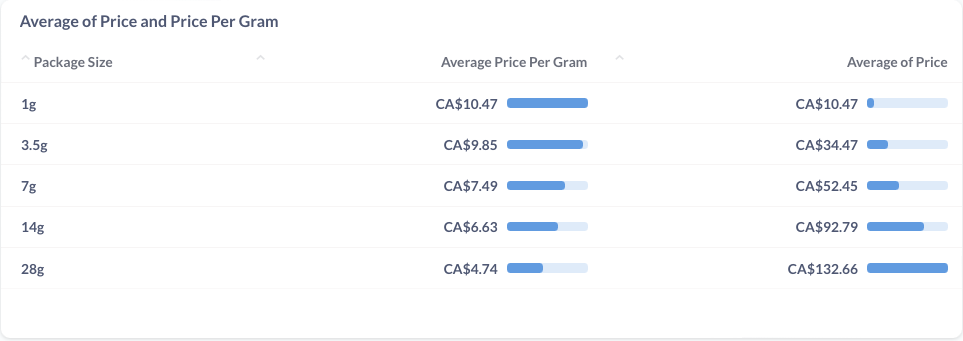
This section examines the static average retail prices of whole-flower cannabis sales by package size. The date range is from January 2021 to October 2023 inclusive. The averages from this time range vary from $10.47 for the 1-gram package size to $132.66 for a 28 gram (1 ounce) package.
Figure 1 – Static averages for price and price per gram spanning January 2021 to October 2023
The average price per gram of whole-flower cannabis decreases as the package size increases. The difference between a 1 gram package at $10.47 per gram and a 3.5 gram package at $9.85 per gram is $0.62 per gram, or a 5.92% decrease. Between a 3.5 gram package at $9.85 per gram and a 7 gram package at $7.49 per gram, we have the most significant decrease of the set in absolute dollar amounts at $2.36, representing a discount of 23.90%. Between the quarter-ounce and half-ounce package sizes with prices per gram of $7.49 and $6.63, respectively, we have a difference of $0.86, which represents an 11.48% decrease in price. Finally, between a 14 gram package at $6.63 per gram and a full-ounce package at $4.74 per gram, we have a difference of $1.89, representing a discount of 28.5%, the most significant percent decrease between tiers in this set.
Finally, if we compare the average price per gram of 1 gram packages at $10.47 to the average price per gram of 28 gram packages at $4.74, then the difference in average price is $5.73 or a discount of 54.71%.
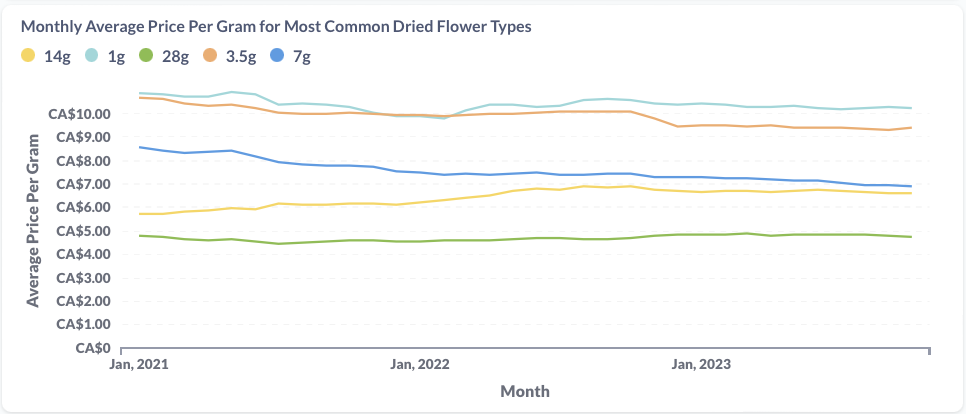
Monthly Price Per Gram Trends
Figure 2 – Monthly price for 1 gram, 3.5 gram, 7 gram, 14 gram, and 28 gram packages
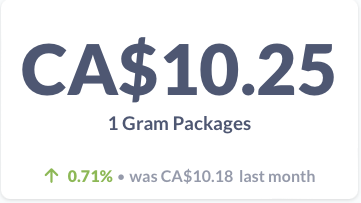
One Gram Packages
In November 2023, the average price for a 1-gram package was $10.25, up $0.07, or an increase of approximately 0.71% from September’s average of $10.18.
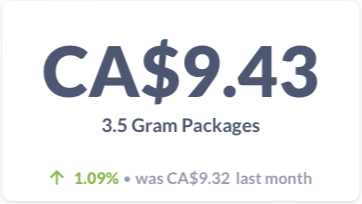
Eighths
For a 3.5 gram package in November 2023, the average price per gram was $9.43, a decrease of approximately 1.09% or $0.11 from the average price of $9.32 in September 2023.
Quarter Ounces
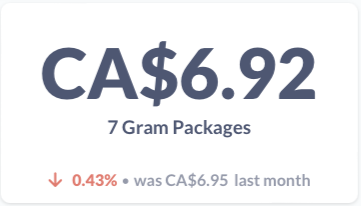
The average price per gram for a 7 gram package in November 2023 was $6.92, down from the September average of $6.95 by $0.03, marking a decrease of 0.43 percent.
Half Ounces
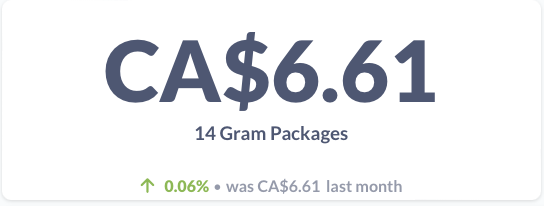
For a half-ounce package, the average price in November 2023 was $6.61 per gram, a decrease of 0.06% from the September price per gram for this package size of $6.61, representing a downward change of $0.00.
Ounces
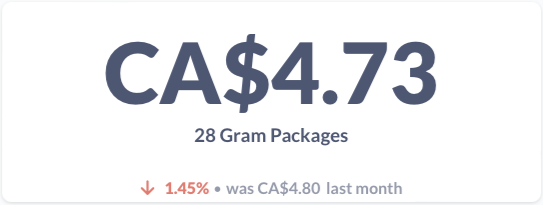
The November 2023 average price per gram for an ounce package was $4.73, representing a decrease of 1.45% or $0.07 from September 2023’s average of $4.80.
Brand Level Price Averages
Now let’s take a look at the maximum and minimum average prices per gram at a brand level.
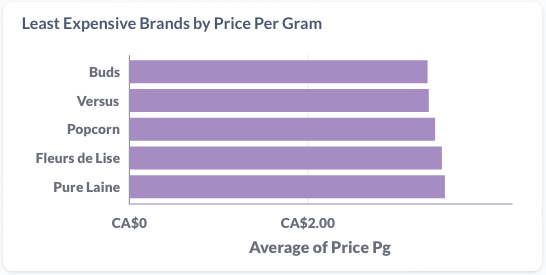
Beginning with the least expensive brands across all package sizes in October 2023, we have Big Bag O’ Buds at $3.34 per gram, followed by Versus at $3.35 per gram. Next, we have Popcorn with an average price per gram of $3.42, Fleurs de Lise at $3.50 per gram, and Pure Laine at $3.53 per gram. Of note, from floor to ceiling of the bottom five in price per gram, the difference is a mere $0.19.
Figure 3 – Least expensive brands by price per gram for October 2023
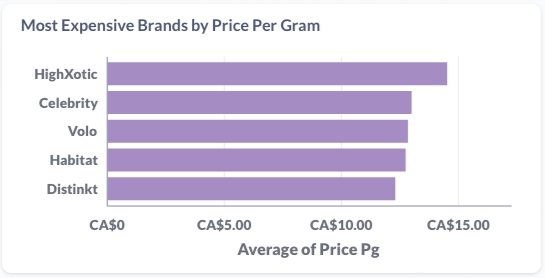
Finally, we examine the most expensive price-per-gram brands across all package sizes. Here we proceed from the least to most expensive, starting with Distinkt, which was listed with an average price per gram of $12.30, followed by Habitat at $12.74 per gram average, third most expensive from our research is Volo at an average price per gram of $12.84, then Celebrity at $13.00 per gram, and finally HighXotic with an average price per gram of $14.52.
Figure 4 – Most expensive brands by price per gram for October 2023
This report is available in full on CannStandard.ca. Sign up for a free trial for a live filterable version.
The United States Department of Veteran Affairs (VA) has expressed that it is willing to consider the use of psychedelics in post-traumatic stress disorder (PTSD) treatment. In a statement issued to KDKA-TV Investigates, the agency said that it is open to the use of hallucinogenics to treat PTSD and noted that it is “committed to safely exploring” all paths that benefit U.S. military veterans.
Psychedelics have attracted a lot of attention in recent years due to claims of their medical efficacy, especially against mental-health conditions. A growing body of scientific literature has found that psychedelics such as MDMA and psilocybin (magic mushrooms) have the potential to treat debilitating mental disorders, including PTSD and treatment-resistant depression, which tend to affect veterans.
When paired with psychotherapy, psychedelics have been found to deliver potent long-term benefits with minimal side effects after just a few doses. Most of this research is still in its infancy. Still, the findings have been so encouraging that policymakers and major companies are looking into the possibility of legalizing and developing psychedelic-based treatments for the masses.
These studies coupled with anecdotal accounts from people who used psychedelics outside of the clinical trial system have significantly increased public interest in the drug, particularly among people who failed to respond to conventional mental health treatments.
Military veteran John Lewandowski is one of the many veterans who have used psychedelics as an alternative mental-health treatment with great success. Lewandowski came back from Afghanistan with a traumatic brain injury (TBI), a drinking problem and horrific memories that pushed him deeper into isolation and addiction. After rounds of pharmaceuticals and talk therapy failed to give him any relief, the veteran turned to psilocybin, the hallucinogenic agent in magic mushrooms, and finally found peace.
Navy vet and local Congressman Chris Deluzio is supporting a bipartisan measure that would facilitate the research of various psychedelics in PTSD treatment, a move that would make psychedelic-based therapies much more accessible to veterans such as Lewandowski. Deluzio is also a member of the House Veterans Affairs and Armed Services Committees, and he is calling for VA officials to attend an impending hearing to discuss a way forward.
The VA also notes that it is committed to exploring substances such as psychedelics that could help the nation’s 15 million-plus veterans. Still, the agency cautions veterans against self-medicating psychedelics and potentially harming themselves, a sentiment held by Deluzio as well.
But with federal approval likely years away, veterans such as Lewandowski who benefited from psychedelics say they will continue self-medicating. Hopefully, startups such as Compass Pathways PLC. (NASDAQ: CMPS) can bring approved psychedelic formulations onto the market quickly so that patients can access these treatments legally instead of taking the unknown risks associated with self-medication.
About PsychedelicNewsWire
PsychedelicNewsWire (“PNW”) is a specialized communications platform with a focus on all aspects of psychedelics and the latest developments and advances in the psychedelics sector. It is one of 60+ brands within the Dynamic Brand Portfolio @ IBN that delivers: (1) access to a vast network of wire solutions via InvestorWire to efficiently and effectively reach a myriad of target markets, demographics and diverse industries; (2) article and editorial syndication to 5,000+ outlets; (3) enhanced press release enhancement to ensure maximum impact; (4) social media distribution via IBN to millions of social media followers; and (5) a full array of tailored corporate communications solutions. With broad reach and a seasoned team of contributing journalists and writers, PNW is uniquely positioned to best serve private and public companies that want to reach a wide audience of investors, influencers, consumers, journalists and the general public. By cutting through the overload of information in today’s market, PNW brings its clients unparalleled recognition and brand awareness. PNW is where breaking news, insightful content and actionable information converge.
To receive SMS alerts from PsychedelicNewsWire, text “Groovy” to 888-902-4192 (U.S. Mobile Phones Only)
Please see full terms of use and disclaimers on the PsychedelicNewsWire website applicable to all content provided by PNW, wherever published or re-published: https://www.PsychedelicNewsWire.com/Disclaimer
(CNW) Calgary — SNDL Inc. reported its financial and operational results for the third quarter ended September 30, 2023. Unless otherwise indicated, all financial information in this press release is reported in millions of Canadian dollars.
THIRD QUARTER 2023 FINANCIAL AND OPERATIONAL HIGHLIGHTS
Net cash provided by operating activities of $27.5 million in the third quarter of 2023, compared to $8.6 million in the third quarter of 2022.
Positive free cash flow1 of $16.5 million in the third quarter of 2023, compared to negative $67.1 million in the third quarter of 2022.
As of September 30, 2023, SNDL’s unrestricted cash stood at $202.0 million, up from $185.5 million on June 30, 2023. This 8.9 per cent sequential increase can be attributed to effective cash-generating initiatives and operational efficiencies implemented throughout the quarter, particularly in working capital.
Net revenue for the third quarter of 2023 of $237.6 million, compared to $230.5 million in the third quarter of 2022, an increase of 3.1 per cent.
Liquor Retail: Net revenue of $151.8 million for the third quarter of 2023, showing stable revenue compared to the same quarter in the prior year.
Cannabis Retail: Net revenue of $75.5 million for the third quarter of 2023, an increase of 14.1 per cent compared to the same quarter of the prior year.
Cannabis Operations: Net revenue of $21.0 million for the third quarter of 2023, an increase of 77.4 per cent compared to the same quarter of the prior year.
Gross margin of $48.6 million in the third quarter of 2023, compared to $50.3 million in the third quarter of 2022, a 3.4 per cent decrease driven by non-cash inventory impairments.
Net loss of $21.8 million for the third quarter of 2023, compared to a loss of $98.8 million in the third quarter of 2022, an improvement of 77.9 per cent mainly driven by asset impairments recorded in 2022.
Adjusted EBITDA of $16.1 million for the third quarter of 2023, compared to $18.3 million from the third quarter of 2022.
SNDL currently has five credit investments in the SunStream portfolio following the monetization of one credit exposure in the third quarter of 2023.
“SNDL’s positive net cash from operating activities and first quarter of free cash flow generation marks a pivotal milestone, reflecting our team’s commitment to operational and financial excellence.” — Zach George, CEO, SNDL
“We are intent on realizing SNDL’s potential for improved profitability, material growth and greater efficiencies across all of our segments. We recently commenced our Liquor Retail data program and continue to see margin improvements in our Cannabis Retail network. In addition, we have rationalized our facility footprint and are moving aggressively into procurement to drive improved results in our Cannabis Operations segment. As previously disclosed, we are in the advanced stages of restructuring key U.S. credit exposures in a manner compliant with U.S. laws. Our commitment to delight consumers remains steadfast as we work to deliver cost-effective, high-quality products and exceptional retail experiences. While we have made significant progress and recognize our achievements, our goals are a far climb from where we stand today. Our industry-leading balance sheet and improved operations enable us to avoid short-term thinking in order to build the foundations of a business that we believe will create sustainable shareholder value through strong free cash flow generation.”
By Michelle Gamage, Local Journalism Initiative Reporter
THE TYEE
Vancouver — Before a police raid shut down a compassion club that offered tested heroine, cocaine and meth, TJ Felix had never used fentanyl.
Soon after, they found themselves their room, using alone during an ongoing toxic drug crisis that has killed more than 34,400 Canadians since 2016.
Advertisement
“It’s fucking scary,” Felix told The Tyee.
On Oct. 25, Vancouver police raided the homes and workplace of the Drug User Liberation Front, also known as DULF, and its co-founders, Eris Nyx and Jeremy Kalicum.
Nyx and Kalicum were arrested and released on condition that they do not speak with one another or visit their compassion club, the Vancouver Police Department told The Tyee. As of Nov. 9, no charges have been laid.
DULF had been running a compassion club for just over a year at the time of the arrests. Organizers purchased illicit cocaine, meth and heroin off the dark web, rigorously tested the drugs and then sold them at cost to club members. The idea was to give people access to a clean, regular supply of drugs to protect people from the toxicity of B.C.’s current illicit street drug supply.
DULF’s 47 compassion club members have now been suddenly cut off from their access to tested, reliable drugs.
For Felix, this meant they had to turn to street drugs and start to use fentanyl because they could no longer access heroin through DULF.
People who use drugs have repeatedly told The Tyee it’s impossible to buy heroin off the street in B.C., and that most opioids are simply sold as “down.”
Felix, who is Secwepemc, has used drugs on and off for more than a decade. They’ve tried methadone to avoid withdrawal and did use the provincial prescribed safer supply program at the start of the pandemic, but say it didn’t meet their needs.
And so, after DULF was raided, they turned to street fentanyl. During their interview with The Tyee they carefully injected five milligrams of the drug every 20 minutes or so, which they said kept them feeling steady.
“I have to do fentanyl in small doses otherwise I’ll drop dead,” they say, adding they didn’t have anyone who could teach them how to use fentanyl and they’ve spent the last week feeling nauseous, throwing up, passing out and spacing out, even while standing up.
When asked how other compassion club members are doing, Felix says they’re not sure and are “terrified” to find out.
Drug toxicity has killed more than 1,836 British Columbians so far this year and 13,120 since a public health emergency was declared in April 2016.
Toxic drugs are the leading cause of death in B.C. for people aged 10 to 59, according to the BC Coroners Office, accounting for more deaths than homicides, suicides, accidents and diseases combined.
There’s also no end in sight to the crisis. A recent government report estimated that as many as 225,000 British Columbians use unregulated substances, meaning more than four per cent of the entire province is at risk of being hurt or killed by the toxic supply.
It was this death and destruction that prompted Nyx and Kalicum to found DULF, the duo previously told The Tyee.
Nyx and Kalicum’s lawyer declined an interview on their behalf for this article.
Almost a month before the arrests, DULF published research that showed its compassion club was working, with members reporting fewer overdoses and negative interactions with police, fewer hospitalizations and less drug-related violence during its first year of operation.
Around the same time, the BC United Party caught wind of what DULF was up to. In a press release the party incorrectly said the BC Centre for Substance Use was funding DULF’s drug purchases. In fact, DULF received $200,000 annually from its local health authority, Vancouver Coastal Health, to run an overdose prevention site and drug testing services at their compassion club. VCH told The Tyee funding was never used for research or drug purchases. DULF has always maintained it uses donations to purchase drugs.
The BC NDP cancelled VCH’s funding of DULF on Oct. 31, 2023.
At a rally in support of DULF on Nov. 3, emotions ran raw over recent political and police actions against drug users.
The rally, which drew around 400 participants, marched with a giant red banner which read “13,000 dead. Safe supply now.”
“Perfect love and perfect hate, that’s what’s inside of me,” Vince Tao told the gathered crowd at Victory Square Cenotaph, quoting George L. Jackson’s book Blood in My Eye. Tao is a community organizer with the Vancouver Area Network of Drug Users.
Love on the Downtown Eastside is “powerful, because it is earned,” Tao says. “We should not be afraid to express our hatred of our oppressors, who profit from our suffering.”
Critiques of for-profit, abstinence-only treatment centres were repeated throughout the rally, as was the sentiment that “unjust laws should be broken.”
In his speech, Tao read the names of 18 Vancouver Area Network of Drug Users members who have died in the last year due to toxic drugs.
Later, the gathered crowd was invited to call out the names of loved ones they’ve lost to the crisis. Hundreds of names echoed through the crowd, with most people speaking several names out loud, one after the other.
Some people were openly sobbing. The crowd lapsed into a minute of silence to honour the thousands of lives lost. The BC Coroners Office says more than 14,564 people have died since January 2013, which is as far back as its toxic drug death reporting goes.
“When laws are unjust it is essential to break them,” DJ Larkin, a lawyer and executive director of the Canadian Drug Policy Coalition, told the gathered crowd.
Larkin cited a recent report by the UN High Commissioner for Human Rights, which called for the decriminalization and regulation of drugs that centre health and human rights.
“At the highest level there is recognition that it is drug laws, not drugs, causing harm,” Larkin told the crowd.
Amongst experts, advocates and some government agencies, there has also been a recognition that current harm reduction strategies aren’t working well enough — but not all levels of government seem to agree on what should be done about it.
On Nov. 1, the BC Coroners Service released a report that called for B.C. to move away from its prescription-based safer supply program and instead adopt a non-medical model distributed to eligible people through community-based programs. Minister of Mental Health and Addictions Jennifer Whiteside turned down the recommendation the same day.
Larkin told The Tyee that if a law puts people’s lives at risk, then it is unconstitutional. They think a constitutional challenge of existing drug laws could happen soon, though they said they couldn’t comment on specifics.
“The community is ready and angry,” Larkin says, adding the energy is similar to how people were feeling two decades ago when the community took to the courts to defend the right to have overdose prevention sites. That case was taken to the Supreme Court of Canada and won, which is the origin story of the DTES’ Insite.
The question, of course, is how a legal challenge could happen.
Drug policy advocate Ann Livingston says she hopes Nyx and Kalicum will be charged so they can argue their case in court and push for policy changes. Without charges police action amounts to harassment, she says.
Drug policy activist Dana Larsen echoed a similar sentiment.
“If you charge people, they get to defend themselves in court. You can win in court. If they just raid you, like they did with DULF, you can get shut down,” he says.
Four of Larsen’s stores — three selling illicit psilocybin and one selling illicit cannabis —were also raided the week after DULF was.
The proceeds from the sale of psilocybin and cannabis at these stores fund Get Your Drugs Tested, a free drug-testing service in Vancouver that conducts about 55 per cent of all current drug testing in the province.
For an established business like his, the raids were a “financial hit,” but for a small organization like DULF it can be a death knell, he says.
The VPD would not answer questions about the value of the drugs or cash seized in the raids on Larsen’s stores, but Larsen says up to $100,000 of product was seized.
When The Tyee asked the VPD what was seized during the DULF raid a spokesperson pointed to a video of the press conference held by police Oct. 26 where Inspector Phil Heard said officers seized “numerous suspected drugs” which they believed to be meth, cocaine and heroin, but did not report an amount or the possible value of what was seized.
“DULF as we know it is dead,” Tao told the crowd at the rally. “Blessed was its flame. With just one spark it ignited a prairie fire and from its ashes may 1,000 DULFs blossom across Turtle Island and across the world.”
Back in their apartment, Felix tells The Tyee they don’t know of any other organizations operating compassion clubs for illicit substances. But buying drugs off the dark web is something “anyone” could do, they say. All you need is a computer and to pool some money with friends. Within four to five days the drugs would arrive in the mail, and people could then take them to free drug testing services around the city.
Felix says they had high hopes that when DULF started it “could change everything.” Nyx and Kalicum deeply cared about those they were helping, they say.
Now DULF is gone, and “it’s just a matter of time before people start dying,” Felix says.
When I discovered this study several years ago and wrote the following extensive piece on it, the study was a bolt from the blue, a complete devastating shocker.
It still is.
It is more than enough to topple the whole vaccine empire.
Honoring the work of the study co-author, Dr. Antonietta Gatti, Catherine Austin Fitts wrote, “Not long after the publication of this revolutionary study, tax authorities raided and investigated Dr. Gatti’s and [her husband] Dr. Montanari’s laboratory and private home—an all too usual method of intimidation.”
THAT was the “scientific follow-up.”
In a nutshell, Dr. Gatti’s 2017 study showed an incredible amount of contamination, in a whole host of traditional vaccines. The contamination was in the form of tiny nanoparticles, mostly metallic, and obviously highly harmful and dangerous.
Before reading my summary and analysis of that study—here is an updated communication from Dr. Gatti I received a few days ago. It describes, in a stark and disturbing fashion, what has been happening to her, her work, and her laboratory. This is chilling:
“At the end of last year, our laboratory no longer had the financial capacity to continue its research. The proceeds from the few analyzes requested by private individuals yielded enormously less than what the research cost us. Then, there were two possibilities: close everything or set up a foundation by giving away everything that belonged to us, hoping to find some sponsors. After all, all initiatives, even the most bizarre, find someone willing to contribute financially. Why not a foundation that does fundamental research on health? So, we opted for the latter choice, and the Nanodiagnostics Foundation was born.”
“But, after almost a year, not a cent has arrived. In short, no company, no private citizen, no institution is willing to contribute.”
“Many people continue to demand results and ask questions to which they have no answers from the institutions or their doctors, but, if it is a question of parting from some money, the silence is absolute.”
“It is clear that our work is a threat to billion-dollar businesses that are not exactly clear, at least for most people. For this reason, the most absurd and incredible slanders are invented to our detriment.
Not being able to dispute our scientific results, there are those who publish, usually anonymously, that we earn enormous sums of money, even giving the impression that the Foundation belongs to us, when it should be known that foundations do not belong to anyone, and no one can profit from them. And this is when we have donated everything that belonged to us, and we work for free.”
“Another tactic is trying to isolate and discredit us with lies. What the University of Bologna did a few days ago, the university where I graduated, then specialized and taught, is a small example.”
“A few months ago, that university asked us if we were willing to accept [a] student… who would prepare her graduation thesis with us. We agreed and agreed with the student on how to proceed. A few months passed, then, a couple of weeks ago, when the University authorities realized that the student would work with us, they sent us a message of a few lines in which they informed us that what we do (and which I had taught at that university) was of no interest to them (which, in a way, is true, although very far from the mission of the University). Needless to say, my letter to the Rector asking for explanations remained unanswered.”
“And it is also useless to say how difficult it is to publish the results that we continue to obtain, and which are not liked by those who financially maintain the medical journals, on whose scientific nature I prefer not to comment. For twice the Editor after the publication of an article (on vaccines and on SIDS) asked to retreat [sic] them. Only the work of the Robert Kennedy Jr lawyers stopped the request.”
“[Paper:] Novel chemical-physical autopsy investigation in sudden infant death and sudden intrauterine unexplained death syndromes” (click here)
“Just for your information, in spite of all difficulties, we are now dealing with very critical topics: spontaneously aborted babies, analysis of the brains of infants who died in cots (Sudden Infant Death Syndrome, aka SIDS), analysis of what falls from the sky (e.g., recently hail never seen before), food, etc. All this can only be fought with personal discredit.”
“We haven’t had any visits from the regime for a long time. For them it is enough to monitor our computers and phones. The rest is done by ‘volunteers’. As for other scientists, no one deals with our topics in full. It must be realized that doing so represents a risk that is obviously preferable not to take.”
“As long as we can manage, we will continue to work. If, however, no sponsor materializes (idle chatter and empty promises are not only useless: they are a waste of time,) we will have no other option than to declare defeat, a defeat that belongs to the whole world and, above all, to the children who do not deserve the fate they are suffering.”
“…I give some details of our Foundation Nanodiagnostics (click here)…”
IF YOU CAN, PLEASE DONATE TO Dr. Gatti’s vital work at the above website.
Here is my original article on Dr. Gatti’s vaccine-contamination study:
Dangerous nano-particles contaminating many vaccines: groundbreaking study
“The Lung,” Second Edition: “Nanoparticles [are] comparable in size to subcellular structures…enabling their ready incorporation into biological systems.”
A 2017 study of 44 types of 15 traditional vaccines, manufactured by leading global companies, has uncovered a very troubling and previously unreported fact:
The vaccines are heavily contaminated with a variety of nanoparticles.
Many of the particles are metals.
We’re talking about traditional vaccines, such as HPV, flu, Swine Flu, Hepatitis B, MMR, DPT, tetanus, etc.
To begin to understand some of the destructive effects of contaminating nanoparticles in vaccines, here is the groundbreaking 2017 study:
International Journal of Vaccines & Vaccination
Volume 4 Issue 1
January 23 2017
New Quality-Control Investigations on Vaccines: Micro- and Nanocontamination
Antonietta M Gatti and Stefano Montanari
(Paper archived here and here)
“The analyses carried out show that in all samples checked vaccines contain non biocompatible and bio-persistent foreign bodies which are not declared by the Producers, against which the body reacts in any case. This new investigation represents a new quality control that can be adopted to assess the safety of a vaccine. Our hypothesis is that this contamination is unintentional, since it is probably due to polluted components or procedures of industrial processes (e.g. filtrations) used to produce vaccines…”
Are the study authors leaving the door open to the possibility that the contamination is intentional?
“The quantity of foreign bodies detected and, in some cases, their unusual chemical compositions baffled us. The inorganic particles identified are neither biocompatible nor biodegradable, that means that they are biopersistent and can induce effects that can become evident either immediately close to injection time or after a certain time from administration. It is important to remember that particles (crystals and not molecules) are bodies foreign to the organism and they behave as such. More in particular, their toxicity is in some respects different from that of the chemical elements composing them, adding to that toxicity…they induce an inflammatory reaction.”
“After being injected, those microparticles, nanoparticles and aggregates can stay around the injection site forming swellings and granulomas…But they can also be carried by the blood circulation, escaping any attempt to guess what will be their final destination…As happens with all foreign bodies, particularly that small, they induce an inflammatory reaction that is chronic because most of those particles cannot be degraded. Furthermore, the protein-corona effect…due to a nano-bio-interaction…can produce organic/inorganic composite particles capable of stimulating the immune system in an undesirable way…It is impossible not to add that particles the size often observed in vaccines can enter cell nuclei and interact with the DNA…”
“In some cases, e.g. as occurs with Iron and some Iron alloys, they can corrode and the corrosion products exert a toxicity affecting the tissues…”
“Given the contaminations we observed in all samples of human-use vaccines, adverse effects after the injection of those vaccines are possible and credible and have the character of randomness, since they depend on where the contaminants are carried by the blood circulation. It is only obvious that similar quantities of these foreign bodies can have a more serious impact on very small organisms like those of children. Their presence in the muscles…could heavily impair the muscle functionality…”
“We come across particles with chemical compositions, similar to those found in the vaccines we analyzed, when we study cases of environmental contamination caused by different pollution sources. In most circumstances, the combinations detected are very odd as they have no technical use, cannot be found in any material handbook and look like the result of the random formation occurring, for example, when waste is burnt. In any case, whatever their origin, they should not be present in any injectable medicament, let alone in vaccines, more in particular those meant for infants.”
This 2017 study opens up a whole new field: the investigation of nanoparticles in vaccines where none were expected.
Such particles are not medicine in any sense of the word.
Many legal and scientific “experts” assert the State has a right to mandate vaccines and force them on the population. But these contaminating nanoparticles are not vaccines or medicines. Only a lunatic would defend the right of the State to inject them.
Here is another section from the 2017 study. Trade names of vaccines, and compositions of the nanoparticle contaminants are indicated. Take a deep breath and buckle up:
“…further presence of micro-, sub-micro- and nanosized, inorganic, foreign bodies (ranging from 100nm to about ten microns) was identified in all cases [all 44 vaccines], whose presence was not declared in the leaflets delivered in the package of the product…”
“…single particles, cluster of micro- and nanoparticles (less than 100nm) and aggregates…debris of Aluminum, Silicon, Magnesium and Titanium; of Iron, Chromium, Silicon and Calcium particles…arranged in a cluster, and Aluminum-Copper debris…in an aggregate.”
“…the particles are surrounded and embedded in a biological substrate. In all the samples analyzed, we identified particles containing: Lead (Typhym, Cervarix, Agrippal S1, Meningitec, Gardasil) or stainless steel (Mencevax, Infarix Hexa, Cervarix. Anatetall, Focetria, Agrippal S1, Menveo, Prevenar 13, Meningitec, Vaxigrip, Stamaril Pasteur, Repevax and MMRvaxPro).”
“…particles of Tungsten identified in drops of Prevenar and Infarix (Aluminum, Tungsten, Calcium chloride).”
“…singular debris found in Repevax (Silicon, Gold, Silver) and Gardasil (Zirconium).”
“Some metallic particles made of Tungsten or stainless steel were also identified. Other particles containing Zirconium, Hafnium, Strontium and Aluminum (Vivotif, Meningetec); Tungsten, Nickel, Iron (Priorix, Meningetec); Antimony (Menjugate kit); Chromium (Meningetec); Gold or Gold, Zinc (Infarix Hexa, Repevax), or Platinum, Silver, Bismuth, Iron, Chromium (MMRvaxPro) or Lead,Bismuth (Gardasil) or Cerium (Agrippal S1) were also found. The only Tungsten appears in 8/44 vaccines, while Chromium (alone or in alloy with Iron and Nickel) in 25/44. The investigations revealed that some particles are embedded in a biological substrate, probably proteins, endo-toxins and residues of bacteria. As soon as a particle comes in contact with proteic fluids, a nano-bio-interaction…occurs and a ‘protein corona’ is formed…The nano-bio-interaction generates a bigger-sized compound that is not biodegradable and can induce adverse effects, since it is not recognized as self by the body.”
“…examples of these nano-bio-interactions. Aggregates can be seen (stable composite entities) containing particles of Lead in Meningitec… of stainless steel (Iron, Chromium and Nickel…) and of Copper, Zinc and Lead in Cervarix…Similar aggregates, though in different situations (patients suffering from leukemia or cryoglobulinemia), have already been described in literature.”
I’m sure you’ve read official assurances that vaccine-manufacturing problems are “rare.” You can file those pronouncements along with other medical lies.
“I’d like the heavy metal sandwich on rye, please. And instead of serving it on a plate, can you inject it?”
Several vital questions demanding answers spring from the findings of this 2017 study:
Are some of these nanoparticles intentionally placed in vaccines?
Does the standard manufacturing process for traditional vaccines INEVITABLY lead to dangerous and destructive nano-contamination?
New nano-technology is already being employed to create several vaccines—supposedly “improving effectiveness.” In fact, the RNA COVID-19 vaccine are a nano-type. Does this manufacturing process carry with it the unavoidable effect of unleashing a hurricane of nanoparticle contaminants?
How many cases of childhood brain damage and autism can be laid at the door of nanoparticle contamination?
And finally, where are these contaminated vaccines manufactured? The above study did not attempt to discover this. It was outside the scope of the research. It’s common knowledge that, for example, in the case of the US, vaccines or their components, are, in many instances, not produced domestically. Where does this put control of safety? In, say, China, where there have been numerous pharmaceutical scandals connected to contamination of products?
The vaccine establishment does not show the slightest interest in answering any of these questions. They are busy pretending the questions don’t exist.
Writes on everything from football to medical research fraud to Yellowstone to Rembrandt, movies, mind control, fake culture, King Arthur, Yeats, Biden, censors











Recent Comments