Your HVAC equipment is the heart of your grow room. All the air and environmental conditions come from this mechanical equipment. However, most people do not adequately sanitise or service it.
Most air handlers, mini splits or other HVAC equipment come with factory-equipped filters. Sometimes, these filters are robust, and sometimes just a plastic mesh. Regardless of the filter provided, these items need constant maintenance. At a minimum, you should inspect these filters every 30 days. Most of the air in your room runs through these units, so any bugs, molds, or particulates you have in the air will be in those filters. The longer they plug up, the harder it is for your fan to push air, and the less effective your HVAC unit works. This also leads to lower efficiency and more power draw on your unit.
Cleaning Filters
Knowing that your filters are this important, you should learn what type of filter you have and how to replace or clean it. Plastic and metal mesh filters are less effective than their fabric counterparts, so you must consider cleaning them more often. Some fabric filters will only last 30 days, while HEPA filters can last over a year if properly maintained. Understanding these maintenance intervals is essential.
Preventing Mold
We typically like to describe the ability of mold to grow based on the “mold square”. This square is based on the four components needed for mold growth: food, moisture, temperature, and spores.
In a grow environment, you, unfortunately, can’t manipulate the temperature and humidity much, as they are a fixed requirement for the growing process. The only way to control mold in a grow facility is to contain food and spores. We can prevent spores with UV or similar technology. They also tend to be drastically reduced in buildings with indirect gas-fired heaters as they reach 400°F + surface temperatures and help kill them. In a cannabis facility, your best bet is to minimize the mold’s food with repeated and regular sanitization to stop mold growth. Direct filters are an excellent place for high amounts of “mold food” to build up.
Filter media and any area where moisture resides tend to have a higher potential for mold. Unfortunately, you cannot control all the aspects of mold, so the best option is to clean regularly and change filters often. Be conscious of sanitizing your HVAC equipment between each crop. I recommend keeping your HVAC fan running, even if the room isn’t operating. Any stagnant air in spaces with moisture will cause mold growth. I have been through buildings that didn’t appear to have any mold smell or problems, so the owner turned the HVAC unit off for a few weeks to save on power. The mold growth and odor were horrible when they turned it back on. You will always have spores in the air, so don’t allow them to grow.
Healthy Environments
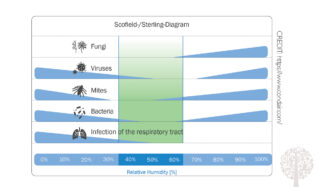
For cannabis growing, we need to keep tight temperature and humidity conditions to maintain a healthy environment. You can see from the Sterling chart below what a healthy environment is not to have mold growth or viruses. You’ll note that both high and low humidity can cause different problems. While the Sterling chart was created to advise on human health in hospitals and health care, it can also show the necessity of an adequately controlled cannabis environment. It is essential to keep humidity between 40-60% to avoid pathogen growth. Knowing that many people try to keep at least 60% RH in a grow room makes it very difficult to control mold as it is on the edge of proliferation. You can see from this that we need to ensure we properly clean our filters so as not to concentrate mold in one spot.
Filter maintenance and regular sanitization of your HVAC will prevent years of problems and stop repeated crop issues. Filters collect thousands of aphids, grow all sorts of stuff, prevent proper airflow, and lead to many other problematic and beneficial things. So make sure to clean them often and pay attention to maintenance.
NORML Canada is petitioning the government of Canada to raise the THC limit on edibles from 10 mg per package to 100 mg THC.
In a petition launched November 8, the cannabis advocacy organization argues that the THC limit needs to be raised to better address consumer demands, further eroding black market demands, while also addressing wasteful packaging.
Jennawae Cavion, the Executive Director at NORML Canada, as well as the founder at Calyx + Trichomes in Ontario, says she’s sympathetic to why Health Canada initially set the package limit for edibles at 10mg THC and that it has been dealing with a global pandemic, but argues that four years into these products being legal in Canada, it’s time to raise the limit.
“We appreciate the reasons why this hasn’t been addressed up to this point,” explains Cavion. “Health Canada has been dealing with a global health crisis. But it’s time for this to be reviewed now.”
While the legal industry is doing a good job of matching price and product availability in many categories—especially dried flower and vape pens and, increasingly, cannabis concentrates—edibles, she says, still have a hard time competing with the illicit market.
Although the petition already has the required 500 signatures to be tabled in the House of Commons, she hopes to see it reach around 5,000 before that happens. The petition is open until March 7, 2024. As of publication of this article, the petition has more than 1,300 signatures.
“Consumers of edible cannabis are seeking much higher limits than what is available through the legal market in Canada, diverting consumers to the illicit market, or simply leading individuals to buy many packages to obtain the desired amount legally.”
Patrick Weiler, MP for West Vancouver-Sunshine Coast-Sea to Sky Country
Patrick Weiler, the Liberal MP sponsoring the petition, says cannabis consumers want to buy edibles with more THC, which is driving them into the illicit market.
“Since cannabis was legalized in 2018, we have seen a safe and regulated supply of cannabis make significant progress in displacing the illicit market while creating tens of thousands of jobs, new business opportunities for Canada’s economy, and a $43.5 billion boost to Canada’s GDP,” Weiler tells StratCann via email.
“While legalization has largely been a success, we have learned a great deal over the past five years that requires us to improve upon our policy and legal frameworks. More needs to be done to ensure that Canadians have access to safe and regulated products, rather than turn to the unknown and potentially dangerous illicit market. Consumers of edible cannabis are seeking much higher limits than what is available through the legal market in Canada, diverting consumers to the illicit market, or simply leading individuals to buy many packages to obtain the desired amount legally.
“Introducing this change will encourage consumers to source their product from a regulated source, while simultaneously reducing excessive packaging. An elevated limit further corresponds with the limits established in many US states that have legalized cannabis sale and use. I was therefore willing to authorize such a petition that raises this important issue, and look forward to hopefully seeing its presentation in the House sometime next spring.”
In addition to serving as MP for West Vancouver-Sunshine Coast-Sea to Sky Country in BC, Weiler is the Co-Chair of the all-party Parliamentary Cannabis Caucus.
Cavion says the petition has also received support from NDP MP Don Davies and Conservative MP Scott Reid. Reid was the only member of his party to vote in favour of legalizing cannabis in 2018.
Related Articles
Many in the industry, as well as consumers, and even Canada’s Competition Bureau, have long protested the 10mg THC limit for cannabis edibles in Canada. The Competition Bureau’s report noted that in recent years two US states, Alaska and Oregon, increased the THC limit from 5 mg per unit and 50 mg per container to 10 mg per unit and 100 mg per container/package, bringing it in line with regulations in other states like Washington and Colorado.
Oregon’s regulatory body, the report explains, said that these updated policies sought to strike a balance between consumer health and safety concerns with economic interests in an effort to displace the illicit market.
Health Canada’s reasoning for the 10mg THC limit on edibles has been around public health concerns, in part informed by feedback from states like Colorado and Washington that legalized cannabis for non-medical purposes several years before Canada. When these states initially legalized, they had very few restrictions on edible potencies and saw some problems with people consuming too much, increasing emergency room visits and other health and safety concerns.
Canada’s cannabis legalization and regulation task force report references these concerns as well, noting that controlling the amount of THC in a product, as well as establishing a standardized serving size, is important to avoid or limit such incidents.
“We appreciate the reasons why this hasn’t been addressed up to this point,” explains Cavion. “Health Canada has been dealing with a global health crisis. But it’s time for this to be reviewed now.”
Jennawae Cavion, Executive Director at NORML Canada
All edible retail cannabis products in the first two states to fully legalize cannabis must come in single servings of 10 mg THC or less, with no more than 100 mg THC per product.
Many public health stakeholders who engaged with the task force had recommended that edibles not be allowed in Canada’s legal market.
From that report:
“The Task Force is concerned by the reports of an increase of accidental ingestion by children in states where cannabis is legal. We acknowledge that a lack of regulation contributed to this risk. Should edibles be allowed for legal sale in Canada, they should, at a minimum, conform to the strictest packaging and labelling requirements for edibles currently in force in U.S. states. Since these measures are fairly recent, the markets (Canadian and U.S.) should be closely monitored to determine the effectiveness of these measures.
“In the event that future research and monitoring identifies new risks with existing or new cannabis products, including increases in use, the Government should be ready to react. The system must be flexible enough to adapt in a timely way to new information and to provide appropriate safeguards as evidence indicates.”
“God is a comedian playing to an audience who is too afraid to laugh.” ~Voltaire
Archetypes are vital. They are important mechanisms for higher thought. They are psychosocial masks that launch us into heightened states of awareness. And could there be anything more Nietzschean, more self-evolving and socially insurgent, more vitally important to our own time, than the ability to let masks come and let masks go… to self-overcome?
As Zlavoj Zizek says, “The true task of radical emancipatory movements is not just to shake things out of their commonplace inertia, but to change the very coordinates of social reality.” Harnessing the power of archetypes, wearing them like masks, does precisely that.
Now enter Heyoka as archetype. No other archetype, except maybe the trickster archetype, is as adept at donning and discarding masks, especially as a means toward shaking things up through radical emancipation.
Heyoka as archetype is the primordial symbol of man as makeshift, as stopgap, as crudely temporary and permanently impermanent. Heyoka is both sacred and profane, the laughter in the whirlwind, a shattered compass pointing in all directions and none; the personification of a crossroads leading to all crossroads, all thresholds, all existential junctions and ecstatic intersections of cognitive genesis. Heyoka understands more than anybody the painful Shadow of the Shaman.
Let’s delve into this vitally important energy. But, reader beware, such vitality can be dangerous, a triple-bladed sword. Proceed with caution.
Backwards Dancer:
“If the fool would persist in his folly, he would become wise.” ~William Blake
Heyokas, otherwise known as sacred clowns, were crucial members of the tribes of the Planes Indians. They were tasked with maintaining social balance and cultural equilibrium by contrary means, daring to ask taboo questions and to question established answers.
Psychosocial troubleshooters of the first order, their backwards tactics, often hilarious and always humbling, shined light on darkness and darkness on light. They personified the painful Middle Gray by being the glue that binds white to black and black to white. Often living in solitude on the outskirts of the tribe, they nevertheless had a huge social impact by poking holes into the sacred and knocking big-headed warriors off pedestals and uppity chiefs off high horses.
As it stands, there has never been a time in the whole of human history that this type of energy was needed more than right now. Our world (tribe) is in dire need of such a humbling force. Heyoka is the infinite-edged Sword of Damocles, dangling warningly over the head of anybody taking themselves too seriously or being irresponsible with their power. Heyoka is the ultimate spell-breaker, shattering mental paradigms, stretching comfort zones, and flattening outdated boxes.
When you need shelter, Heyoka is the rain. When you need a parachute, Heyoka is the fall. When your glass house needs a mirror, Heyoka is the stone.
Precious Law-Breaker:
“As anywhere else in the world, the unwritten law defeated the written one.” ~Hermann Hesse
Like the thunder gods from whom they are initiated, Heyokas are a force that cannot be tamed. They are the only power within the tribe perceived to be outside of the law. Heyoka scoffs at mediocrity, assails clichés, and laughs at the petty laws of men, knowing that cosmic law is all that truly matters in the end.
Heyoka is the Dialectical Overman of the human condition, dropping halos into choke-chains, and mocking saccharine romanticism. Heyoka’s tongue is meat and acid, pillorying and hijacking, scorning trite banalities and resurrecting absolute ambiguity. Heyoka’s voice is détournement and paradox, shatter-happy in its power to reroute all moments through the power of backward antics and retrograde ways.
Post-secular, post-theistic, and post-apocalyptic, Heyoka has escaped from the clutches of human history only to reemerge as a force to be reckoned with. Revered and feared by the tribe, all human laws are at the Heyoka’s mercy. Nothing is independently sacred when all things are interdependently sacred. And so Heyoka’s twisted path shows the way through all straight paths.
Heyoka declares to the tribe, “You can have your moral high ground and immoral low ground; I will stick with the amoral middle ground and astonish you all.”
Infinite Mask-Wearer:
“There are people in this world who can wear whale masks and people who cannot, and the wise know to which group they belong.” ~Tom Robbins
More is possible than actual. Heyokas understand this and they proceed to tap the possible in order to make it actual. Mirror-shower and smoking mirror, Heyoka practices radical reflection and unhindered psychosocial mirroring; triggering mirror neurons like a billiard player puts English on a cue ball.
Never comfortable, but always invigorating, Heyoka wills absolute discomfort, surrendering to the bouleversements of the cosmos while burning the “authentic self” at the stake and dancing around the ashes while wearing a Phoenix-mask. Heyoka is constantly in the throes of self-overcoming. Even Nietzsche’s Übermensch blushes with envy.
Heyokas are both gamboling gamblers and gambling gambolers. Coup-stick happy in their incessantly blasphemous dancing on the face of all false gods. They understand that everything which can be imagined is real. And so they are constantly donning and discarding masks. All masks: whale masks, thunder masks, medicine-wheel masks, coyote masks, crow masks, thunderbird masks, love masks, and even death masks.
Any and all masks are at the heyokas disposal. They are necessary to reveal the fact that mankind is never more human than when he is playing a role, and to unleash the infinite secrets hidden within the human condition.
Sacred Humor Between Worlds:
“The seat of the soul is there where the inner and outer worlds meet.” ~Novalis
Equal parts worldly and otherworldly, the soothsayer of smithereens, the impossible bridge between all things, Heyoka is the sacred arthritis in the joints of the tribe, the pain that binds.
Through lampoon and travesty, satire and infinite jest, Heyoka transcends worlds. Especially the worlds of men. Constantly in the throes of metanoia, Heyoka humorously flattens all aggrandized egos and overreaching ideologies. With uncanny wit and absurd acumen, Heyoka socially ninjaneers awe and sacred amusement, existentially hell-bent on disturbing the undisturbed by pulling the Heavens down to earth in order to give it roots.
Heyokas are tragi-comedians and solemn-jokers. Adept at uniting joy with pain, they act on the higher and more inscrutable imperatives of the Great Mystery. They are seen as continual reminders of the contingency and arbitrariness of the social order. As determined to give wings to the worms in the hearts of men as to give the gods feet of clay, they are conduits to forces that defy comprehension. And by their absurd, backwards behavior they are merely showing the ironic, mysterious dualities that exist within the universe itself.
Heyoka-energy is the epitome of expiation, and the cure for an over-reaching, aggrandized, and unsustainable human world. If this powerful energy can be harnessed today, it can be an amoral force for moral good in an otherwise immoral world, thereby balancing the equation of power. It can be the personification of checks and balances, all at once keeping the powers that be from becoming corrupt, and flipping the tables on power itself. And although a true heyoka is chosen by fate, and one cannot simply choose to be heyoka, there’s nothing saying that this sacred and vital energy cannot be tapped into and used to humble a not-so-humble humanity run amok.
From his tattered and smoke-darkened tipi, Swallowing Arrows, post-modern Heyoka and Disaster Shaman, rouses the thunder god within himself. Tomorrow he will remind the “World Tribe” that Wakan Tanka, the Great Mystery, is beyond good and evil; that its primordial nature doesn’t correspond to human platitudes of right and wrong.
This inner-thunder god has sharp teeth, but no mouth; sharp claws, but no limbs; giant wings, but no body. It speaks a language older than words, and it longs for the people to shed their self-seriousness, to cast off their nature deprivation, and to recondition their preconditioning so that they can once again translate the numinous into a human experience and beyond.
This Image source:
Clownville by Eolo Perfido
About the Author:
Gary Z McGee, a former Navy Intelligence Specialist turned philosopher, is the author of Birthday Suit of God and The Looking Glass Man. His works are inspired by the great philosophers of the ages and his wide-awake view of the modern world.
For several decades, the federal government’s categorization of marijuana as a Schedule I controlled substance has prompted the FDA to assess various applications from researchers looking to create therapeutic drugs derived from the plant. The FDA recently published two documents that reflect on more than 50 years of exploring marijuana-based drugs and offer insights into the potential future of drug development.
The documents highlight the evolution of the FDA’s evaluations regarding marijuana-related drugs and products and also discuss the exploration of different consumption methods, such as edibles, and delve into the examination of lesser-known cannabinoids and additional components like terpenes.
Throughout the past half century, the FDA has reviewed more than 800 investigational new drug (IND) applications linked to marijuana and marijuana-derived products. This extensive period witnessed significant changes in the forms of cannabis products, societal perspectives, and the legal framework surrounding cannabis, all of which have influenced the FDA’s stance.
Initially, there were only a few applications after the Controlled Substances Act (CSA) passage in 1970. However, in recent years, especially as more states have legalized cannabis for medical and recreational use, there has been a substantial surge in applications. In the last decade alone, the number of marijuana-related drug applications nearly equaled those from the preceding 40 years combined. Presently, the FDA is reviewing more than 150 active INDs concerning marijuana-based drugs and related synthetics.
The FDA has adapted its guidance for researchers and drug developers venturing into the realm of cannabis. It released a guidance document on botanical drug development in 2016 and, earlier this year, provided separate guidance on the distinctive considerations surrounding cannabis and hemp.
The INDs have mainly focused on four key clinical areas over the years, predominantly centered around addiction and pain medicine (53%), followed by neurology (19%), immunology and inflammation (14%) and ending with psychiatry (9%).
The evolution of product forms has also been substantial. Initially, in the 1970s, most INDs revolved around smokable marijuana. Yet, as the landscape shifted with state-level legalization, the FDA began receiving more applications concerning vapor, oral and infused food products such as sweets and baked goods. This transition in product forms, according to the FDA, is largely due to changes in consumer preferences, which are moving from exclusively smoking dried marijuana flowers to consuming alternative forms such as edibles.
Despite these transformations, challenges persist in developing marijuana-related drugs for clinical trials, particularly concerning the safety of unknown compounds. Nonetheless, the broadening exploration of different form factors aligns with recent drug approvals such as Syndros (2016) and Epidiolex (2018), both oral formulations.
The FDA anticipates increased interest in clinical research regarding marijuana-based drugs, envisioning a focus on new products, diverse forms and lesser-known components such as terpenes. However, challenges remain due to the Schedule I status of marijuana, hindering extensive research into its properties.
Change is, however, slowly underway. The DEA recently ended a long-standing monopoly on domestic cannabis manufacturing for research purposes and is streamlining access to marijuana for scientists after a marijuana research bill’s enactment last year. Additionally, the DEA is reviewing marijuana’s scheduling status following a recommendation from the Department of Health and Human Services (HHS) to reclassify it from Schedule I to Schedule III.
Once this reclassification is completed, cannabis industry players such as Tilray Brands Inc. (NASDAQ: TLRY) (TSX: TLRY) could see an easing of some of the hurdles they have been facing in their bid to bring innovative products to the market.
About CNW420
CNW420 spotlights the latest developments in the rapidly evolving cannabis industry through the release of two informative articles each business day. Our concise, informative content serves as a gateway for investors interested in the legalized cannabis sector and provides updates on how regulatory developments may impact financial markets. Articles are released each business day at 4:20 a.m. and 4:20 p.m. Eastern – our tribute to the time synonymous with cannabis culture. If marijuana and the burgeoning industry surrounding it are on your radar, CNW420 is for you! Check back daily to stay up-to-date on the latest milestones in the fast -changing world of cannabis.
To receive SMS alerts from CNW, text CANNABIS to 888-902-4192 (U.S. Mobile Phones Only)
Please see full terms of use and disclaimers on the CannabisNewsWire website applicable to all content provided by CNW, wherever published or re-published: https://www.CannabisNewsWire.com/Disclaimer
A strike that had impacted up to 26 cannabis stores in Quebec for more than a year is coming to an end.
The Société québécoise du cannabis (SQDC) posted the news on Monday, November 13, and the Canadian Union of Public Employees (CUPE-5454) shared their confirmation on November 14.
The strike began 18 months ago and called for better working conditions and wages for the 300 members currently employed in two dozen SQDC branches. The SQDC has said that they hope to reach a negotiated agreement to the satisfaction of all parties involved.
The wage scale of employees at the SQDC was reviewed as part of the negotiations and now includes fewer wage steps. Also, beginning in 2024, new hires will be paid $21 an hour. For 2025-2026 and 2026-2027, the wage rates will increase in accordance with the general parameters negotiated by public sector unions. The union expects wages to be between $21.60 and $25.45 an hour. The agreement from the union is for a period of 5 years.
“Our members decided to fight to the hilt to get better working conditions and wages on par with those paid by other Crown Corporations. We set the bar high and cleared it. We’re proud of our success that we owe to the solidarity, combativeness, and determination of our members,” said David Clément, president of CUPE 5454.
Other negotiated terms include reduced uncertainty for workers, with improved schedules and hour guarantees.
“Our members’ acceptance of the conciliator’s recommendation allows us to emerge from this crisis with our heads held high. These recommendations include an improved wage scale and settlements of all disputes. We now have to sign these new contracts which, once signed, will take effect and remain in force until March 31, 2027,” added CUPE union representative Daniel Morin.
The SQDC says it is “pleased to count on the professionalism and commitment of all of its teams in its 98 branches in order to pursue its mission of ensuring the sale of cannabis from a health protection perspective” and notes that the resumption of normal opening hours could take place over a few weeks. Schedules will be posted on the SQDC.ca website.
“The SQDC salutes the valuable work of the striking branch managers, who oversaw the operations of their reduced-staff branches for several months,” continued the press release. “We would also like to thank customers for their understanding during this period.”
Department of Veteran Affairs (VA) doctors will now have the ability to recommend medical cannabis to their patients as long as they reside in states with legal marijuana markets. The measure will provide support for American military forces and their families in critical facets such as housing and infrastructure while increasing healthcare and benefits funding for military veterans.
It advanced by a unanimous vote of 28–0 and will be a godsend for U.S. military veterans and their families, a community that often doesn’t receive the support it needs. Military veterans are much more likely to develop crippling mental disorders such as depression, anxiety and post-traumatic stress disorder, especially soldiers who see active combat.
Many of them fail to integrate into society when they return from war due to limited access to mental-health care services, resulting in tens of thousands of military vets living on the streets.
According to Senate Appropriations Committee vice chair Susan Collins, the bill will provide “much-needed funding” to support the housing and treatment of American military veterans. Collins said that she would keep pushing for funding for the country’s veterans as the measure moves through the appropriations process in her capacity as the Appropriations Committee Vice Chairman. She also noted that the investments made by the legislation are critical to America’s national security and will reduce maintenance costs in the military while ensuring safety and readiness.
Expanding medical marijuana access to veterans has been a hot topic since states began legalizing medical marijuana. While several studies show that cannabis can be effective at alleviating conditions that tend to affect veterans such as chronic pain, anxiety, low appetite and insomnia, federal law still classifies the plant as a Schedule I controlled substance with no medical applications.
Consequently, VA doctors have been unable to recommend medical cannabis to their patients even if they live in states with regulated cannabis markets.
With the new bill’s passage, veterans around the country now have access to medical marijuana with a government doctor’s recommendation, providing them and their families with another tool to deal with the long-term effects of military service.
Companies such as SNDL Inc. (NASDAQ: SNDL) will be watching this development closely as the cannabis industry awaits the DEA’s recommendation regarding the rescheduling of marijuana in the United States. This is because these developments can open more opportunities for not just U.S.-based companies but also enterprises from other countries.
About CNW420
CNW420 spotlights the latest developments in the rapidly evolving cannabis industry through the release of two informative articles each business day. Our concise, informative content serves as a gateway for investors interested in the legalized cannabis sector and provides updates on how regulatory developments may impact financial markets. Articles are released each business day at 4:20 a.m. and 4:20 p.m. Eastern – our tribute to the time synonymous with cannabis culture. If marijuana and the burgeoning industry surrounding it are on your radar, CNW420 is for you! Check back daily to stay up-to-date on the latest milestones in the fast -changing world of cannabis.
To receive SMS alerts from CNW, text CANNABIS to 888-902-4192 (U.S. Mobile Phones Only)
Please see full terms of use and disclaimers on the CannabisNewsWire website applicable to all content provided by CNW, wherever published or re-published: https://www.CannabisNewsWire.com/Disclaimer
Last week, the National Institutes of Health (NIH) announced funding for the development of psychedelic treatments for substance-use disorder. This latest announcement comes after three earlier notices posted by the NIH, which centered on funding opportunities for managing drug addiction using psychedelics. One of the postings would focus on understanding how psychedelics worked while the others would center on the use of these drugs on human subjects in clinical trials.
In its recent statement, the federal agency revealed that it planned to allocate $2 million in grant money for research projects for the fiscal year 2025. This funding, which will be awarded through the National Institute on Drug Abuse, will enable research into various substances that can help treat addiction, including empathogens such as MDMA, classic psychedelics such as LSD and psilocybin, and dissociative drugs such as ketamine, as well as other hallucinogens such as ibogaine.
In its latest statement, the agency discussed the urgent need for new substance-use disorder treatments, considering the increasing rates of overdose, addiction and use of illicit substances including cocaine, opioids, marijuana, methamphetamine and nicotine (excluding alcohol). The statement also acknowledged that it was difficult to determine specific dosing for psychedelics that would produce a therapeutic effect, period of administration and frequency of drug use.
In addition to this, the NIH emphasized the need to determine the best type of psychotherapy to use with a psychedelic treatment as well as the required number of sessions and the duration and frequency.
While the NIH noted that its goal was to advance the development of effective and safe psychedelic treatments for substance-use disorders in the FDA approval pathway, it also highlighted that despite claims of psychedelics’ therapeutic effects, their effectiveness and safety hasn’t been empirically and sufficiently established. It should be noted that the FDA has yet to approve the use of any psychedelic substances in treating substance-use disorders.
Online applications will be accepted from Jan. 28, 2024, through Feb. 28, 2024. All applications have to provide entry and exit points of the proposed research plan in the FDA regulatory approval pathway. Additionally, interested applicants can submit proposals that involve clinical trials. However, this is not a requirement.
The posting states that the $2 million grant may be split among up to five awards, but applicants may request no more than $2 million annually for direct costs. Eligible organizations include nonprofits, institutes of higher education, for-profit businesses, U.S. agencies, individual state or local governments, faith-based groups, housing authorities, school districts, global entities and tribal organizations.
These research grants will expand the fields of investigation and add onto what private sector actors such as Seelos Therapeutics Inc. (NASDAQ: SEEL) are doing to bring efficacious psychedelic medicines onto the market.
About PsychedelicNewsWire
PsychedelicNewsWire (“PNW”) is a specialized communications platform with a focus on all aspects of psychedelics and the latest developments and advances in the psychedelics sector. It is one of 60+ brands within the Dynamic Brand Portfolio @ IBN that delivers: (1) access to a vast network of wire solutions via InvestorWire to efficiently and effectively reach a myriad of target markets, demographics and diverse industries; (2) article and editorial syndication to 5,000+ outlets; (3) enhanced press release enhancement to ensure maximum impact; (4) social media distribution via IBN to millions of social media followers; and (5) a full array of tailored corporate communications solutions. With broad reach and a seasoned team of contributing journalists and writers, PNW is uniquely positioned to best serve private and public companies that want to reach a wide audience of investors, influencers, consumers, journalists and the general public. By cutting through the overload of information in today’s market, PNW brings its clients unparalleled recognition and brand awareness. PNW is where breaking news, insightful content and actionable information converge.
To receive SMS alerts from PsychedelicNewsWire, text “Groovy” to 888-902-4192 (U.S. Mobile Phones Only)
Please see full terms of use and disclaimers on the PsychedelicNewsWire website applicable to all content provided by PNW, wherever published or re-published: https://www.PsychedelicNewsWire.com/Disclaimer















Recent Comments