The ‘revolt of the elites’ has reversed the source of social disorder from the masses to the elites.
Prescient social critic Christopher Lasch’s 1996 book, The Revolt of the Elites and the Betrayal of Democracy, laid out a blueprint of social decay that continues to inform our descent into social disorder. Lasch excoriated our revolting elites for abandoning the foundations of social stability, upward mobility, the middle class and democracy in their race to enrich and insulate themselves in protected enclaves–neighborhoods, corporate suites, foundations and institutions–of fellow elites.
In Lasch’s analysis, America’s elites are revolting against the obligations imposed on traditional elites to nurture the foundational values that support democracy, national purpose, civic pride and a moral order that restrains narcissism and greed as a means of protecting opportunities for advancement from the pillage of the wealthy.
Lasch identified the ways in which globalization fosters elite pathologies. In his view, America’s technocratic elites are a new class of symbolic analysts whose financial means “rest not so much on the ownership of property as on the manipulation of information and professional expertise.”
Serving trans-national corporations, foundations and agencies, they have “more in common with their counterparts in Brussels or Hong Kong than with the masses of Americans not yet plugged into the network of global communications.”
America’s elite defines itself as the hard-working winners of a Darwinian global meritocracy, an atomized world ruled by The Triumph of the Individual: “the new class has to maintain the fiction that its power rests on intelligence alone. Hence it has little sense of ancestral gratitude or an obligation to live up to responsibilities inherited from the past. It thinks of itself as a self-made elite owing its privileges exclusively to its own efforts.”
From this lofty perch, America’s elite is disconnected from those still mired in the real-world economy they’ve left behind: in Lasch’s words, the elite “betray the venomous hatred that lies not far beneath the smiling face of upper-middle-class benevolence… Simultaneously arrogant and insecure, the new elites, the professional classes in particular, regard the masses with mingled scorn and apprehension.”
In Lasch’s view, this revolt of the elites has reversed the source of social disorder from the masses to the elite: “Once it was the ‘revolt of masses’ that was held to threaten social order and the civilizing traditions of Western culture…Today it is the elites–those who control the international flow of money and information, preside over philanthropic foundations and institutions of higher learning, manage the instruments of cultural production and thus set the terms of public debate–that have lost faith in the values” that underpin a fair and vibrant social and economic order.
For all its breadth and depth, there’s a simple message at the core of “End Times”: At the heart of our problems, Turchin writes, is “a perverse ‘wealth pump’ … taking from the poor and giving to the rich,” and we have to find a way to turn it off. America has essentially done that before, during the New Deal era, and other nations and societies have done it as well. But only about one in five of the nation-states or empires that face cyclical crises like the one we’re in today escapes it, Turchin reports. So the odds aren’t great, unless we act fast and with purpose, making full use of what we now know.
Turchin’s book strongly argues that something akin to New Deal reforms isn’t just a good idea in moral or political terms but is an objective necessity to avoid disaster and rebuild social trust. But he’s also clear about the deeply rooted forces that stand in the way of such reforms, casting them as damaging partisan politics or even an existential threat.
He sees four main drivers that lead to societal crisis, of which the most important is “intraelite competition and conflict,” and the most variable is “geopolitical factors,” which for large and powerful nations like the U.S. tend to be negligible. Another driver, “popular immiseration,” increases as population growth drives down living standards, which leads to “elite overproduction,” for example when too many middle-class college graduates compete for a stagnant number of well-paying jobs. The last driver, the “failing fiscal health and weakened legitimacy of the state,” is exacerbated by both popular immiseration and elite overproduction, which are clearly the central features.
Turchin also focuses attention on what he calls the “engine” at the heart of the model, the previously mentioned “perverse ‘wealth pump’… taking from the poor and giving to the rich.” It intensifies and locks in popular immiseration and also drives elite overproduction, undermining social trust at both the top and bottom of the social pyramid.
This reflects “one of the most fundamental principles in sociology, the ‘iron law of oligarchy,’” he writes, “which states that when an interest group acquires a lot of power, it inevitably starts using that power in self-interested ways.” For example, while wages fell far behind the growth of economic productivity from 1979 onward, Turchin cites analysis from the Economic Policy Institute indicating that three-fourths of that gap was due to elite-driven policy shifts: weakened labor standards, the erosion of collective bargaining, corporate globalization and so-called fiscal austerity.
Diminished economic conditions for the less educated were accompanied by a decline in the social institutions that nurtured their social life and cooperation. These institutions include the family, the church, the labor union, the public schools and their parent-teacher associations, and various voluntary neighborhood associations.
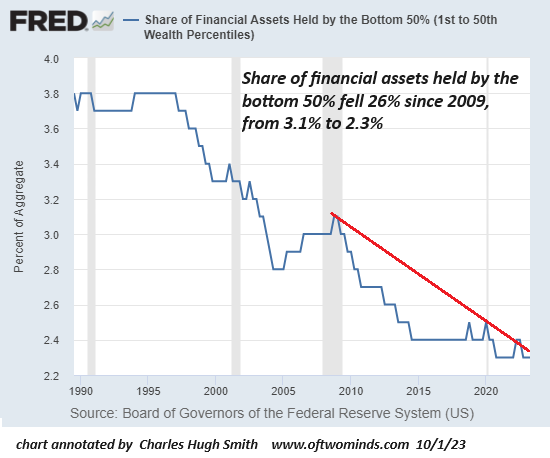
As evidence that Turchin’s “perverse wealth pump” has been running full speed, please glance at this chart showing the bottom 50%’s meager share of the nation’s stupendous financial assets fell 26% from 3.1% to 2.3% since 2009–a sliver so thin that it’s essentially signal noise.
In contrast, the top 1%’s share of financial assets rose 24% since 2009.
The top 0.1%’s share of financial assets soared 34%% since 2009.
In sum: our elites are revolting, and their narcissism, greed, moral decay and pathology must be restrained lest these forces dissolve our social order.
Oct. 27, 2023, marked the first day of medical cannabis sales at independent pharmacies in Georgia, with Robin’s Pharmacy, Allen Pharmacy Group and Omega Pharmacy becoming the first to secure state licenses for the sale of low-THC (less than 5% concentration) medical cannabis products.
Dr. Ankit Patel of Robins Pharmacy expressed his excitement, calling it a historic moment. He had been closely monitoring the development of the state’s cannabis laws for about four years, eagerly awaiting the opportunity for independent pharmacies to stock these products.
To gain state approval, pharmacies need to undergo inspections by the Georgia Drugs & Narcotics Agency, which assesses security measures and evaluates the staff’s knowledge of handling and dispensing medical marijuana. State law mandates that cannabis products be displayed on shelves alongside other prescription medications.
Bill Posey, owner of Allen Pharmacy Group, likened medical cannabis to other “dangerous” drugs, citing examples such as blood pressure medication that are categorized similarly. Posey’s pharmacy commenced cannabis sales on Oct. 30, 2023, and he reported receiving inquiries from potential customers even before the official sales launch.
Dr. Jordan Day, owner of Omega Pharmacy, expects to initiate medical cannabis sales at her pharmacy in the near future. She envisions her pharmacy playing a crucial role in educating patients about the benefits of medical cannabis, potentially replacing traditional anxiety, pain, and sleep medications.
Georgia’s Access to Medical Cannabis Oil Commission chair, Andrew Turnage, expressed the significance of this development, stating that it would greatly enhance accessibility to medical cannabis for patients across the state as pharmacies are just a short drive away.
The journey to this point began when Governor Brian P. Kemp signed HB 324, known as Georgia’s Hope Act, in April 2019, with the law coming into effect in July of the same year. The measure aimed to provide access to medical marijuana oil for individuals in need, especially those battling chronic and debilitating diseases.
The law entrusted the regulation, production, cultivation, manufacturing and sale of low-THC oil to the Georgia Access to Medical Marijuana Commission. The commission was formed in November 2019, but it wasn’t until July 2021 that the state revamped its medical marijuana program, ultimately approving six companies to sell cannabis.
Recent updates revealed that the number of medical marijuana patients in the state was significantly lower than initially believed. While it was originally thought that there were more than 50,000 patients, anomalies in the system, such as expired patient cards and patient passings since 2015, have now reduced the count to approximately 14,000.
This development is probably welcome news to the entire marijuana industry, including companies such as Tilray Brands Inc. (NASDAQ: TLRY) (TSX: TLRY) since the availability of cannabis products at pharmacies increases access for those who badly need these products to address their medical needs.
About CNW420
CNW420 spotlights the latest developments in the rapidly evolving cannabis industry through the release of two informative articles each business day. Our concise, informative content serves as a gateway for investors interested in the legalized cannabis sector and provides updates on how regulatory developments may impact financial markets. Articles are released each business day at 4:20 a.m. and 4:20 p.m. Eastern – our tribute to the time synonymous with cannabis culture. If marijuana and the burgeoning industry surrounding it are on your radar, CNW420 is for you! Check back daily to stay up-to-date on the latest milestones in the fast -changing world of cannabis.
To receive SMS alerts from CNW, text CANNABIS to 844-397-5787 (U.S. Mobile Phones Only)
Please see full terms of use and disclaimers on the CannabisNewsWire website applicable to all content provided by CNW, wherever published or re-published: https://www.CannabisNewsWire.com/Disclaimer
British American Tobacco (BAT) announced today that it will invest nearly $125 million into New Brunswick’s Organigram and more than doubling its equity position in the cannabis company from about 20% to 45%.
The move still requires the approval of Organigram shareholders.
Since 2021, BAT, the British multinational that manufactures and sells cigarettes, tobacco and other nicotine products, has made several minority investments in the cannabis space, including its 19.9% equity in Organigram in their “beyond nicotine” campaign.
Jupiter, the strategic investment pool, is expected to accelerate Organigram’s ambitious growth plans, enabling further geographic, technological and product expansion.
Beena Goldenberg, CEO of Organigram
Organigram sells an array of cannabis products in Canada under brands like Edison Cannabis Co., SHRED, Big Bad O’ Buds, Holy Mountain, and others. Organigram’s most recent quarterly report said SHRED products, one of the more popular in Canada, have made nearly $190 million in retail sales in the previous 12 months.
Despite these concerns, Organigram’s recreational net revenue was $92.5 million for the nine months ended May 31, 2023, an increase of $8 million over the same prior-year period. International sales for the first nine months of fiscal 2023 also increased considerably, nearly doubling from $9.5 million in 2022 to $18.4 million.
In a press release, BAT says its increased investment in Organigram is due to the company’s performance and “careful financial governance” in an economic downturn.
Most of BAT’s investment will be used for Organigram to establish a “strategic investment pool, intended to be applied for emerging opportunities within the cannabis space to accelerate Organigram’s growth and to support geographic, technological and product expansion.”
Organigram says the majority of the $124.6 million investment will be used to create a strategic investment pool named Jupiter, focusing on “emerging cannabis opportunities,” including “geographic expansion”.
“We are excited to bring this transformative transaction to Organigram’s shareholders, reinforcing our commitment to delivering shareholder value,” says Beena Goldenberg, CEO of Organigram, in a press release.
“This investment bolsters an already strong balance sheet and solidifies our position as a leading cannabis company. In addition, this deepens the strategic partnership between Organigram and BAT, and we look forward to continuing to leverage BAT’s global capabilities and scientific expertise. Jupiter, the strategic investment pool, is expected to accelerate Organigram’s ambitious growth plans, enabling further geographic, technological and product expansion.”
The White Buffalo Calf Woman: Supernormal Experiences
With A Warning For Humanity
by Arjun Walia
A story from the Lakota people that may be telling of the current times of great upheaval we are currently in now.
“The Coming of White Buffalo Calf Woman” by Vera Louise Drysdale, 1976
The concept of ‘Supernatural’ or ‘Supernormal’ abilities and phenomena are embedded throughout human history across multiple cultures. They have been documented in various ancient, medieval and modern history texts.
Indigenous people have passed down these stories orally for generations, and many of their stories/prophecies are now more important than ever.
But for the tellers of these stories, they aren’t mere tales with a mythological origin, they are accounts of real events that took place in the past, with a crucial message for the future, which is now.
The story I’d like to share with you today comes from Native American lore. It’s the story of the White Buffalo Calf Woman.
What really makes this story so hard hitting is the fact that this ‘supernatural/mythological’ woman gifted a pipe to the Lakota (also known as Sioux) people, and the pipe is currently kept on the Cheyenne River Reservation in South Dakota.
Some of the messages within this story may be telling of the current times we are in now.
Chief Arvol Looking Horse was born on the Cheyenne River Reservation. At the age of 12, he was given the responsibility of becoming the 19th Generation Keeper of the Sacred White Buffalo Calf Pipe, the youngest ever. It was passed to him from his grandmother. He is widely recognized as a spiritual leader of all three branches of the Sioux tribe.
The bowl of the pipe is made with a rare red stone and the stem resembles the windpipe of the calf.
Joseph Epes Brown, (1920-2000) renowned scholar, author, and teacher of Native American Traditions and World Religions explains,
“With this sacred pipe, you will walk upon the Earth, for the Earth is your Grandmother and Mother, and she is sacred. Every step that is taken upon Her should be as a prayer. The bowl of this pipe is of red stone; it is the Earth. Carved in the stone and facing the center is this buffalo calf who represents all the four-leggeds who live upon your Mother. The stem of the pipe is of wood and this represents all that grows upon the Earth. And these twelve feathers which hang here, where the stem fits into the bowl, are from Wanbli Galeska, the Spotted Eagle, and they represent the eagle and all the wingeds of the air. All these peoples, and all the things of the universe, are joined to you who smoke the pipe—all send their voices to Wakáŋ-Táŋka, the Great Spirit. When you pray with this pipe, you pray for and with everything.”
– The Gift of the Sacred Pipe by Black Elk, Holy Man of the Oglala Sioux as told to Joseph Epes Brown in The Sacred Pipe
The Story of the White Buffalo Calf Woman
This prophecy originated approximately 2000 years ago. It came from what the Lakota people know as the White Buffalo Calf Woman, or Ptesanwin.
The story goes that she appeared in front of two warriors who were out hunting buffalo in the sacred Black Hills of South Dakota. They saw a large body coming toward them, and as it came close enough it was seen as a white buffalo calf. As it came even closer, it shape-shifted into a young Indian woman.
Frithjof Schuon (1907-1998) painted “Apparition of the Buffalo Calf Maiden” in 1959
When this happened, ‘bad thoughts’ entered into the mind of one of the warriors, and the woman told him to step forward. When he did, a black cloud came over his body, and when it disappeared the warrior who had bad thoughts was nothing but a skeleton, with no flesh on his bones.
The other warrior then kneeled and began to pray. When he did this, the woman told him to go back to his people and warn them that in four days, she was going to bring a sacred bundle.
The warrior did as instructed. He returned to his people and gathered all of the elders and leaders in a circle and told them what the woman had instructed him to do.
On the fourth day, the woman appeared. Some tell the story as if a cloud came down from the sky, and from this cloud stepped a beautiful white buffalo calf. When this happened and the calf stepped on the ground, it became the same beautiful young woman who was now carrying the sacred bundle in her hand.
As she entered into the circle, she sang a sacred song and handed over the sacred bundle. Included within it was the pipe. She spent four days among the tribe and taught them about the bundle and what it means.
She taught them seven sacred ceremonies, which included the sweat lodge, a child naming ceremony, a healing ceremony, a making of relatives or the adoption ceremony, and a vision quest. The last one was the Sundance ceremony, also known as the people’s ceremony for the entire nation.
She instructed the Lakota people that as long as they performed these ceremonies they would always remain caretakers and guardians of sacred land. She told them that as long as they took care of it and respected it, their people would never die and would always live.
The legend states that she chose this particular tribe at the time because the leaders had very pure hearts.
The White Buffalo Calf Woman also made prophecies while with the tribe. One of those prophecies was that the birth of a white buffalo calf would be a sign that it would be near the time when she would return again to purify the world.
There would be birthing pains as these changes are brought out, including climate changes and many other earth and societal changes.
When she was done teaching, she left the way she came. She went out of the circle, and as she was leaving she turned and told the people that she would return one day for the sacred bundle.
Many years later, when Chief Arvol Looking Horse’s grandmother passed the pipe on to him, she told him that he might be the last keeper of the pipe if the people of Earth don’t straighten things out.
Are we perhaps at this time of great prophecy?
Chief Arvol Looking Horse has stated that since 1994 a white buffalo calf has been born each year. And that there have been sightings of other rare white animals.
Below is a video of him explaining the prophecy.
The Main Message
As Looking Horse has explained, in order for great positive change to come about, and a complete re-shaping of the human experience to occur, we must unite globally, collectively, and spiritually.
But what would this look like? What would it mean for humanity to come together? The changes we see on our planet, the environmental degradation, the war, the pain, and the suffering – these are opportunities to have moments of great reflection. These are opportunities for humanity to come together and do something different as that is what it will take to solve this level of crisis.
In most cases, “extreme“ events serve as a catalyst for humanity to “wake up” and start asking important questions about our world and why it is the way it is.
“What we change in ourselves and in our world is a direct result of the questions we ask ourselves. Are we asking the right questions?”
– Joe Martino, founder of Collective Evolution and The Pulse
Coming together in a collective and spiritual manner at this stage is going to be hard. We are a society that’s living primarily in our minds, disembodied from our hearts due to generations of stress and trauma.
This of course does not mean it’s impossible for us to change, but that it will take focus, attention and intention. We need to open our minds and hearts and draw upon courage.
Our world seems to be in a constant state of finger-pointing. “Those are the bad guys.” But the result of our human experience is in large part a result of our psychological, physiological, and spiritual states. Often states built from stress, hyper-individualism and separation.
Sure, there are unelected elitists with their hands on societal levers, but collaborative agency at a grassroots level does exist and can create change.
But we must seek to unite instead of continually dividing over small differences. Beginning with building our individual capacity to open our hearts and minds seems a good place to start.
What does it mean to have an open mind to you?
What does it mean to have an open heart to you?
How do both change the way we listen to and communicate with others?
Last week, an alliance of marijuana companies in the state of Massachusetts filed a lawsuit that challenges the federal prohibition of cannabis as it applies to individual states. Currently, marijuana remains classified as a Schedule I substance under the Controlled Substances Act. This is despite the fact that the medical use of marijuana is legal in 38 states, 4 U.S. territories and the federal District of Columbia. Adult-use marijuana is also legal in 23 states, 3 U.S. territories and D.C.
The Controlled Substances Act was enacted by the 91st United States Congress and signed into law by President Richard Nixon in 1970.
In their suit, the companies argue that the Controlled Substances Act, which prohibits the growing, manufacture, sale and possession of intrastate cannabis, is an unconstitutional ban. They maintain that this act deprives marijuana companies of their rights under the Fifth Amendment by depriving them of liberty without due process and by introducing unlawful and unwarranted federal government intrusion into their businesses.
The coalition has asked that the Massachusetts district court deem the act to be unconstitutional, in their quest for a declaratory judgment. The suit names its sole defendant as U.S. Attorney General Merrick Garland.
The challengers also note that the Controlled Substances Act subverts state cannabis programs, giving the example of the 2012 Massachusetts Medical Marijuana Initiative. During this time, voters in the state opted to legalize medical cannabis. A few years later in 2016, the Massachusetts Marijuana Legalization Initiative was introduced, with voters legalizing recreational cannabis for adults.
The lawsuit states that the comprehensive state regulations protect consumers while also ensuring that the regulated cannabis sold in Massachusetts is distinguishable from illegal, interstate cannabis.
The suit also claims that the Controlled Substances Act harms small and large businesses and threatens public safety. The companies argue that because of this act, marijuana businesses aren’t able to take part in federal programs. It also leads to issues with advertising, hiring, loans, payroll and insurance because most service providers have affiliations with the federal governments.
At the moment, state-regulated marijuana businesses are not allowed to use credit-card processors because financial institutions are regulated by the federal government. By relying on cash, most cannabis businesses have a higher risk of being robbed.
Following the suit’s filing, Verano president Darren Weis, stated that he was honored to be supporting this groundbreaking suit that pushed for equal treatment under the law. Weiss is one of the plaintiffs involved in the suit.
This lawsuit is likely to draw the attention of many cannabis companies that are operating in other jurisdictions such as TerrAscend Corp. (TSX: TSND) (OTCQX: TSNDF) since it could have implications for the industry across the country.
About CNW420
CNW420 spotlights the latest developments in the rapidly evolving cannabis industry through the release of two informative articles each business day. Our concise, informative content serves as a gateway for investors interested in the legalized cannabis sector and provides updates on how regulatory developments may impact financial markets. Articles are released each business day at 4:20 a.m. and 4:20 p.m. Eastern – our tribute to the time synonymous with cannabis culture. If marijuana and the burgeoning industry surrounding it are on your radar, CNW420 is for you! Check back daily to stay up-to-date on the latest milestones in the fast -changing world of cannabis.
To receive SMS alerts from CNW, text CANNABIS to 844-397-5787 (U.S. Mobile Phones Only)
Please see full terms of use and disclaimers on the CannabisNewsWire website applicable to all content provided by CNW, wherever published or re-published: https://www.CannabisNewsWire.com/Disclaimer
Researchers have found that there may be a “clear association” between psychedelic use and embracing alternative viewpoints. Intent on determining whether exposure to psychedelics made people more likely to affirm alternative views, the research team provided a Conspiracy Mentality Questionnaire to nearly 400 participants who had taken part in a prior poll on the potential associations between schizotypy and psychedelic use.
Schizotypy refers to personality traits with mild characteristics that are similar to schizophrenia symptoms, such as unusual behaviors and beliefs. According to the survey, 233 of the 392 study participants had recently used classic psychedelics such as LSD, psilocybin (magic mushrooms), mescaline and lysergic acid diethylamide (LSD).
The Conspiracy Mentality Questionnaire measured “individual differences in conspirational thinking and ideation” and allowed researchers to measure participants’ belief in alternative facts. It also measured their inclination to use empirical evidence as proof of their claims, reliance on intuition to form factual beliefs and how political factors affect how they perceive factual information.
The Epistemic Belief System classifies these three tendencies as “epistemic beliefs” that include personal beliefs and attitudes toward knowledge and learning. These beliefs determine how people approach new information and integrate it into their existing belief systems.
On top of studying the connections between “nonconformist thinking styles,” the researchers also explored the association between forming alternative views and other substances like alcohol. They found that there is a link between psychedelic use and belief in alternative viewpoints such as conspiracy theories. Additionally, they discovered a “moderate-positive association” between the idea that politics can influence factual information and psychedelic use, indicating that psychedelic users may be more inclined to believe that factual information isn’t inherently resistant to political influence.
The researchers also found that a history of psychedelic use did not have any significant connection to a preference for intuition-based beliefs rather than evidence-based beliefs, challenging the notion that psychedelic users are more likely to have fringe or alternative beliefs.
Generally, the poll found that psychedelic users tend to look at widely accepted facts with more skepticism than the average person. The researchers surmised that a history of psychedelic use is connected with believing alternative facts and the belief that political agendas influence factual information.
The poll comes at a time of rising psychedelic use in the country amid historic levels of misinformation and political violence. Psychedelics have drawn a lot of public attention in recent months, thanks to studies connecting them to significant improvements in mental health. With a lot more research being undertaken by enterprises such as Compass Pathways PLC (NASDAQ: CMPS), plenty more is bound to be uncovered regarding the effects of these psychedelic substances.
About PsychedelicNewsWire
PsychedelicNewsWire (“PNW”) is a specialized communications platform with a focus on all aspects of psychedelics and the latest developments and advances in the psychedelics sector. It is one of 60+ brands within the Dynamic Brand Portfolio @ IBN that delivers: (1) access to a vast network of wire solutions via InvestorWire to efficiently and effectively reach a myriad of target markets, demographics and diverse industries; (2) article and editorial syndication to 5,000+ outlets; (3) enhanced press release enhancement to ensure maximum impact; (4) social media distribution via IBN to millions of social media followers; and (5) a full array of tailored corporate communications solutions. With broad reach and a seasoned team of contributing journalists and writers, PNW is uniquely positioned to best serve private and public companies that want to reach a wide audience of investors, influencers, consumers, journalists and the general public. By cutting through the overload of information in today’s market, PNW brings its clients unparalleled recognition and brand awareness. PNW is where breaking news, insightful content and actionable information converge.
To receive SMS alerts from PsychedelicNewsWire, text “Groovy” to 21000 (U.S. Mobile Phones Only)
Please see full terms of use and disclaimers on the PsychedelicNewsWire website applicable to all content provided by PNW, wherever published or re-published: https://www.PsychedelicNewsWire.com/Disclaimer
Grodan consistently tests its stone wool for heavy metal content using a third party lab called Bureau Veritas, which has hundreds of locations in North America.
That’s just one way we’re looking out for cannabis cultivators. By creating a consistent substrate developed to incredibly high standards, we give growers greater control over their crop inputs. Not only does that benefit cannabis brands’ integrity and their customers, transitioning from peat or coco to stone wool helps operators stay well ahead of fresh regulations that may come out of renewed government scrutiny on soil health.
By using a growing medium that has already been tested and proven to contain negligible levels of heavy metals, operators can save time and effort on their own testing and compliance processes and head off concerns about substrate contaminants at the pass.
As more and more consumer products are revealed to have alarming levels of heavy metal concentrations, from baby food to clothing textiles, cannabis operators can offer the industry a little extra peace of mind with one simple input decision.
Advertisement
Testing stone wool substrates for heavy metals
The important thing to remember when testing growing media for heavy metals is that there are different methods for testing organic media (i.e. “living” material) and inert media (like stone wool).
For example, the acid digestion process is useful for determining heavy metal concentrations in organic, or carbon-based substances like soil, peat and coco. With acid digestion, different acidic chemicals are used to break down organic compounds in a sample so that other elements, including heavy metals, can be better observed and quantified. It’s a good way to see what hidden components of an organic substrate might be absorbed by plants growing in those media.
However, the acid digestion method produces inaccurate results for inert mineral substrates like the perlite, often included in potting-soil mixtures, as well as stone wool, aka rock wool.
Applying the acid digestion process to such non-carbon, inorganic growing media will release 100 per cent of all elements in the stone wool material—not just the elements that would naturally become available to plants under the average temperature and pH levels observed during the growing cycle.
The best testing process for inorganic growing media is a Toxicity Characteristic Leaching Procedure (TCLP). TCLP simulates how metals would leach over a typical growing season, providing an accurate picture of the bioavailability and mobility of various compounds in mineral substrates. It’s the same process specified by the EPA when it established federal standards for hazardous and industrial waste disposal in the 1970s.
Cannabis operators can trust TCLP results because they often slightly overestimate the total level of leaching that takes place over an entire growing season.
When mineral substrates are examined through electron micrographs, you can see the physical degradation of stone wool fibers after several years of use and compare them to similar fibers subject to the TCLP extraction process. The TCLP method degrades the fibers even more than in a typical year of mineral substrates being exposed to water, nutrient solutions and shifts in temperature and pH over time.
This level of accuracy, along with the buffer of additional degradation during testing, is why Grodan regularly performs TCLP analysis of our products as part of our rigorous quality control standards.
While all types of basalt rock, from which stone wool growing media is made, have naturally occurring and variable levels of heavy metals, we are able to demonstrate that any heavy metals are detectable at well below legal limits — if there are any detected at all.
Madison Walker is Head of Public Affairs for North America at Grodan, a global leader in precision growing solutions and inventor of stone wool cultivation. She is responsible for the development and implementation of Good Manufacturing Practices and Good Production Practices protocols for the United States, Canada, and International markets.
Get a closer look at Grodan products and cannabis crop steering techniques on their blog and podcast.
By Jaymie White, Local Journalism Initiative Reporter
WRECKHOUSE WEEKLY NEWS
St. John’s — Even NL residents who have never even tried drugs or alcohol are paying for it.
Substance use continues to be an issue across the province, and with that comes drug trafficking. According to the Canadian Centre on Substance Use and Addiction in 2023, substance use cost the province $833 million in 2020 alone.
Advertisement
Those numbers cost every single resident in Newfoundland and Labrador, to the tune of $1,575 per person.
This number is actually higher than the national average. For all of Canada as a whole, the substance use cost is $49.1 billion, which amounts to $1,291 per person.
The data states that this amount can further be broken down into four cost categories:
— Lost productivity which amounts to $402 million, or 48 per cent
— Criminal justice which amounts to $128 million, or 15 per cent
— Healthcare which amounts to $258 million, or 31 per cent, and;
— Other direct costs, which amounts to $45 million, or 6 per cent.
The most common substance abused in NL is alcohol, totaling $351 million, or 42 per cent. Tobacco follows closely behind at $270 million, or 32 per cent, but the following restricted substances are also on this list:
— Cocaine _ $63 million, or 8 per cent
— Opioids _ $54 million, or 7 per cent
— Cannabis _ $33 million, or 4 per cent
According to a report published by the Canadian Harm Reduction Project, the following statistics were uncovered:
— 39.4 per cent of the population of Newfoundland and Labrador reported lifetime use of one or more illicit drugs
— Over their lifetime, 6.6 per cent of individuals in Newfoundland and Labrador reported using cocaine/crack
— 8.2 per cent reported using hallucinogens, and 4.9 per cent reported using ecstasy
— 11.1 per cent reported using at least one illicit drug in the past year, while 11 per cent reported using one of the following illicit drugs: cannabis, cocaine/crack, speed, ecstasy, hallucinogens or heroin.
These numbers are consistent with national trends, including that 43.2 per cent of Canadians have reported lifetime use of one or more illicit drugs and 11.3 per cent have used at least one illicit drug in the past 12 months.
Statistics Canada found that substance abuse is often directly related to criminal activity.
“The association between illicit drugs and crime in general has been well established by criminological researchers in Canada and elsewhere in the world. Research has shown that not only are many crimes committed by those who are under the influence of drugs and/or alcohol, but crime, particularly property-related crime, is often committed to obtain money to purchase drugs.”
Obviously, where there is a demand for the product, there will undoubtedly be an increased potential for access, often through drug trafficking, which is something the RCMP is consistently trying to curb.
Those efforts extend into the Southwest coast region. Last month the Port aux Basques detachment reported on its continued efforts to target drug trafficking.
“Channel-Port aux Basques RCMP arrested and charged 55-year-old Kevin Parsons after executing a search warrant authorized under the Controlled Drugs and Substance Act at his residence in Port aux Basques on Thursday, October 12, 2023, as part of an ongoing investigation.
“Channel-Port aux Basques RCMP, with assistance from Police Dog Services Central, searched the home and located a quantity of cocaine, cash, and other material indicative of drug trafficking.
“Parsons is charged with possession for the purpose of trafficking cocaine, possession of cocaine and unsafe storage of ammunition. He is set to appear in court at a later date. A second person arrested at the time of the search was released without charge.
“The investigation is continuing.
“Channel-Port aux Basques RCMP thanks the public for their assistance and reminds residents to continue to report suspected drug trafficking by calling 709-695-2149. Anonymity is guaranteed. You can also contact Crime Stoppers at 1-800-222-TIPS (8477), visit www.nlcrimestoppers.com or use the P3Tips app. #SayItHere.”
Earlier this summer, on July 26, the RCMP reported a drug trafficking bust in Corner Brook.
“Three Corner Brook residents were arrested on July 26, 2023, as part of an ongoing drug trafficking investigation by the RCMP-RNC Joint Forces Operations West (JFO West).
“Twenty-nine-year-old Travis Chambers is charged with Possession for the Purpose of Trafficking in Cocaine.
“Police officers executed a search warrant at the residence of Chambers in Corner Brook, authorized under the Controlled Drug and Substances Act, and also searched his vehicle. A quantity of cocaine and cash, among other items, were seized.
“Also arrested were twenty-six-year-old Brittany Lawlor, who is charged with Possession for the Purpose of Trafficking in Cocaine, and thirty-year-old Alex Payne, who is charged with Possession for the Purpose of Trafficking in Cocaine and Breach of Release Order.
“JFO West, which includes dedicated police officers from both the RCMP and RNC, targets drug trafficking and organized crime on the west coast of the province.”
According to the RCMP, drug trafficking is a consistent issue and the most common drugs seized include cocaine and crack cocaine, as well as various prescription medications.
“Drug trafficking remains an issue in many communities throughout the province. Information gathered from the past three years shows that police involvement with drug trafficking has remained fairly consistent. Local detachments are continuing to receive and investigate reports of suspected drug trafficking. The RCMP-RNC Joint Forces Operation West is continuing its work to target prolific drug traffickers and networks on the west coast of the province and beyond that bring dangerous illicit drugs to communities.
“Controlled drugs and substances are present in communities throughout the province. Our police officers continue their work towards drug enforcement and the seizure of these drugs and substances. The RCMP is continuing to seize various drugs as part of ongoing investigations. Since the legalization of cannabis, seizures of that particular drug are on the decline. Anyone having information about drug activity in their community is encouraged to make a report.
“If you are a resident on the province’s west coast and you suspect there is drug trafficking in your neighbourhood, RCMP-RNC JFO West wants to talk with you. You can remain anonymous while speaking directly with a police officer by contacting the JFO West designated drug line at (709) 637-4221.
Toronto — Shares of Organigram Holdings Inc. rose 30 per cent after it says BAT signed a deal to increase its stake in the cannabis company by investing $124.6 million.
The company says it plans to use $83.1 million of to create a strategic investment pool to help grow its geographic footprint and invest in emerging growth opportunities. The rest of the money will be will be used for general corporate purposes.
Organigram says the investment will help it extend its footprint beyond Canada and strengthen its financial position for long-term, sustainable growth.
Under the proposal, which is subject to regulatory and Organigram shareholder approvals and other conditions, BAT has agreed to buy 38,679,525 common shares and non-voting class-A convertible preferred shares over three tranches. The first tranche is expected to close on or around Jan. 16, 2024, followed by two more on or around Aug. 30, 2024 and Feb. 28, 2025.
Advertisement
BAT already holds an 18.8 per cent stake in Organigram. Organigram says the deal will see BAT increase its voting common share ownership stake to 30 per cent and overall equity interest to 45 per cent, including the non-voting class-A preferred shares.
Organigram shares were up 48 cents at $2.07 in early trading on the Toronto Stock Exchange.
















Recent Comments