A recent study on methamphetamines and MDMA has produced interesting findings on the two drugs and their potential association with human connection. Researchers found that both MDMA and methamphetamines can enhance feelings of closeness and connectedness, but methamphetamines seemed to deliver stronger long-term benefits on social bonding compared to the psychedelic.
While both methamphetamines and MDMA are psychoactive in nature, they affect people in wildly different ways. MDMA (also known as molly or ecstasy) is a hallucinogenic with prosocial and empathogenic properties. MDMA users often report increased feelings of emotional closeness and trust, which has led to increased MDMA use in recreational settings.
A recent wave of psychedelic-related research has also found that MDMA can aid in the treatment of mental-health conditions, including anxiety, depression and severe post-traumatic stress disorder (PTSD), resulting in an increase in therapeutic use as well.
Methamphetamine, on the other hand, is a stimulant that can improve focus and increase energy. While it is most known for its potential for abuse and addiction, methamphetamines also have applications in the treatment of conditions such as obesity and attention deficit hyperactivity disorder (ADHD).
The study sought to determine how both drugs affected social interaction dynamics under rigorous scientific conditions. Study author and University of Chicago professor of psychiatry and behavioral neuroscience Harriet de Wit said the team’s interest in the premise was born of MDMA’s purported ability to induce feelings of closeness to other people. de Wit and her team wanted to study this prosocial effect in a double-blind study and used methamphetamine, a more common stimulant, as a comparison.
Eighteen participants received MDMA and 19 individuals received methamphetamine. Both groups then took part in conversations while under the influence of either a drug or a placebo before being asked to rate different aspects of their conversations. The researchers also used the Couples’ Daily Conversation Scale (CDCS) and the inclusion in the Self (IOS) scale to assess participant interest and partner responsiveness.
Surprisingly, participants reported that methamphetamines induced feelings of connection as well as higher levels of meaningfulness and enjoyment. Meth reportedly increased the participants’ attentiveness during their conversations while minimizing the negative aspects associated with conversation, such as energy drain or communication difficulties.
Both methamphetamine and MDMA also induced feelings of connectedness with conversation partners, but methamphetamine seemed to produce a stronger and more long-lasting effect. However, the researchers admitted the study had several limitations and noted that further research would be necessary to determine if methamphetamine can induce similar feelings of connectedness in a more diverse group of people.
Such research insights vindicate the view of research and drug-development companies such as Lucy Scientific Discovery Inc. (NASDAQ: LSDI) that wish to undertake thorough research and come up with the right formulation for a given mental-health indication instead of users self-prescribing psychedelics without sufficient data on the compounds’ efficacy for the condition for which they are taking those substances.
NOTE TO INVESTORS: The latest news and updates relating to Lucy Scientific Discovery Inc. (NASDAQ: LSDI) are available in the company’s newsroom at https://ibn.fm/LSDI
About PsychedelicNewsWire
PsychedelicNewsWire (“PNW”) is a specialized communications platform with a focus on all aspects of psychedelics and the latest developments and advances in the psychedelics sector. It is one of 60+ brands within the Dynamic Brand Portfolio @ IBN that delivers: (1) access to a vast network of wire solutions via InvestorWire to efficiently and effectively reach a myriad of target markets, demographics and diverse industries; (2) article and editorial syndication to 5,000+ outlets; (3) enhanced press release enhancement to ensure maximum impact; (4) social media distribution via IBN to millions of social media followers; and (5) a full array of tailored corporate communications solutions. With broad reach and a seasoned team of contributing journalists and writers, PNW is uniquely positioned to best serve private and public companies that want to reach a wide audience of investors, influencers, consumers, journalists and the general public. By cutting through the overload of information in today’s market, PNW brings its clients unparalleled recognition and brand awareness. PNW is where breaking news, insightful content and actionable information converge.
To receive SMS alerts from PsychedelicNewsWire, text “Groovy” to 21000 (U.S. Mobile Phones Only)
Please see full terms of use and disclaimers on the PsychedelicNewsWire website applicable to all content provided by PNW, wherever published or re-published: https://www.PsychedelicNewsWire.com/Disclaimer
Discover the natural beauty and regenerative practices of Greenman Acres, an outdoor organic dry flower producer in Ontario located in the quiet town of Meaford, near Collingwood, on the southern shores of Georgian Bay.
The peak of the 100-acre farm looks out over 13 acres of actively cultivated land with a vantage of the bay on the horizon. This year, the family run farm produced seven cultivars, half of which are already in market under several SKUs including Grand Daddy Purple, Mother of Berries, Critical Cure and Scotch Mountain. “It’s the hill it was named after – we’re on Scotch Mountain,” says Cam Hagreen, sales and marketing director of the company. The family owned and operated business is the product of two families united by marriage – Hagreen and Mantrop – beneath the Greenman family moniker.
The stunning landscape and sunny microclimate with its warm lake air suspended in the valley over the summer months create ideal growing conditions for an ecosystem of cannabis plants, beneficial insects and adjacent fallow meadows grown tall for natural wildlife. The tour, which took place mid-September, revealed robust aromatic plants about three weeks away from harvest.
Other cultivars new this year include Roadhouse, a Tahitian Punch and Hitman OG cross along with Blue Dream not yet in market. “The Blue Dream is an amazing plant,” says company founder Rob Mantrop. “She did so well inside, saying ‘clone me, clone me!’ So, we grew 500 of them.”
Advertisement
Production planning
The mothers grow year-round inside the clean rooms of an indoor facility on site. “It’s our propagation room as well,” says Mantrop. “As we look at making our annual plan in November-December, we look at what we’re going to grow next year and of each quantity, then we start building up our production moms for the purpose of cloning.”
Come April, clones rooted in three-inch pots will be moved into the greenhouse and ideally the first week of June, after the last frost, they are planted outdoors. A job that used to be done manually by hand with shovels has been replaced by a waterwheel planter on the back of a tractor enabling them to plant 1,200 clones over the course of a single morning rather than a 12-person job over a lengthy shift.
Near harvest time, plants come in off the field “for a slow dry followed by a minimum 21-day cure,” says Mantrop. Curing plants have sugar leaves intact after a loose trim coming in off the field. The buds then receive a manicured hand trim once cured.
“So then as we’re fulfilling orders over the year,” says Mantrop, “they’re still curing, and that’s key.”
The organic producer sells dry flower and pre-rolls to the Ontario Cannabis Store made from whole buds, as “we don’t have room to bring shake into the building,” he says. “It takes up too much drying space, so it all gets composted.” The tubes are also fully compostable, made from corn starch, while the flower is coming to market in recyclable glass jars.
Aerial view of the 100-acre farm. Photo: Greenman Acres
Educational hot spot
What used to be a retired judge’s hobby farm was converted to an organic cannabis farm after Greenman took possession. The farm, located at the end of a dead-end road, is surrounded by other regenerative farmers. “Our neighbours on this side are the Good Family Farm– a 600-acre holistic farm,” says Mantrop.
“We’re joined by the river on both sides. They now bring their cattle over here to other fields and it’s amazing what they’re doing to regenerate the soil. The cattle all free range; rather than bringing tractors, and clean up the understory and the vines.”
It’s an agricultural community, and “we’re curiosity to a lot,” says Mantrop, citing stories of the different neighbours dropping by to poke around their fields. Formerly, “outdoor growing was guerilla style and you had to be clandestine in a swamp, in a corn field; somewhere unseen” he says.
“Once it became legal, we had a blank slate to explore, and now we can put systems in and use full southern exposures.”
The picturesque countryside with its regenerative practices also serves as an excellent educational venue where budtenders and other local retailers are invited to visit the farm each year for interactive sessions.
Visitors are invited to touch and connect with the 20 test strains growing tall in 50-gallon pots in the greenhouse. This year, three events were hosted on site: two budtender-focused events and one that operated as a company retreat for a retail franchise complete with meals and downtime to socialize.
Greenman Acres greenhouse test plants. Photo: Annex Business Media
“Having people come to the farm before harvest,” says Hagreen, “their amazement you get to share with them, and it gives you this energy to keep going.”
“It’s fulfilling,” says Mantrop, overlooking the property.
Recently, the land was also made subject of a two-year study by entomologists with the University of Guelph who completed their thesis on the topic of beneficial insects in outdoor cannabis. “They called and asked if they could join us,” says Hagreen. “Three people, one day a week, all summer long for two years,” says Mantrop. “They scouted our fields, and they taught us how to build a sustainable environment.
The PhD and master’s students studied populations in a survey area and the Greenman team received a weekly report enabling them to watch the evolution of the insect life cycles, beneficial or not.
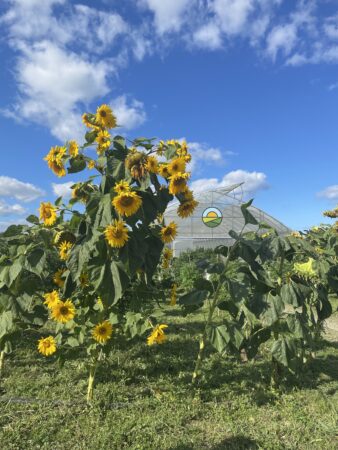
Sunflowers and Greenman Acres logo. Photo: Annex Business Media
Growing season
Rows of organic cannabis “grow in raised beds and the drip line gets put underneath,” says Hagreen. “New for us this year, these plastic covers on top protect the soil,” bringing worms to the surface and reducing weed pressure and evaporation. This means the team can conserve energy by irrigating and weed whacking less frequently.
The farm traditionally uses local labour, nine people total, and it’s all-hands-on-deck for harvest. “This year we were approached by a staffing agency with landed immigrant workers, so we have 10 of them here who started yesterday,” says Mantrop. “It’s great because we have a work force that all shows up at the same time, and they want to put the hours in, and their level of care is amazing.”
At harvest time, the cultivars have been staged one week after the next to help streamline the process. “Depending on what we’re doing with the plants, some are going to come in for flower. Some will be half for flower, half for freezing, and some will be all freezing,” says Mantrop. “So, we can always have the same amount of people here.”
Walking through the field, Hagreen and Mantrop point out new strains they’re trying, such as a cultivar with a dill pickle terpene that smells like Lays potato chips. Another strain, Roadhouse the brother-in-laws identify, will be the first off the field this year – their own breeding of Tahitian Punch crossed with Hitman OG – a sturdy plant with no trellis required.
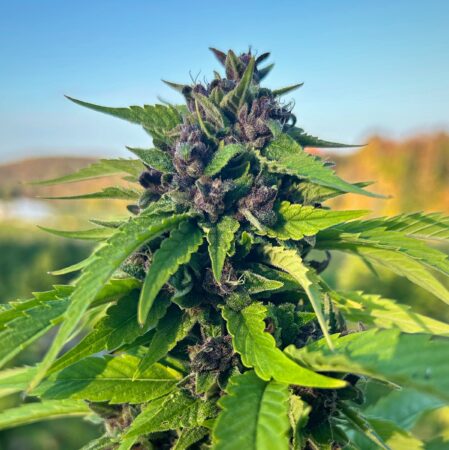
Close up of Roadhouse cultivar. Photo: Greenman Acres
Hagreen also identified a balanced 8:8 strain called CBD Critical Cure that’s selling in market as a 3.5-gram flower. The majority of the plants in the field use trellis to protect against Georgian Bay’s west wind. “Again, this Blue Dream just earned her way into the field,” says Mantrop. “But it does need support, especially once those buds develop. If there was a heavy rain, those branches would start crashing down.”
Overall, the plants remain fairly low maintenance. “We’re not growing poodles,” he says.
The team scouts throughout the growing season, keeping an eye out for cannabis aphids. By mid-September, “the aphids have done their cycle, they’ve come and gone, and it’s mainly the beetles that take care of them – lace wings and lady bugs,” says Mantrop. In the fall, the team scouts for moth or caterpillar activity, of which there is very little.
“There’s a few things we can use in our arsenal as an organic grower,” he continues. “The biggest thing is prevention. Aside from feeding through the drip lines, we do foliar spraying treatments, such as regalia an extract from giant knotweed as an immune booster.”
As the team now concludes their fantastic 2023 growing season, they will spend the winter processing product with time to reflect on the year and consider what improvements can be made moving forward.
“Plant quality and care is what drives our decision making,” says Mantrop. “And then it’s ‘how do we do this and make it more efficient without breaking our backs?’ We talked about the shovels at first – we’re always doing a lot more with less,” he says. “And that’s farming.”
Every business has its fair share of paperwork, and in all sectors, complaints about the burden of regulation and reporting are common. Within Canada’s cannabis industry, however, the paperwork requirements are intense, with a significant burden on smaller cultivators and processors.
“Larger companies producing a more standardized product are able to streamline their data entry requirements,” says Kirk Tousaw, CEO of Great Gardener Farms. “They may have more paperwork in the aggregate, but they’ll also have more employee resources available. At small companies like ours – three total employees, including the two owners – it’s very hard to find extra time or person-power to do the work.”
The nature of the paperwork itself can be frustrating. In many instances, the requirements aren’t only time-consuming – they also seem illogical.
“Particularly onerous is the requirement that all inputs into the cultivation process be tracked,” says Tousaw. “This means that every time we add nutrients to our reservoirs, we’re required to create dozens of data points. This information is absolutely unnecessary to track, which makes spending time on it frustrating.”
Perhaps due to the fact that Canada’s legal cannabis industry is a relatively young sector, the government’s cautious approach has resulted in many redundancies. The bureaucracy associated with these requirements can, at times, seem absurd.
“The fact that Health Canada and the CRA require almost the same information in slightly different formats is ridiculous,” says Sarah Campbell from the Craft Cannabis Association of BC. “You’d think they could coordinate in some way to be more efficient for all involved.”
There are also differing paperwork challenges that are dependent on the number of strains grown, and the type of cultivator, with indoor and outdoor grows having unique burdens.
“If we grow one strain and one crop a year, the paperwork is quite easy, but if we grow three strains, it gets a bit more challenging,” says Katy Connelly, owner of Sea Dog Farm, a micro in Saanichton, BC. “The harvest paperwork is a bit of a pain because they want you to weigh every leaf that comes off the field, and every plant before it goes into the compost. As an outdoor grower, my plants are the size of a Christmas tree, so all this weighing is a bit ridiculous and time-consuming if it’s done ‘by the book’.”
Working for paper
The time required to do the paperwork can be less onerous than all the weighing and recording, which are necessary administrative steps before any form is filled out.
“It makes sense to report on the number and plants and the weight of the flower,” says Connelly. “However, weighing harvested plants or raking up all the fallen leaves so I can weigh them does absolutely nothing to ‘keep the public safe’. It is just a huge waste of my time. I think most people either make these numbers up, or weigh one and multiply.”
Connelly says that processors have their fair share of headaches, too.
“I have to count seeds and weigh plants, but my processor has to register every product at the provincial and federal levels, as well as deal with labelling and excise.”
Given that smaller companies have fewer resources to fill out all the paperwork, these added requirements for microprocessors can be extreme.
“Once you get into the world of extracts, and products created from extracts – such as topicals and edibles – the way that Health Canada and the CRA track things differs hugely, and staying on top of all the requirements for reporting becomes a nightmare,” says Sami Majadla, CEO of CertiCraft, a seed-to-sale compliance software solution. “Tiny microprocessors working with edibles and topicals probably have the worst burden, in my opinion.”
Making it right
The government could fix many of these problems by reducing or streamlining requirements and eliminating redundancies. Sadly, there is no set timeline for regulatory overhaul. The current review of the Cannabis Act is part of a much larger process unlikely to result in change any time soon.
That said, given that the legal cannabis market has made a significant dent in illicit activity and that the need for such rigorous reporting requirements is moot, for many now is the time to transition to a more rational approach.
“We should move toward treating cannabis more like, for example, wine in terms of reporting requirements,” says Tousaw from Great Gardener Farms. “Vineyards don’t have to track and report their fertilizer usage monthly. While valuable and age-restricted, their product isn’t treated as inherently criminogenic. Cannabis and those in the industry continue to be stigmatized with the perspective that this substance requires significant control and reporting burdens. It does not.”
It would seem inevitable that the paperwork requirements will change at some point. For many observers, a rational approach to the sheer inefficiency and nonsensical nature of today’s regimen could result in some easy fixes.
“First off, the CRA and Health Canada should completely harmonize their requirements,” says Majadla from CertiCraft. “Secondly, the actual amount of data being tracked can be greatly reduced. To share just one example: needing to keep records of all of your prunings that have been destroyed is such a waste of time. Who cares about leaves that have no value? Nobody benefits from tracking something like that.”
In a challenging domestic market with early-mover status – Canada was the first major industrialized country to legalize cannabis – the added administrative burden placed on industry, particularly small cultivators and processors, is significantly hindering a commercial sector that’s already struggling.
“If paperwork was the only thing troubling this industry, we would all be just fine,” says Connelly of Sea Dog Farms. “As it stands, paperwork is just one more straw added to the incredible challenge of trying to survive.”
A recent investigation by Colorado marijuana regulators has found that 99% of state-legal cannabis stores were compliant with underage sales checks. Out of 285 checks, cannabis regulators found only four failures, representing a “very high” compliance rate of around 99% for 2023.
The state Department of Revenue’s Marijuana Enforcement Division (MED) noted in its latest quarterly Weeds newsletter that while any failure is unacceptable, the state still had an extremely high compliance rate for underage cannabis checks. Cannabis retailers in Colorado also had a 99% compliance rate in 2022 up from 95% in 2021, and 97% in 2020 and 2019.
While many cannabis reform opponents argued that legalizing marijuana would increase youth access to the controversial plant, data shows that age verification laws are limiting youth access to legal cannabis across the country.
Colorado residents who would like to buy legal cannabis have to show photo IDs before they can even enter a recreational cannabis retail location, meaning minors have little chance of accessing regulated cannabis products. Adult-use cannabis retailers also have to go through a training program to receive a “Responsible Vendor” certification, which further encourages company compliance while significantly limiting youth access.
Colorado legalized recreational cannabis in December 2012 and launched retail sales in January 2014. The state’s adult-use industry soon ballooned in size, thanks to significant demand for cannabis within and outside the state, reaching a whopping $1.537 billion in 2022.
With more than 20 states legalizing recreational cannabis, tens of millions of Americans have access to recreational cannabis. Consequently, most states with recreational cannabis markets only allow adults aged 21 and older to access cannabis markets and require that cannabis retailers verify their customers’ ages before selling cannabis products.
A Journal of Safety Research study from last May used underage operatives to investigate if 90 cannabis retailers in California followed state-mandated age restrictions and discovered a 100% compliance rate. Another study showed 100% of cannabis stores in Oregon passed the underage check test in a 2017 sting operation, indicating that a majority of cannabis businesses follow underage cannabis consumption restrictions deadly serious.
Data on underage cannabis checks has been so positive that former Colorado Governor John Hickenlooper said he was wrong to think that legalizing cannabis in Colorado could result in increased drug use by the youth. He explained that there has been no change in the frequency of cannabis use among teenagers, no increase in cannabis experimentation and no change in rates of driving under the influence.
This goes to show that the rise of marijuana companies such as Verano Holdings Corp. (CSE: VRNO) (OTCQX: VRNOF) may have in some way actually helped to avert teen access to cannabis due to the stringent age verification requirements retailers adhere to.
About CNW420
CNW420 spotlights the latest developments in the rapidly evolving cannabis industry through the release of two informative articles each business day. Our concise, informative content serves as a gateway for investors interested in the legalized cannabis sector and provides updates on how regulatory developments may impact financial markets. Articles are released each business day at 4:20 a.m. and 4:20 p.m. Eastern – our tribute to the time synonymous with cannabis culture. If marijuana and the burgeoning industry surrounding it are on your radar, CNW420 is for you! Check back daily to stay up-to-date on the latest milestones in the fast -changing world of cannabis.
To receive SMS alerts from CNW, text CANNABIS to 844-397-5787 (U.S. Mobile Phones Only)
Please see full terms of use and disclaimers on the CannabisNewsWire website applicable to all content provided by CNW, wherever published or re-published: https://www.CannabisNewsWire.com/Disclaimer
Beyond our institutional and social conditioning, we have our own personal programming. Whether it is our defense mechanisms, individuation, societal integration or self-righteousness, our selective conditions inhibit our interpretation and perception. The common element in these human behaviors is ego. The mind is a complex organism with conscious, intuitive and subliminal activity. It is a dense forest within which we often lose ourselves. Yet, it is not the thoughts we conjure, it is the point of perception we adopt and apply to navigate our way through the nuances of social reality.
Mirages of Interpretation
When we decide not practice awareness of our thoughts, they wander into obscure oblivion, composing assumption, criticism, judgement and interpretation. Whether it is of ourselves or others, the absence of our communication results in our perceptual dissonance. Eventually, this spirals out of control, and we lose our compass of understanding. Social reality is rife with collusion, delusion and illusion, fabricating a plethora of personal narratives which induce infinite mirages of interpretation. Our egos proliferate the stories we invent of ourselves and others, distorting and inhibiting our experience and relativity.
Female face with beautiful eyebrows and artificial eyelashes for maximum volume ” data-medium-file=”https://growupconference.com/wp-content/uploads/ur-vi-1.jpg?w=300″ data-large-file=”https://growupconference.com/wp-content/uploads/ur-vi-1.jpg?w=676″ data-id=”5422″>
Peripheral Contact
When relationships become personalized and uncomfortable, we tend to talk with everyone but the person with whom we are in dispute. Not all diversities of interpretation are “conflict.” Most are merely differences in perception. It is evident that all who were not present in our exchange(s) will be unable to provide accuracy, empathy and neutrality. Yet, we race to the first available sounding board who will quench our desire for consensus and conspiracy, regardless of our errant objectives. Our impulse is to blame and shame our opposition. In a quest to relieve ourselves of our anger, hurt and upset, we invest in malevolent actions, thoughts and feelings. Our personal toxicity becomes viral, as our venom metabolizes into our disease.
Once Upon a Time…
Our universal nature is to be creative, energetic and kind. As we “mature,” this natural expression devolves into adopting and inventing narratives and storylines of ourselves and others to occupy lapses in our communication. This becomes a justifiable practice, particularly when we lose touch with our relations and vice versa. We harbor pre-conceived delusions, believing them into existence as truth. One of the greatest crimes against humanity occurs when we give our listening (power) to erroneous narratives about others; approving with our engagement, even though we disagree. Many go the extra mile, and later feign empathy with the targeted individuals as a plea of clemency and conscience.
“Interpretation is perception without observation.”
Perceptual Reality
How we perceive our experiences is not how they occur. Before we establish our consciousness, institutionalization imposes intolerant filters of interpretation. We do not observe social reality for what it is, we see it for what we desire. The driving force of our interaction is based on our personal fears, guilt, insecurities and self-invalidation. Most of us don’t even exist, let alone evolve and thrive. Our engagement is often reactionary to the nuances of our environment. Therefore, our perceptions are distorted; influenced and manipulated by all to whom we acquiesce our personal power. Social perception is an energetic vortex, seizing every ounce of our attention, inspiration and motivation. It is the hostile takeover of our being, destroying our relativity with universality.
The Virtuality of Society
Reality, as we are conditioned to interpret, is contrary to our heart, intuition, soul and the universe. Living in a three-dimensional paradigm is a paradox of being. It confines us within the duality of thought and instinct. We have fleeting moments of epiphany, insight and transformation. However, the watermark of our extraordinary experiences vanishes, much as the impression of an ebbing wave on a beach. We may even opt to chase them, or place ourselves in environments of spirituality, though the dynamics of social reality annihilate our universality with its very existence. In essence, society is the antithesis of universal being.
The Relativity of Universality
Authentic relatedness does not exist in social reality. Our current, collective awareness simply lacks the acumen to comprehend the omnidimensionality of universal being. Universality is present in our every experience, available to all who synergize with its resonance. However, society stigmatizes the adoption, expression and embodiment of universality. Who we are being establishes what we manifest. Relativity is about being empowering and supportive of ourselves and others. Before it exists in society, it must thrive within us all. This is the human schism between what we perceive and who we choose to be.
Incommunicado
In this age of social media and artificiality, we opt for a multitude of virtual communication. Perhaps it is our amusement, indolence, obsessions, pre-occupation and routines which sentence us to the self-imposed isolation we now exhibit as contemporary, human nature. The personal conditioning we enact with our self-righteousness and vanity simulates our artificial contentment and security. It is an evasion of our opportunity to authentically relate with ourselves and others. Yet, it is our relationship with our heart, soul and the universe which empowers the experience we equate with belonging, and its eventuality as community.
The Embodiment of Soul
The deeper we spiral down the vortices of misinterpretation, misrepresentation and misunderstanding, the further we are from ourselves, others and the universe. The energetic shift now available is to observe, understand and transform the feelings, thoughts, words and actions we express as a universal way of being. In social reality, our conscious behavior empowers us, and ultimately others, to fulfill our universal purpose. It is who we are and why we exist in this paradigm. Being an expression of our soul in every moment empowers us to embody universality; so that others may empower their own.
Universal Relativity
Relatedness with each other is essential. The source of our social interaction is the unique relativity we experience with the universe. When we observe, understand and express our universality, we shift from the endless nuances of contemporary artificiality into the infinite possibility of universality. Releasing the social deficiencies of interpretive filters, judgements, opinions and prejudice empowers us to accept and embrace each other, as we are and as we are not. Our opportunity for community is in our listening. This transforms social reality. Being universality collectively is how we experience universal relativity.
You know I love Halloween, right? I also love making eco-friendly choices. So why not combine these two worlds? We’ve covered greener Christmases, so let’s strive for a less wasteful Halloween too. These ecological tricks will be a real treat!
Boo!
It’s easy to get caught up in the wasteful ways of Halloween. According to Oberlo, Americans spent $10.6 billion on Halloween in 2022. Now that’s scary!
These days, we’re all looking for ways to cut back and make better choices for our health, bank accounts, and the environment. And Halloween is no exception!
Decorations
Buying the 12-foot-tall inflatable witch at the local big box store is tempting. But save yourself the cash and the garage space by making your decorations this year.
Some of the best displays I’ve seen include homemade gravestones with handwritten ‘RIP’ messages. Making ghosts out of old sheets or spider webs using construction paper, gauze, or pipe cleaners is a fun, spooky activity.
When I was a kid, my mom had us make a homemade scarecrow using some of our old clothing and hay bales. We had so much fun making him and pulled him out of storage every Halloween!
If you splurge on Halloween decorations, buy good-quality ones that won’t be destroyed by the elements and can be used again yearly.
Costumes
Pre-packaged costume kits can be expensive, cheaply made, and are often worn once before being forgotten.
Part of the fun of Halloween is being creative. Go through things in your closet and see what you can throw together. I’ve gone to thrift shops in the past and given old things new life at Halloween.
I have a ‘tickle trunk’ of wigs and accessories we’ve found over the years and keep them neatly stored in the basement. This way, the kids can go through it and come up with a new costume idea every year!
Homemade Goodies
I’m not suggesting making homemade goodies and handing them out on the street because I feel this is a major ‘stranger-danger-red-flag’ situation. You don’t want to go down as that creepy neighbor.
But skip the pre-packaged candies if you’re celebrating at home with the kids or having a Halloween party with friends and family! Those plastic wrappers go straight to the landfill.
Like Christmas, consider making homebaked goods; there are plenty of cool ways to make them spooky. Think spider cookies, graveyard brownies, and mummy dogs. You can also make homemade candy with the kids as a science experiment. Educational and eco-friendly – the best!
If you buy candies to hand out to trick-or-treaters, plenty of ethical options exist that aren’t wrapped in a ton of plastic.
Trick-Or-Treat Bags
Plastic buckets and bags to collect candy – are you kidding me? Pillowcases will do the trick just fine. Or, you can put your harvest basket to use for the evening. Whatever you use this year, use it again every year.
Pumpkins
Lastly, ensure your jack-o’-lantern doesn’t end up rotting in a landfill. Millions of gourds are tossed into the trash on November 1st, which is madness when you consider pumpkins are food!
Carving a pumpkin as close to the big day as possible means you can chop it up and roast it to eat in soups and stews or turn it into a puree for muffins.
Many farms also look for donated, unpainted pumpkins for the pigs to snack on after Halloween.
If your pumpkin is too far gone for any of the above, add it to the compost bin for the garden!
Remember, if you don’t have the extra cash to spend on a pumpkin right now, you can always carve potatoes, turnips, melons, or beets. Get creative!
This week on Stratcann, we covered a BC company that is asking the province to use part of its share of excise tax revenues to aid struggling cannabis businesses. We also covered an ongoing string of grievances between cannabis producers and processors, and touched on the continuing issue of Canadian pot firms that are sitting on massive stockpiles of dried cannabis flower.
We also looked at new developments in the ongoing plight of some cannabis producers to use a perceived loophole in the regulations to market orally ingested cannabis products as ‘extracts’ to circumvent dosage and packaging limitations imposed on edible cannabis products by Health Canada.
Also, one year into new farmgate rules in BC, only a handful of producers are even exploring the idea due to what some say are an ill-conceived set of rules surrounding the program’s implementation.
As large cannabis companies continue to suffer from the hubris of the early days of legalization, Sundial Cannabisannounced the closure of its flagship production facility in Olds, Alberta, a rural community of about ten thousand people.
The SQDC named former food services executive Suzanne Bergeron as its new president and CEO.
Aurora Cannabis announced that it has recently completed a confidential settlement with Willow Biosciences regarding patent infringement, where the latter is alleged to have used technology developed by former Aurora CSO Jonathan Page to biosynthesize cannabinoids. Aurora also announced that it will reveal its second-quarter earnings on November 9.
A group of researchers from the University of Bangkok, Thailand, found that CBD does not interfere with certain forms of cancer treatment, and a study out of California found that cannabis packaging that appeals to youth also appeals more to grown adults, emphasizing the importance of packaging requirements and warning labels.
Scientists also say they discovered cannabidiol, a compound in cannabis known as CBD, in a common Brazilian plant, opening potential new avenues to produce the increasingly popular substance.
Two European organizations say they have received the final approval from the Swiss Federal Office of Public Health (BAG) to conduct a cannabis pilot study in Basel-Landschaft (Baselland), following approval from the Ethics Committee Northwest and Central Switzerland (EKNZ) last year. The study, led by Prof. Dr. Michael Schaub, Scientific Director of the ISGF, will examine the regulated sale of cannabis for non-medical purposes.
Up to 3,950 healthy adults living in the canton of Basel-Landschaft will be able to participate in the study in the future. Unlike other Swiss projects, the dispensing of cannabis will not take place via pharmacies or clubs but via stores as a point of sale, initially in the municipality of Allschwil.
Leafie ran a piece looking at Canadian cannabis company TGOD’s products making their way to the UK.
Monsters with Human Faces Wreak Havoc on Our Freedoms
By John & Nisha Whitehead
“But these weren’t the kind of monsters that had tentacles and rotting skin, the kind a seven-year-old might be able to wrap his mind around—they were monsters with human faces, in crisp uniforms, marching in lockstep, so banal you don’t recognize them for what they are until it’s too late.” ― Ransom Riggs, Miss Peregrine’s Home for Peculiar Children
Enough already.
Enough with the distractions. Enough with the partisan jousting.
Enough with the sniping and name-calling and mud-slinging that do nothing to make this country safer or freer or more just.
We have let the government’s evil-doing, its abuses, power grabs, brutality, meanness, inhumanity, immorality, greed, corruption, debauchery and tyranny go on for too long.
We have seen this convergence before in Hitler’s Germany, in Stalin’s Russia, in Mussolini’s Italy, and in Mao’s China: the rise of strongmen and demagogues, the ascendency of profit-driven politics over deep-seated principles, the warring nationalism that seeks to divide and conquer, the callous disregard for basic human rights and dignity, and the silence of people who should know better.
Yet no matter how many times the world has been down this road before, we can’t seem to avoid repeating the deadly mistakes of the past.
This is not just playing out on a national and international scale. It is wreaking havoc at the most immediate level, as well, creating rifts and polarities within families and friends, neighborhoods and communities that keep the populace warring among themselves and incapable of presenting a united front in the face of the government’s goose-stepping despotism.
We labor today under the weight of countless tyrannies, large and small, disguised as “the better good,” marketed as benevolence, enforced with armed police, and carried out by an elite class of government officials who are largely insulated from the ill effects of their actions.
For too long now, the American people have rationalized turning a blind eye to all manner of government wrongdoing—asset forfeiture schemes, corruption, surveillance, endless wars, SWAT team raids, militarized police, profit-driven private prisons, and so on—because they were the so-called lesser of two evils.
Yet the unavoidable truth is that the government—through its acts of power grabs, brutality, meanness, inhumanity, immorality, greed, corruption, debauchery and tyranny—has become almost indistinguishable from the evil it claims to be fighting, whether that evil takes the form of terrorism, torture, drug trafficking, sex trafficking, murder, violence, theft, pornography, scientific experimentations or some other diabolical means of inflicting pain, suffering and servitude on humanity.
At its core, this is not a debate about politics, or constitutionalism, or even tyranny disguised as law-and-order. This is a condemnation of the monsters with human faces who walk among us.
Many of them work for the U.S. government.
This is the premise of John Carpenter’s film They Live, which was released thirty-five years ago and remains unnervingly, chillingly appropriate for our modern age.
Best known for his horror film Halloween, which assumes that there is a form of evil so dark that it can’t be killed, Carpenter’s larger body of work is infused with a strong anti-authoritarian, anti-establishment, laconic bent that speaks to the filmmaker’s concerns about the unraveling of our society, particularly our government.
Time and again, Carpenter portrays the government working against its own citizens, a populace out of touch with reality, technology run amok, and a future more horrific than any horror film.
In Escape from New York, Carpenter presents fascism as the future of America.
In The Thing, a remake of the 1951 sci-fi classic of the same name, Carpenter presupposes that increasingly we are all becoming dehumanized.
In Christine, the film adaptation of Stephen King’s novel about a demon-possessed car, technology exhibits a will and consciousness of its own and goes on a murderous rampage.
In In the Mouth of Madness, Carpenter notes that evil grows when people lose “the ability to know the difference between reality and fantasy.”
And then there is Carpenter’s They Live, in which two migrant workers discover that the world is not as it seems. In fact, the population is actually being controlled and exploited by aliens working in partnership with an oligarchic elite. All the while, the populace—blissfully unaware of the real agenda at work in their lives—has been lulled into complacency, indoctrinated into compliance, bombarded with media distractions, and hypnotized by subliminal messages beamed out of television and various electronic devices, billboards and the like.
It is only when homeless drifter John Nada (played to the hilt by the late Roddy Piper) discovers a pair of doctored sunglasses—Hoffman lenses—that Nada sees what lies beneath the elite’s fabricated reality: control and bondage.
When viewed through the lens of truth, the elite, who appear human until stripped of their disguises, are shown to be monsters who have enslaved the citizenry in order to prey on them.
Likewise, billboards blare out hidden, authoritative messages: a bikini-clad woman in one ad is actually ordering viewers to “MARRY AND REPRODUCE.” Magazine racks scream “CONSUME” and “OBEY.” A wad of dollar bills in a vendor’s hand proclaims, “THIS IS YOUR GOD.”
When viewed through Nada’s Hoffman lenses, some of the other hidden messages being drummed into the people’s subconscious include: NO INDEPENDENT THOUGHT, CONFORM, SUBMIT, STAY ASLEEP, BUY, WATCH TV, NO IMAGINATION, and DO NOT QUESTION AUTHORITY.
This indoctrination campaign engineered by the elite in They Live is painfully familiar to anyone who has studied the decline of American culture.
A citizenry that does not think for themselves, obeys without question, is submissive, does not challenge authority, does not think outside the box, and is content to sit back and be entertained is a citizenry that can be easily controlled.
In this way, the subtle message of They Live provides an apt analogy of our own distorted vision of life in the American police state, what philosopher Slavoj Žižek refers to as dictatorship in democracy, “the invisible order which sustains your apparent freedom.”
Tune out the government’s attempts to distract, divert and befuddle us and tune into what’s really going on in this country, and you’ll run headlong into an unmistakable, unpalatable truth: what we are dealing with today is an authoritarian beast that has outgrown its chains and will not be restrained.
We’re being fed a series of carefully contrived fictions that bear no resemblance to reality.
Despite the fact that we are 17,600 times more likely to die from heart disease than from a terrorist attack; 11,000 times more likely to die from an airplane accident than from a terrorist plot involving an airplane; 1,048 times more likely to die from a car accident than a terrorist attack, and 8 times more likely to be killed by a police officer than by a terrorist , we have handed over control of our lives to government officials who treat us as a means to an end—the source of money and power.
As the Bearded Man in They Live warns, “They are dismantling the sleeping middle class. More and more people are becoming poor. We are their cattle. We are being bred for slavery.”
We have bought into the illusion and refused to grasp the truth.
From the moment we are born until we die, we are indoctrinated into believing that those who rule us do it for our own good. The truth is far different.
The powers-that-be want us to feel threatened by forces beyond our control (terrorists, pandemics, mass shootings, etc.).
They want us afraid and dependent on the government and its militarized armies for our safety and well-being.
They want us distrustful of each other, divided by our prejudices, and at each other’s throats.
We are little more than expendable resources to be used, abused and discarded.
In fact, a study conducted by Princeton and Northwestern University concluded that the U.S. government does not represent the majority of American citizens. Instead, the study found that the government is ruled by the rich and powerful, or the so-called “economic elite.” Moreover, the researchers concluded that policies enacted by this governmental elite nearly always favor special interests and lobbying groups.
In other words, we are being ruled by an oligarchy disguised as a democracy, and arguably on our way towards fascism—a form of government where private corporate interests rule, money calls the shots, and the people are seen as mere subjects to be controlled.
Rest assured that when and if fascism finally takes hold in America, the basic forms of government will remain: Fascism will appear to be friendly. The legislators will be in session. There will be elections, and the news media will continue to cover the entertainment and political trivia. Consent of the governed, however, will no longer apply. Actual control will have finally passed to the oligarchic elite controlling the government behind the scenes.
Sound familiar?
Clearly, we are now ruled by an oligarchic elite of governmental and corporate interests.
We have moved into “corporatism” (favored by Benito Mussolini), which is a halfway point on the road to full-blown fascism.
Corporatism is where the few moneyed interests—not elected by the citizenry—rule over the many. In this way, it is not a democracy or a republican form of government, which is what the American government was established to be. It is a top-down form of government and one which has a terrifying history typified by the developments that occurred in totalitarian regimes of the past: police states where everyone is watched and spied on, rounded up for minor infractions by government agents, placed under police control, and placed in detention (a.k.a. concentration) camps.
For the final hammer of fascism to fall, it will require the most crucial ingredient: the majority of the people will have to agree that it’s not only expedient but necessary.
But why would a people agree to such an oppressive regime?
Fear is the method most often used by politicians to increase the power of government. And, as most social commentators recognize, an atmosphere of fear permeates modern America: fear of terrorism, fear of the police, fear of our neighbors and so on.
The propaganda of fear has been used quite effectively by those who want to gain control, and it is transforming the populace into fearful, compliant, pacified zombies content to march in lockstep with the government’s dictates.
This brings me back to They Live, in which the real zombies are not the aliens calling the shots but the populace who are content to remain controlled.
When all is said and done, the world of They Live is not so different from our own. As one of the characters points out, “The poor and the underclass are growing. Racial justice and human rights are nonexistent. They have created a repressive society, and we are their unwitting accomplices. Their intention to rule rests with the annihilation of consciousness. We have been lulled into a trance. They have made us indifferent to ourselves, to others. We are focused only on our own gain.”
We, too, are focused only on our own pleasures, prejudices and gains. Our poor and underclasses are also growing. Injustice is growing. Inequality is growing. A concern for human rights is nearly nonexistent. We too have been lulled into a trance, indifferent to others.
Oblivious to what lies ahead, we’ve been manipulated into believing that if we continue to consume, obey, and have faith, things will work out. But that’s never been true of emerging regimes. And by the time we feel the hammer coming down upon us, it will be too late.
So where does that leave us?
The characters who populate Carpenter’s films provide some insight.
Underneath their machismo, they still believe in the ideals of liberty and equal opportunity. Their beliefs place them in constant opposition with the law and the establishment, but they are nonetheless freedom fighters.
When, for example, John Nada destroys the alien hypno-transmitter in They Live, he delivers a wake-up call for freedom. As Nada memorably declares, “I have come here to chew bubblegum and kick ass. And I’m all out of bubblegum.”
In other words: we need to get active and take a stand for what’s really important.
Stop allowing yourselves to be easily distracted by pointless political spectacles and pay attention to what’s really going on in the country.
As I make clear in my book Battlefield America: The War on the American People and in its fictional counterpart The Erik Blair Diaries, the real battle for control of this nation is taking place on roadsides, in police cars, on witness stands, over phone lines, in government offices, in corporate offices, in public school hallways and classrooms, in parks and city council meetings, and in towns and cities across this country.
All the trappings of the American police state are now in plain sight.
Wake up, America.
If they live (the tyrants, the oppressors, the invaders, the overlords), it is only because “we the people” sleep.
Organigram, the New Brunswick producer that had its Jolts lozenges taken off shelves earlier this year, says it is again offering the “ingestible extract” product in several provincial markets.
The move comes after a Federal Court ruled in August that Health Canada’s decision on the ingestible extracts was, in part, due to it including additional factors in its decision-making process that Ogranigram was not provided an opportunity to respond to.
The judgement, posted on August 8, states that Organigram’s application for judicial review had been granted. The matter was then sent back to Health Canada for redetermination, taking the judge’s reasons into consideration.
Organigram now says that Health Canada has accepted the Judge’s ruling and no longer considers Jolts to be out of compliance with federal regulations.
“On August 8th, the Federal Court ruled in Organigram’s favour by finding that Health Canada had breached its duty of procedural fairness in rendering its classification decision on JOLTS; the court ordered Health Canada to make a redetermination,” a representative with Organigram tells StratCann via email.
“Health Canada has acknowledged that it accepts the decision of the court, and that it considers its initial classification decision on JOLTS to be void. As such, pending the final redetermination by Health Canada, Organigram has reinstated the commercialization of JOLTS.”
“Organigram remains of the view that Edison JOLTS are properly classified as a cannabis extract.”
The products, the spokesperson says, are being sold in New Brunswick now, will be at Manitoba retail next week, and they expect a shipment to Ontario in two weeks time.
Health Canada was not immediately available for comment.
Organigram and others who have made these products contend they are compliant products.
In early January 2023, Health Canada sent a notice to producers highlighting their concerns with these types of products. Companies were told they had until May 31, 2023, to cease sales and distribution. They all complied.
Health Canada issued a public warning about these products on March 3. However, earlier this week, Health Canada told StratCann that it had again identified several edible cannabis products it deems as being incorrectly sold as cannabis extracts, and that the regulator is working with several cannabis producers to address the issue.
This article will be updated as more information becomes available.
Ohio may soon be the latest state in America to legalize recreational cannabis. Reform activists collected enough signatures for a legalization initiative titled Issue 2, and Ohioans are on track to vote on the measure in November.
Multiple polls have found that most Ohio residents plan to vote in favor of the initiative to legalize and regulate recreational cannabis in the state. For example, a September poll by the Coalition to Regulate Marijuana Like Alcohol found that 55% of voters would “probably” or “definitely” support the recreational cannabis legalization initiative.
Before Ohio potentially launches the latest recreational cannabis market in the country, the state could learn from neighbor Michigan, which legalized recreational marijuana in 2019. Soon after, border towns such as Adrian, Michigan, were home to dispensaries that regularly served customers from Ohio.
Amazing Budz dispensary general manager Chris Jacobson notes that half of his customers drive from Ohio, many of them wearing Ohio State University jerseys. Jacobson says some customers come in search of a sleep aid while others are looking for something to boost their appetites.
Ohio Issue 2 will legalize the cultivation, processing, distribution, sale, purchase, possession, home cultivation and use of cannabis for adults aged 21 years and older. It would allow adults to possess up to 15 grams of cannabis concentrates and up to 2.5 ounces of cannabis while also allowing the cultivation of up to six cannabis plants at home.
Local and state taxes on cannabis sales would be divvied up between social-equity and job programs, addiction treatment and education, funding for dispensary host communities, and administrative and regulatory costs.
If Ohio does legalize recreational cannabis, the state could learn some lessons from Michigan’s adult-use industry as well. This could include the average onboarding process for customers at cannabis dispensaries.
Jacobson says his dispensary serves all adults aged 21 and older regardless of their state of origin and uses state-issued IDs to verify customer identity and age. Like Michigan, Ohio first started with a medical cannabis industry and could copy Michigan’s format of dispensaries selling both recreational and medical cannabis.
For instance, Amazing Budz started out as a medical cannabis dispensary, incorporated adult-use marijuana two years later, and now serves both medical and recreational cannabis customers. Jacobson says the creation of cannabis testing standards reduced the risk of tainted products hitting the market, something that could also benefit the Ohio market and protect Ohioans from consuming contaminated cannabis products.
However, recreational cannabis operators in Ohio will also have to deal with the drawbacks of federal prohibition, such as lack of access to banking services.
If and when Ohio eventually launches its recreational marijuana market, opportunities will open up for many companies to potentially grow to the levels that other cannabis enterprises such as TerrAscend Corp. (TSX: TSND) (OTCQX: TSNDF) have risen to in the years that they have been in operation.
About CNW420
CNW420 spotlights the latest developments in the rapidly evolving cannabis industry through the release of two informative articles each business day. Our concise, informative content serves as a gateway for investors interested in the legalized cannabis sector and provides updates on how regulatory developments may impact financial markets. Articles are released each business day at 4:20 a.m. and 4:20 p.m. Eastern – our tribute to the time synonymous with cannabis culture. If marijuana and the burgeoning industry surrounding it are on your radar, CNW420 is for you! Check back daily to stay up-to-date on the latest milestones in the fast -changing world of cannabis.
To receive SMS alerts from CNW, text CANNABIS to 844-397-5787 (U.S. Mobile Phones Only)
Please see full terms of use and disclaimers on the CannabisNewsWire website applicable to all content provided by CNW, wherever published or re-published: https://www.CannabisNewsWire.com/Disclaimer










 Female face with beautiful eyebrows and artificial eyelashes for maximum volume ” data-medium-file=”https://growupconference.com/wp-content/uploads/ur-vi-1.jpg?w=300″ data-large-file=”https://growupconference.com/wp-content/uploads/ur-vi-1.jpg?w=676″ data-id=”5422″>












Recent Comments