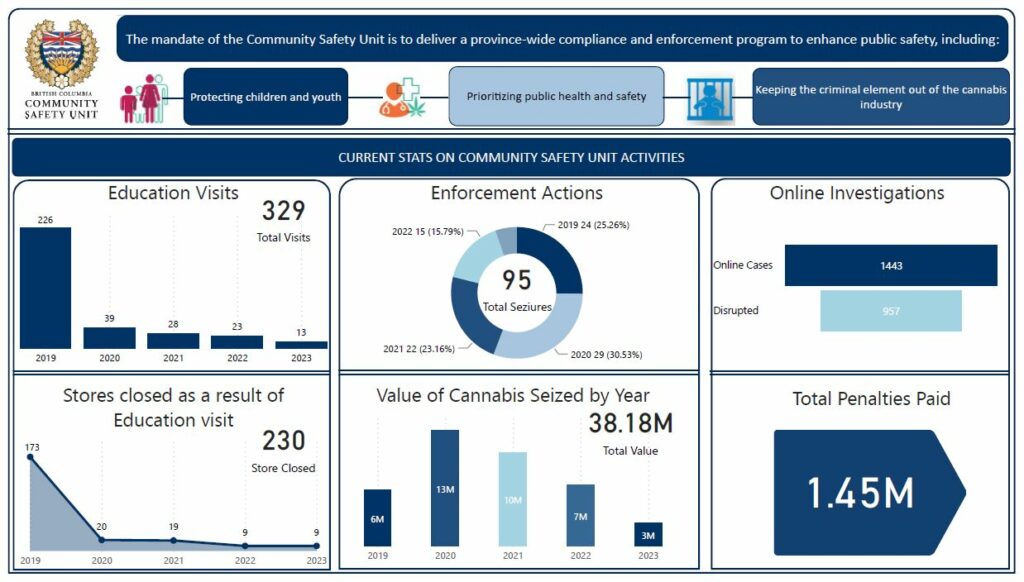
The BC Community Safety Unit has seized $3 million worth of cannabis so far this year, for a total of $38.18 million since it began enforcement actions in 2019.
BC’s Community Safety Unit (CSU) is the provincial agency charged with monitoring and enforcing the province’s retail cannabis rules and regulations. CSU investigators can conduct compliance and enforcement activities against unlicensed cannabis retailers and other illegal sellers across the province.
The agency began with a mandate of education in 2019, in many cases first visiting stores and informing them of provincial cannabis laws and regulations before moving on to issuing fines, seizing products and equipment, or shutting down unlicensed businesses.
It has undertaken four enforcement actions so far in 2023, for a total of 95 seizures since 2019. The most significant number of product seizures was in 2020, worth $13 million, following 227 educational visits in 2019.
There have been 230 stores that have closed as a result of those education visits, nine of them in 2023.
The number of seizures and correlating value has been declining since then, with $10 million worth of cannabis products seized in 2021, $7 million in 2022, and $3 million in the first ten months of 2023.
In Parliament earlier this year, BC Minister of Public Safety and Solicitor General Mike Farnworth said that the CSU has also conducted nine enforcement actions on First Nations reserves in the province, seizing about $12 million worth of products.
The province also issues fines to illicit cannabis stores if they refuse to close after several warnings and/or seizures. So far, the CSU has issued at least 58 notices of administrative monetary penalty with proposed penalties totalling approximately $39.9 million, with only about $1.45 million of these penalties already collected.
Under BC’s Cannabis Control and Licensing Act, there are three types of orders issued by the Director of the Community Safety Unit (CSU) with respect to the issuance of administrative monetary penalties (AMPs); Concession Orders, Compliance Orders, and Reconsideration Orders.
Administrative penalties are generally twice the value assigned to the products seized.
If the Director proposes to impose a monetary penalty for a contravention of the CCLA, the Director must serve the person with an NAMP. Unless the person signs a waiver and admits to the contravention (Concession Order), the monetary penalty (AMP) is an amount equal to two times the retail value of the cannabis that the person, in contravention of the Act, sold, possessed for the purpose of sale, or produced. If they do sign the waiver (Compliance Order), their penalty is equal to the retail value of the cannabis sold, possessed or produced.
Canada legalized recreational cannabis in October 2018 via the Cannabis Act and allowed the cultivation, production, import, export, distribution, purchase, sale and consumption of recreational cannabis by legal adults. The country’s cannabis industry reached $4.4 billion in value in 2022 and is expected to hit $7.7 billion by 2026.
However, even though around 27% of the population has reportedly used cannabis in the past 12 months and recreational cannabis has been legal for half a decade now, stigma about cannabis still persists throughout the country.
Legalization was swiftly followed by a rush of new cannabis shops in several Canadian cities, but many users still contend with cannabis-related stigma. Kate Grimmell, a budtender in LaSalle-based Greentown Cannabis, gives the example of her favorite customer, an elderly woman who still hasn’t told her daughter she uses cannabis and hides her purchases to keep her consumption secret.
While some Canadians are open about their cannabis use and treat the drug the same way they would treat buying alcohol at a liquor store, some people go to great lengths to hide the fact that they use cannabis, Grimmell says. Such people refuse to create accounts with cannabis dispensaries to avoid leaving a paper trail because they are worried about what other people would think if their cannabis use was discovered.
Canadian law has also severely limited the recreational cannabis industry’s ability to market and advertise itself. Facebook and Instagram’s parent company Meta has banned cannabis marketing on all its platforms as well. In addition, Google does not allow ads that promote the sale and use of marijuana.
Greentown Cannabis’s operator Katzman Enterprises vice president Palash Tiwari explains that cannabis stores cannot advertise on billboards. Tiwari says that while the recreational industry is grateful to the government for issuing many cannabis licenses, restrictive cannabis marketing policies severely limit the sector’s ability to reach customers.
According to Windsor-Essex County Health Unit (WECHU) director of public health programs Eric Nadalin, recreational cannabis legalization has been accompanied by a “slight increase” in cannabis-related emergency room visits and hospitalizations. WECHU’s data shows that there were only 76 marijuana-related hospitalizations per 100,000 Canadians in 2018; however, the number ballooned to 101 in 2021.
Nadalin says the increase is due to accidental cannabis poisonings, traffic accidents caused by intoxicated driving and marijuana’s effect on young brains. He noted that we should ensure members of the community are aware of the risk of consuming “legal but harmful” products like alcohol and cannabis.
The persisting stigma against people who use marijuana either for medical or recreational reasons may be having some impact on the licensed companies that are active in this regulated industry, such as Cronos Group Inc. (NASDAQ: CRON) (TSX: CRON), in one way or the other.
About CNW420
CNW420 spotlights the latest developments in the rapidly evolving cannabis industry through the release of two informative articles each business day. Our concise, informative content serves as a gateway for investors interested in the legalized cannabis sector and provides updates on how regulatory developments may impact financial markets. Articles are released each business day at 4:20 a.m. and 4:20 p.m. Eastern – our tribute to the time synonymous with cannabis culture. If marijuana and the burgeoning industry surrounding it are on your radar, CNW420 is for you! Check back daily to stay up-to-date on the latest milestones in the fast -changing world of cannabis.
To receive SMS alerts from CNW, text CANNABIS to 844-397-5787 (U.S. Mobile Phones Only)
Please see full terms of use and disclaimers on the CannabisNewsWire website applicable to all content provided by CNW, wherever published or re-published: https://www.CannabisNewsWire.com/Disclaimer
Nearly one year into the launch of BC’s cannabis farmgate program, some growers say the current cost to participate is too high for them.
The program, launched in late 2022, has only seen three companies apply so far—one in the interior, one on Vancouver Island, and one in the Greater Vancouver area or Sunshine Coast, these few out of more than 100 eligible growers in the province.
Only one of those has been licensed so far, ShuCanna in Salmon Arm, while another on Vancouver Island, the Victoria Cannabis Co, is in the final stages of licensing as it awaits final approval from the city. A third, identified by BC only as being in either the Vancouver region or Sunshine Coast, only recently applied and is still making its way through the approval process.
BC’s official name for a farmgate licence is a Producer Retail Store (PRS). The province previously licensed two other farmgate stores through special arrangements with two First Nations-owned cannabis producers, both approved in 2022, although these are not listed by the province as a PRS.
This low number of applicants indicates a policy failure, say some growers in the province. The licence category is impractical for their location or business model, especially with the high costs involved, including application fees and adhering to all the building and security requirements.
In addition to the nearly $10,000 in provincial application fees for the farmgate licence, Alannah Davis at Dabble Cannabis on Vancouver Island says another hurdle is the need to spend significantly more to build a full-time store that would adhere to provincial rules.
“We really want Farmgate,” says Davis. “So the low number of applications, in my opinion, is not indicative of the number of farmers wanting to sell directly to customers. That’s the dream.
Alannah Davis, Dabble Cannabis Co.
Dabble Cannabis is a federally licensed cannabis cultivator and processor with its own highly secured storage areas, something she says should more than satisfy provincial concerns around security rather than building a new store.
While the provincial regulations require a Farmgate store to essentially operate as a full-time retail store, she sees the model making more sense on a seasonal and case-by-case basis.
Instead of running a full-time retail cannabis store on her farm, Davis wants the province to allow her to get a more scaled-down licence that would enable her to sell products to visitors at her farm.
“We really want Farmgate,” says Davis. “So the low number of applications, in my opinion, is not indicative of the number of farmers wanting to sell directly to customers. That’s the dream.
“We definitely want to, but the way it is now, it has the same requirements as a cannabis retail establishment, which means that the cost of creating an entirely new full-fledged retail environment, at this point in time, I don’t believe we’ll see a return on the investment that is required.”
“The cost to get there is too prohibitive right now,” she continues. “I want an interim fulfilment step, either via mail or in-person click-and-collect, using my existing infrastructure. Then that allows for any producer with a secure storage area to complete a transaction online and deliver it to that person. It is really an over-engineering of the policy to prohibit producers from selling direct to customers.”
“People love the product, they keep coming back. They love how fresh it is. But now it’s a matter of letting more people know we are here. There’s so many restrictions on advertising that it’s hard to get the message out.”
Terry Robinson, ShuCanna
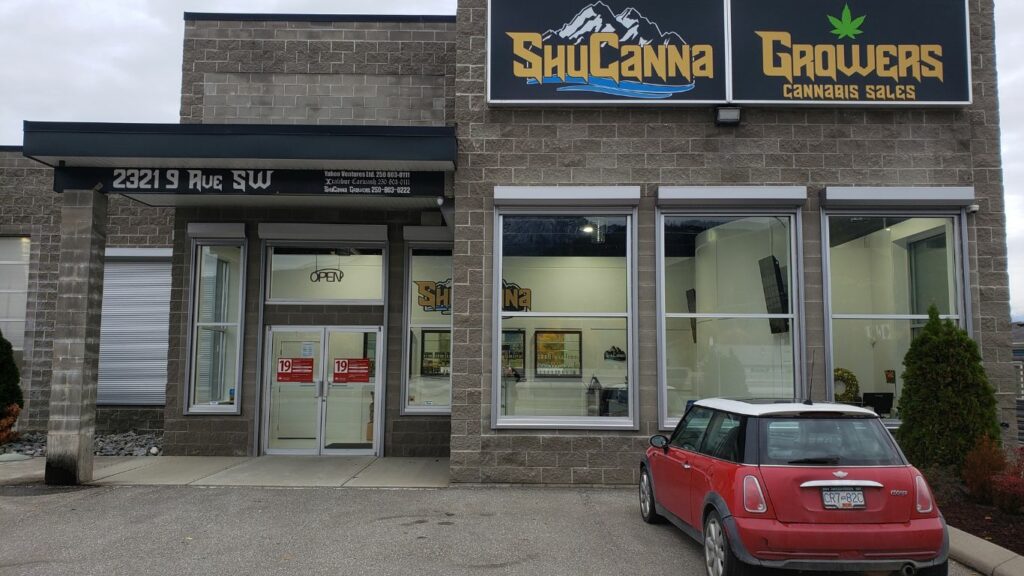
ShuCanna’s farmgate store located at 2321 Trans-Canada Hwy, Salmon Arm.
Katy Connelly, the co-owner of Seadog Farm, another outdoor cannabis grower on Vancouver Island, echoes Davis’ concerns, especially regarding the costs of building a store.
If there were a more affordable and streamlined program, she says she might consider taking part—her business already operates a small farmgate stand for other products from her farm, such as fresh seasonal produce. But as it stands, the process is too costly and onerous. Instead, she says she would rather focus on good relationships with those who already have retail.
“I would need three licences, and each licence is $2,500 a year. I would have to report on each of these licences,” she says. “I would also need at least a million in excise bonds and a special business licence from the BC government. I would have to build a store to sell cannabis from; I would have to hire an employee to sell the cannabis. I only have one thing to sell; I don’t have a huge storefront.”
“It’s not worth the paperwork, and there’s a system already in place to sell my product,” adds Connelly. “There are processors who will process my cannabis into pre-rolls, so why would I want to do that myself? And there are stores that are looking for products and enthusiastic about selling our product. So why would I not sell through them?
Connelly says she’s explained these issues to the government and does think they are hearing and understanding them but hasn’t seen any policy changes yet. Instead, she thinks they are listening to those who want a system that won’t ever be viable for a regulated product like cannabis.
“I think the people who are advocating for Farmgate want to sell like they used to sell in the old days and not have to do all the paperwork and insurance and all of that. They just want to put their cannabis in jars and sell like they used to, but that is not the way of the world.”
Back at Dabble, Davis says the ideal model is something more resembling the seasonal tourism of wineries.
“It really comes down to an ROI and the upfront cost. The running of the entire retail operation has tons of costs associated with getting it up and operational. “
Like Connelly, she has engaged with the government’s policymakers on the issue but has been told their focus now is on event licensing and consumption spaces, not refining Farmgate. While these could tie into her vision of Farmgate, until the province makes it more viable and practical for smaller growers like herself, she says she expects there won’t be more applying.
“Three licence holders out of a hundred plus, that’s an obvious failure in the policy, and I think that given the taxpayer funds already spent on this program, I think it is their responsibility to take the feedback of those who actually want to do it and work together to make the changes to make it attractive for us. Otherwise, who is this for? It is a failure. It was designed for farms like us, and if we don’t want to do it, who will?
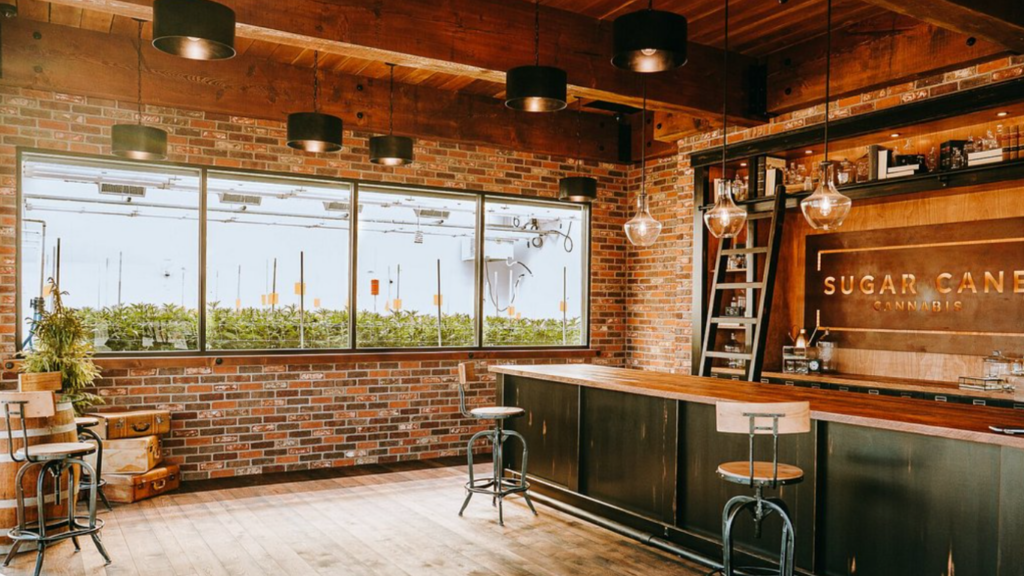
Sugar Cane Cannabis’s farmgate store in Williams Lake, which includes an in-store window into their grow room. Image via William’s Lake First Nation.
BC’s first official farmgate store licensed in BC, ShuCanna, located on the Trans Canada Highway in Salmon Arm, opened recently. Terry Robinson, owner of the facility, says he was eager to apply as soon as BC announced its licensing program in late 2022. While it was a lengthy and pricy process, including the nearly $10,000 in provincial fees—not to mention municipal licensing fees and the cost of renovating and then stocking and staffing the store—Robinson says it was fairly easy.
The challenge he says he faces now is getting the word out about their store. ShuCanna currently carries their own dried flower and pre-rolls, as well as an array of products from the LDB, such as concentrates vape pens, accessories, and more.
“People love the product; they keep coming back,” says Robinson. “They love how fresh it is. But now it’s a matter of letting more people know we are here. There are so many restrictions on advertising that it’s hard to get the message out.”
Although their “soft launch” was in late August, ShuCanna’s grand opening will be Friday, October 27.
Cannabis Farmgate across Canada
Ontario and New Brunswick are the only other provinces with any formal Farmgate program in place, both launched in 2021. Five locations are currently open in Ontario and six in New Brunswick.
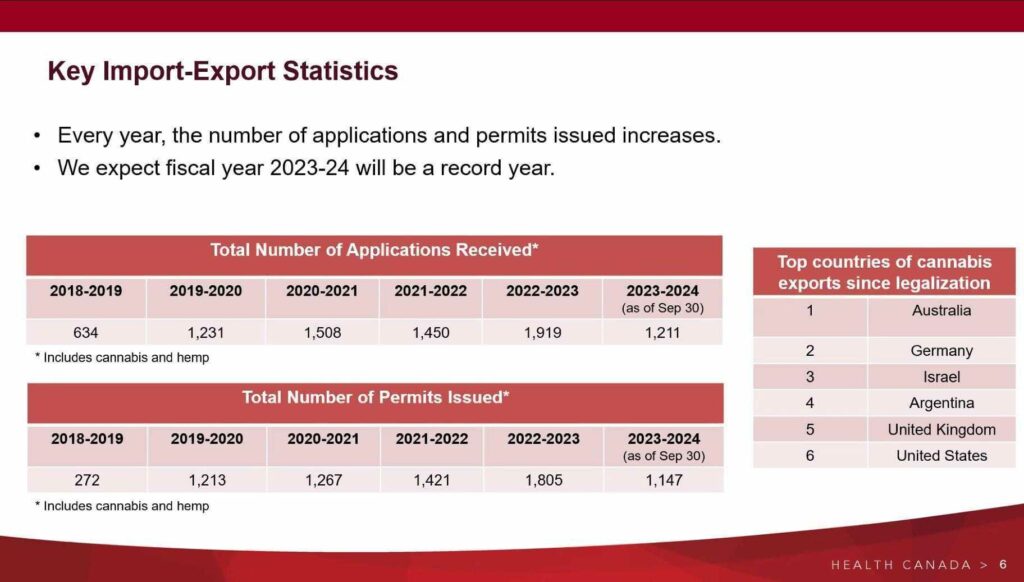
Health Canada expects cannabis exports to continue to increase significantly, with more than a thousand applications already submitted as of September 12, 2023.
The federal regulator has already received 1,211 applications from Canadian companies seeking to export cannabis since the beginning of the fiscal year on April 1, 2023, and has approved 1,147. In a presentation made online on Tuesday, October 24, a representative with Health Canada said they expect these numbers to continue to increase.
The number of applications and permits issued has been increasing on an annual basis, with 1,805 permits issued in 2022-2023, 1,421 in the previous year, 1,267 in 2020-21, 1,213 in 2019-20, and 272 in 2018-19.
The top countries for Canadian companies to export cannabis to are, in order, Australia, Germany, Israel, Argentina, the UK, and the US.
Canada’s Cannabis Regulations allow for the export of cannabis to countries with a recognized legal medical cannabis framework. Currently, exports are only allowed to countries with a medical cannabis framework, often helping to address supply gaps in various countries that have recently legalized.
Canada also allows imports of cannabis on a very limited basis, such as importing starting materials (e.g., seeds, plants) for a new licence holder, or for small quantities of cannabis for research purposes.
As of March 2023, the most recent data from Statistics Canada shows that 125,981.76 kg of dried cannabis had been permitted to be exported from Canada, and 98,260.18 litres of cannabis oil. Only 28.05 kilograms of dried cannabis and 65.88 litres of oil were imported into Canada.
Several medical cannabis companies in Hawaii have pioneered a new sales route in the state that involves delivering wholesale cannabis flower and other cannabis products from one island to another. Hawaii legalized medical cannabis in 2000 via the state legislature and has only eight licensed medical marijuana dispensaries scattered across the archipelago.
The island state’s unique topography may have allowed for the growth of this new sales route as medical marijuana businesses strived to increase their reach and serve as many Hawaiians as possible.
Hopping between islands by boat, helicopter or plane is common for both residents and visitors, and cannabis businesses in the state are leveraging established transportation pathways to deliver their products across various islands. Although these businesses haven’t been quick to share how they move their products between islands, likely to avoid legal and other issues, it is clear that they are island hopping to serve the thousands of medical marijuana patients in the state as efficiently as possible.
This new process is in a legal gray area because traveling between islands in Hawaii requires moving across federal waters — and federal law still outlaws cannabis. Hawaii legislators allowed cannabis operators in the state to island hop in June when they legalized wholesale marijuana sales by state-licensed firms to cannabis businesses on other islands. The interisland trade route officially became legal in August, and cannabis operators in Hawaii have been quick to take advantage.
Big Island Grown was the first company to complete Hawaii’s first cannabis wholesale interisland deal with Kauai-based Green Aloha dispensary. Green Aloha sold out of Big Island Grown’s cannabis flower in only slightly over a week at its dispensaries in Koloa and Kappa, Big Island Grown CEO Jaclyn Moore says.
Big Island Grown is also the sole licensed hydrocarbon extractor in Hawaii, and it is currently seeking Hawaii State Department of Health approval to deliver concentrates such as live resin vape pens and gummies wholesale to retailers. Moore says the cannabis company noticed a market for cannabis concentrates on the other islands that don’t have hydrocarbon extractors. The company now supplies around 30% of all weighted marijuana products in the Hawaiian market, Moore says.
Moore declined to discuss specific details on logistics and cannabis transportation, citing worker safety and the inherent sensitivity of the issue.
Big Island Grown and other companies may be using commercial flights and island-hopper planes, commercial boats and private charters to move their products between islands.
Given the challenging operational environment that cannabis companies often have to contend with, it isn’t surprising that island hopping has become the norm. Even large companies such as Canopy Growth Corp. (NASDAQ: CGC) (TSX: WEED) operating in large markets such as Canada also have their own regulatory issues to navigate.
About CNW420
CNW420 spotlights the latest developments in the rapidly evolving cannabis industry through the release of two informative articles each business day. Our concise, informative content serves as a gateway for investors interested in the legalized cannabis sector and provides updates on how regulatory developments may impact financial markets. Articles are released each business day at 4:20 a.m. and 4:20 p.m. Eastern – our tribute to the time synonymous with cannabis culture. If marijuana and the burgeoning industry surrounding it are on your radar, CNW420 is for you! Check back daily to stay up-to-date on the latest milestones in the fast -changing world of cannabis.
To receive SMS alerts from CNW, text CANNABIS to 844-397-5787 (U.S. Mobile Phones Only)
Please see full terms of use and disclaimers on the CannabisNewsWire website applicable to all content provided by CNW, wherever published or re-published: https://www.CannabisNewsWire.com/Disclaimer
Nova Scotia saw an 8.7 percent increase in cannabis sales in its second quarter of 2023, to $31.4 million.
Retail customer transactions for cannabis also increased by 13.8 percent, while the average dollar value of each transaction decreased by 4.4 percent to $37.04. The average price per gram for cannabis also decreased by 3.5 percent to $6.03, one of the lowest average prices in Canada.
As in the previous quarter, growth in cannabis sales was led by a significant increase in sales of local cannabis products, for a total of $10.3 million in Q2. This brings the sale of locally-grown and produced cannabis products in Nova Scotia to nearly one-third of all cannabis sales.
The same time period saw alcohol sales increase by only 0.1 percent, although the total sales still significantly surpassed cannabis, at $210.7 million.
Sales increases for cannabis are potentially related to the opening of a new retail cannabis store in Halifax by adding cannabis to an existing liquor store location on Young Street. Nova Scotia is one of the few provinces that allows the co-location of cannabis and alcohol.
“Over the past five years, we have worked hard to increase the opportunity for our customers to access cannabis safely,” explains Greg Hughes, President & CEO of the Nova Scotia Liquor Corporation (NSLC). “We started with 12 cannabis locations, and now we’re up to 49 stores across the province.”
Advances in psychedelic research have found that psilocybin mushrooms may be able to treat mental conditions such as depression, cancer-related psychological stress and substance use disorders.Psilocybin-assisted therapy typically involves going through a guided psilocybin experience and using talk therapy to integrate the insights and realizations made during the experience into everyday life.
This kind of treatment has proven that it can alleviate mental disorders including depression, but many patients aren’t keen on going through what might be an hours long psilocybin trip. While some people simply aren’t comfortable with the idea of being under the influence of a drug, others can be held back by anxiety. Some can develop intense feelings of anxiety during psychedelic trips, which can significantly reduce the quality of the experience even making it quite unpleasant.
Fortunately, this intense anxiety is often temporary, and patients can use psilocybin-assisted therapy to alleviate anxiety-related symptoms for the long-term. According to neuroscientist Natasha Mason, some people feel anxious during psychedelic trips because of glutamate level changes in different brain regions. The researcher found that people who experience anxiety and have bad trips often have higher glutamate levels in the medial prefrontal cortex.
Furthermore, lower glutamate levels in the hippocampus were associated with positive ego dissolution. Ego dissolution refers to the decoupling of the medial temporal lobe and the default mode network and can result in either anxiety or feelings of oneness and unity. Anxious ego dissolution can cause generalized anxiety, excessive vigilance and paranoia.
The presence of neurotic personality traits can also increase a patient’s likelihood of experiencing anxiety during a psilocybin trip. Researchers from the Institute of Psychiatry, Psychology and Neuroscience at King’s College London found that neuroticism resulted in more challenging and anxiety-ridden psychedelic experiences.
A study analyzing the role of neuroticism in psychedelic trips found that higher levels of neuroticism caused more intense feelings of anxiety compared to lower levels of neuroticism. The researchers discovered that neuroticism increases the risk of feelings such as anxiety, depression, irritability and anger.
The study also found that age can determine the presence and intensity of anxiety during psilocybin trips. Data from the King’s College London study indicated that older people had less anxiety and more pleasant psychedelic experiences compared to younger individuals. This may be due to the benefits associated with advanced age, such as better coping skills for challenging experiences. Factors such as environment, dose and mind set can also determine whether you experience anxiety during a psychedelic trip.
As companies such as Seelos Therapeutics Inc. (NASDAQ: SEEL) gather more data during their psychedelic drug-development activities, more insights could be revealed about the nuances observed in how different people react during psychedelic-assisted therapy.
About PsychedelicNewsWire
PsychedelicNewsWire (“PNW”) is a specialized communications platform with a focus on all aspects of psychedelics and the latest developments and advances in the psychedelics sector. It is one of 60+ brands within the Dynamic Brand Portfolio @ IBN that delivers: (1) access to a vast network of wire solutions via InvestorWire to efficiently and effectively reach a myriad of target markets, demographics and diverse industries; (2) article and editorial syndication to 5,000+ outlets; (3) enhanced press release enhancement to ensure maximum impact; (4) social media distribution via IBN to millions of social media followers; and (5) a full array of tailored corporate communications solutions. With broad reach and a seasoned team of contributing journalists and writers, PNW is uniquely positioned to best serve private and public companies that want to reach a wide audience of investors, influencers, consumers, journalists and the general public. By cutting through the overload of information in today’s market, PNW brings its clients unparalleled recognition and brand awareness. PNW is where breaking news, insightful content and actionable information converge.
To receive SMS alerts from PsychedelicNewsWire, text “Groovy” to 21000 (U.S. Mobile Phones Only)
Please see full terms of use and disclaimers on the PsychedelicNewsWire website applicable to all content provided by PNW, wherever published or re-published: https://www.PsychedelicNewsWire.com/Disclaimer
Before pumpkins became the canvas for a witch’s cat or toothless scarecrow, there were turnips. In ancient times, the Celts living in Ireland, the UK, and northern France celebrated the new year on November 1st. They believed that the night before the new year, the veil between the worlds of the living and the dead lifted, and spirits roamed the earth. Lanterns with ghoulish faces were carved out of turnips, potatoes, and beets and then placed on windowsills to scare away those ghosts with evil intentions.
Irish immigrants brought the tradition to North America, but instead of turnips, they carved pumpkins. Primarily found in North America, a pumpkin was easy to grow, much larger than a turnip, and soon became the quintessential emblem of Halloween.
But who’s to say you still can’t carve a turnip? How about a bell pepper or watermelon?
Turnips
Turnips are more challenging to carve than pumpkins and will take more time and effort to hollow out, but they might be even scarier when lit up. Just keep the top to add a cover and flatten the bottom so it sits solidly on the porch or windowsill.
Shorter lasting than pumpkins, they’re only good outdoors for about three to five days before they start to rot, so carving them closer to October 31st is a must. But, like a pumpkin, you can cut anything in a turnip, from the traditional toothless-faced goblin to a small ghost.
Potatoes
Potatoes are great for carving. Although a little tricky to hollow out, the starch in the potato means it holds up well to sculpting. Buy a bag of Russet potatoes (the best for carving), and if you make a mistake, eat potato salad for dinner! Carve a whole bunch, stack them, and create a pyramid of scary ghouls and goblins!
Bell peppers
Bell peppers add color to any Halloween display. Mostly hollow, they are super easy to scoop out but don’t last long once carved. They can also be brittle, so keep your carving simple to avoid cracks and breakage.
Beets
Beets are similar to turnips in size and texture. Their dark red color adds a ghoulish vibe to the Halloween display. Carved beets will last up to a week if kept cool outside or in the fridge until you are ready to set them out. Beets bleed, and as you carve them, your hands will get blood red – how much fun for the kids is that?
Melons
Cantaloupe and honeydew are easy to carve, but watermelon ranks alongside pumpkins as the easiest alternative vegetable and fruit to carve.
They’re large, easy to hollow out, and can be made into anything. The bright pink interior is a freakish sight when lit up against the green skin of the fruit. Sadly, melons will not last long outside, so plan to carve close to the big day.













Recent Comments