(Globe Newswire) Vancouver — Rubicon Organics Inc., a licensed producer focused on cultivating and selling organic certified, premium cannabis, today announces the launch of Wildflower brand edibles crafted with minor cannabinoids including CBD, CBN and CBG.
Wildflower is Canada’s leading topical brand with the #1 brand positioning in its market, and is expanding its product portfolio into the edibles category.
“I am excited to expand the Wildflower brand into a new product category with our launch of minor cannabinoid edibles,” said Melanie Ramsey, chief commercial officer. “At Rubicon Organics we strive to deliver innovative and premium products and these edibles are a significant step to expanding our Wildflower product line-up to offer a range of high-quality, natural gummies. Our entry into the edibles category reflects our commitment to meeting the evolving needs and preferences of our diverse consumer base.”
Wildflower is launching four flavours of edibles that have been expertly crafted to provide a range of experiences to meet various consumer needs including the minor cannabinoids CBN, CBG and CBD as well as full spectrum THC Live Rosin. These innovative gummies contain all natural ingredients; made with real fruit purees, with no added sugar or colours and are vegan and gluten free.
Advertisement
Sweet Dreams Blood Orange CBN + CBD +THC Gummies: naturally sweetened with real fruit puree, vegan, gluten free with no added sugar, or colours. Each of the 10 gummies has 1 mg of full spectrum Live Rosin, as well as 1 mg of CBD, and 1 mg of CBN.
Sweet Dreams Goji Berry CBN + CBD +THC Gummies: naturally sweetened with real fruit puree, vegan, gluten free with no added sugar, or colours. Each of the 5 gummies has 2 mg of full spectrum Live Rosin, as well as 10 mg of CBD, and 10 mg of CBN.
Sweet Dreams Cherry THC + CBN + CBD Gummies: naturally sweetened with real fruit puree, vegan, gluten free with no added sugar, or colours. Each of the 5 gummies has 2 mg of full spectrum Live Rosin, as well as 1 mg of CBD, and 1 mg of CBN.
Daily Bliss Lemon Ginger CBG + CBD Gummies: naturally sweetened with real fruit puree, vegan, gluten free with no added sugar, or colours. Each of the 10 gummies has 10 mg of CBD, and 10 mg of CBG.
The Blood Orange, Goji Berry and Lemon Ginger Gummies will be available for ordering in British Columbia starting October 2023. All four flavours will be available in Alberta in November 2023. Ontario will launch the Cherry and Goji Berry flavours in February 2024. Learn more about Wildflower at: www.wildflower.ca.
Hifyre data for topical products covering the three months ending June 30th, 2023 with 22.5 per cent market share and #1 ranking.
Researchers like myself have since investigated the real effects of legalization. As it turns out, certain trends were already underway before legalization and continued afterward. On the flip side, some changes did not happen as anticipated.
This information can help other countries that are now grappling with similar uncertainties about their own legalization plans. Politicians across the globe have been making diverse claims about the impact legalization will have on their countries.
Given these debates, Canada’s cannabis legalization experience can offer valuable insights to countries navigating the same terrain.
Cannabis use
Many were concerned that legalizing cannabis would trigger a huge increase in usage, resulting in “hordes of stoned teenagers”. Opponents to legalization argued that any increase in usage would prove it had failed.
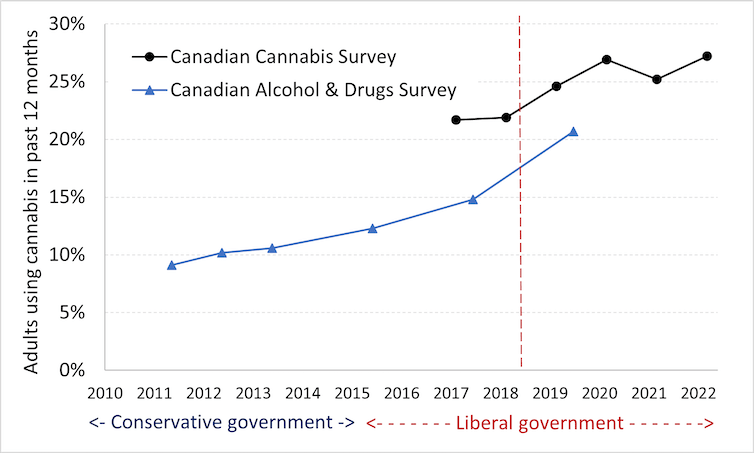
However, the percentage of adults using cannabis had already been increasing prior to 2018. Unsurprisingly, it continued to rise after legalization. Government surveys put the usage rate at nine per cent in 2011, 15 per cent in 2017 and 20 per cent in 2019.
Percentage of adults using cannabis during the previous 12 months.(Health Canada)
On the other hand, teenagers’ cannabis use hardly budged after 2018. This suggests teenagers who wanted cannabis were already able to buy it easily from dealers.
Health issues
Health impacts were also a significant concern while Canada was debating cannabis legalization.
Canada’s previous prime minister, Stephen Harper, claimed cannabis was “infinitely worse” than tobacco. His successor, Justin Trudeau, instead said legalization would “protect” health.
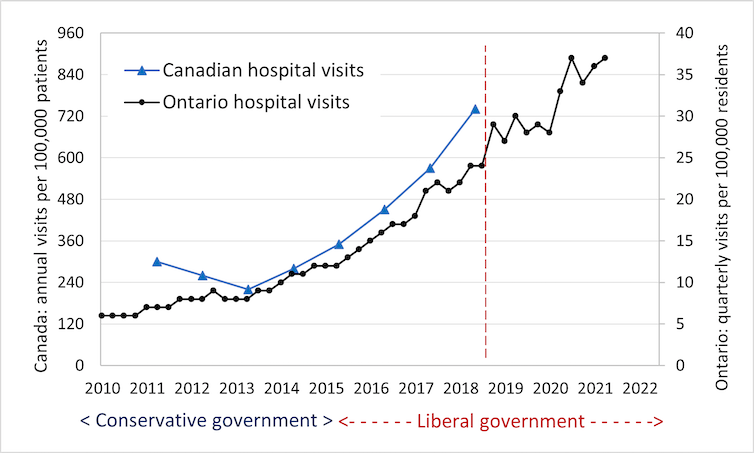
In reality, cannabis-related hospital visits by adults were already growing before 2018 and kept growing afterward. Compared to early 2011, the rate in Ontario was about three times higher in 2018 and five times higher in 2021.
Adults’ emergency department visits for cannabis-related problems at hospitals across Canada (left axis) and in Ontario (right axis).(Champagne et al. 2020 and Myran et al. 2023)
However, some health impacts have been more serious. There has been significant growth in children’s hospital visits due to accidental cannabis consumption. Among children under 10 years old, there was a nine-fold increase in emergency room visits and a six-fold increase in hospitalizations.
Research on whetheror not legalization actually resulted in more cannabis-impaired driving remains inconclusive. Unfortunately, government reports often don’t specify which substances caused drivers’ impairments.
However, we do know overall drug-impaired driving — any substance except alcohol — increased before and after 2018. Compared to 2011, drug-impaired driving arrests roughly doubled by 2017 and quadrupled by 2020.
There have also been ongoing increases in injuries from traffic accidents involving cannabis. Compared to 2011, the injury rates in Ontario were about two times higher in 2017 and three times higher in 2020.
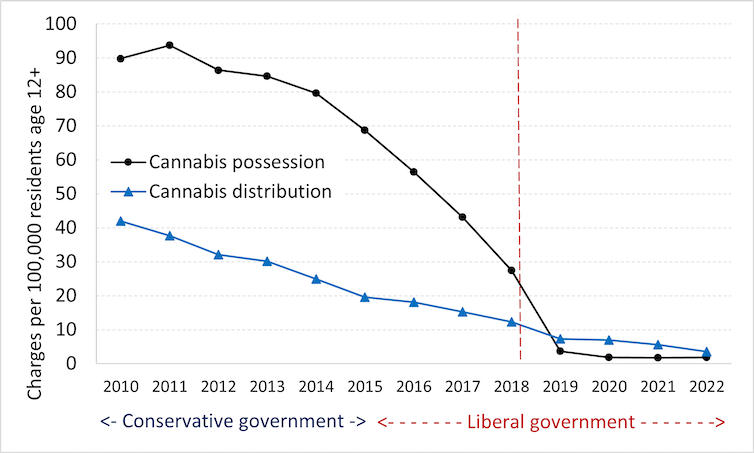
By 2018, the arrest rate was already 71 per cent lower than its 2011 level.
While arrests fell again in 2019, they bottomed-out afterwards, leaving little room for further rate drops.
Arrests for illegal cannabis distribution offences, like growing and trafficking, fell 67 per cent between 2011 and 2018. This trend largely continued after 2018.
Arrest rates for illegal cannabis possession or distribution. The vertical dashed line represents legalization in October 2018.(Statistics Canada)
After legalization, cannabis business did boom in some ways. Although most provinces initially lacked enough stores, there are now more than 3,600 across Canada.
Sales have surged from $42 million in October 2018 to $446 million in July 2023. They’re now half as large as beer sales.
While legalization did cause some changes, it was also a government response to changes that were already underway. There are three potential lessons that can be taken away from this.
The second lesson is that Canadian policymakers should worry less about whether legalization caused specific cannabis problems. Instead, they should focus on resolving them.
The third lesson is for other countries considering legalization, like Germany, Denmark and the U.S. For these countries, Canada’s experience serves as a valuable case study. Policymakers should review their own trends before legalizing, because the outcomes afterward might not be as different as they expect.
Michael J. Armstrong does not work for, consult, own shares in or receive funding from any company or organisation that would benefit from this article, and has disclosed no relevant affiliations beyond their academic appointment.
Become one of the only privately held EU–GMP facilities in Canada.
Did you know that the 23 registered EU-GMP Canadian cannabis facilities are all owned by public companies (data sourced from “EudraGMDP” European Medicines Agency)? There are currently no privately owned Canadian companies with spare capacity available for your use to export product.
Canadian exports surged in the 2022-23 fiscal year when Canada exported CAD$160m, a 50% increase from 2021-2022. It is estimated that the world cannabis market will reach $62B in 2026, comprised of around 50% in the US. If/when federal prohibition is removed in the US, American exports will dwarf Canadian exports.
With Canadian exports surging due to international recognition of consistent quality, it’s a great time for potential Canadian exporters to seize the moment.
The most significant advantages of exports are increased gross margins (2.5x) over domestic prices, with insured receivables (Export Development Canada), and no payment delays or holdbacks experienced with provincial liquor and cannabis regulation branches.
Australia and other importing countries are increasingly leaning towards stricter import regulatory criteria similar to or the same as the EU. This creates an opportunity to expand beyond the domestic market, unlock exciting export opportunities in international cannabis markets, and become one of the first private EU-GMP cannabis facilities in Canada.
However, in the burgeoning export markets, exercise caveat emptor—buyer beware—in purchasing GMP certification. Prices range from CAD$200k to CAD$600k with different lag times and significant upfront fees.
Embark on a journey with Pharmaceutical Consultancy Services (PCS)—the EU-recommended service provider based in the Netherlands—to attain GACP and EU-GMP* certifications. As a pharmaceutical consultancy firm, PCS was the first firm, in cooperation with the Dutch inspectorate, to bring a cannabis facility to GMP level. (*Please note that the here-mentioned “EU-GMP certification” is proof of compliance level. A formal EU-GMP certificate can only be provided by a governmental institute).
The PCS team—headed by Dr. Jaap Koster, educated, trained, and experienced in pharmaceutical manufacturing—has also assisted customers in reaching their GACP/GMP or GMP objectives. PCS has performed over 2,000 GMP audits globally for small and large companies, mainly as lead auditors.
By capitalizing on this window of opportunity, your business could command higher prices for your products in the global market. Additionally, with the receivables insured by the Canadian federal government, you would be well-equipped to navigate the challenges that come with international trade. The advantage of working with PCS is that it offers a reasonable payment plan. In addition, for the first three Canadian client projects, there is a 40% discount on the PCS listed price for GACP, EU-GMP certification. This certification will also cover other countries’ principle GACP/GMP requirements for the same price with the same payment plan.
PCS works in conjunction with Nigel Boast (BSc., LLB MBA), principal of Growth West Finance in BC, who will facilitate the onboarding and, if required, will assist with funding facilitation for consulting fees, and also the facility retrofit (provided applicant qualifies for such funding). Although PCS does not assist in product export, Growth West Finance will also, if appropriate, assist the Client in export marketing plan(s) separate to the GMP certification process upon request.
Unlock the world of export opportunities, find out if your facility will qualify for GMP certification, and take advantage of early price discounting (40% of regular price).
Contact Nigel Boast, principal of Growth West Finance Ltd. in Canada for an appointment, or Dr. Jaap Koster principal of PCS in the Netherlands.
The U.S. marijuana industry received a boost of positive news from Washington, D.C., in late summer, but the road ahead may not be as smooth as initially hoped. There are fresh challenges that may hinder the passage of cannabis banking reform in Congress.
On the positive side, experts on Capitol Hill believe that the U.S. Senate is likely to approve the SAFER Banking Act. The act offers protections for financial institutions serving state-legal marijuana businesses, shielding them from federal prosecution. The legislation successfully passed a significant Senate committee in late September. However, complications unrelated to the banking reform or marijuana are currently clouding the outlook. Much of the congressional business is at a standstill due to ongoing internal conflicts within the House of Representatives.
The Republican Party, which holds a slim majority, has yet to choose a new speaker following the ousting of Rep. Kevin McCarthy. Moreover, when legislative activities do resume, they will be preoccupied with other pressing priorities, including averting a government shutdown and addressing the escalating conflict in Israel.
Another complicating factor is the opposition to marijuana policy reform by key House members, including Representatives Steve Scalise and Jim Jordan, both of whom were nominated for speaker. Scalise eventually dropped out of the speaker race due to insufficient support, leaving the House Republicans in turmoil.
Despite these challenges, the Senate appears to maintain a positive outlook. Majority Leader Chuck Schumer is determined to pass the SAFER Banking Act and intends to introduce a “SAFER-plus” package, combining provisions related to gun ownership rights and marijuana arrest-record expungements.
A full Senate floor vote for SAFER Banking could happen in the upcoming work period, with David Culver, a senior vice president for public affairs at the U.S. Cannabis Council, expressing optimism. However, the House must also approve the bill, and it may not be as straightforward as the Senate.
While the full House passed the predecessor to SAFER Banking, SAFE Banking, multiple times, the current bill faces opposition from House Republicans due to specific language regarding Operation Chokepoint. This challenge requires further negotiations, competing for time and attention with pressing international issues and potential government shutdowns.
As the year progresses, the 2024 presidential election will further complicate the legislative calendar. Congress is expected to have limited attention for standalone bills as election season gains momentum, making the window for passing the bill narrow.
Nonetheless, there are still potential positive developments on the horizon, particularly with the Biden administration’s rescheduling recommendation in August. The recommendation, if implemented, could alleviate federal tax challenges for marijuana businesses.
Some industry executives see this as a sign that SAFER Banking, while important, may not be as critical as other ambitious bills, including federal legalization and the potential for interstate commerce.
Cannabis companies such as Cresco Labs Inc. (CSE: CL) (OTCQX: CRLBF) will be looking forward to the enactment of federal cannabis banking legislation so that some of the operational challenges they face, especially in accessing financial services, ease.
About CNW420
CNW420 spotlights the latest developments in the rapidly evolving cannabis industry through the release of two informative articles each business day. Our concise, informative content serves as a gateway for investors interested in the legalized cannabis sector and provides updates on how regulatory developments may impact financial markets. Articles are released each business day at 4:20 a.m. and 4:20 p.m. Eastern – our tribute to the time synonymous with cannabis culture. If marijuana and the burgeoning industry surrounding it are on your radar, CNW420 is for you! Check back daily to stay up-to-date on the latest milestones in the fast -changing world of cannabis.
To receive SMS alerts from CNW, text CANNABIS to 844-397-5787 (U.S. Mobile Phones Only)
Please see full terms of use and disclaimers on the CannabisNewsWire website applicable to all content provided by CNW, wherever published or re-published: https://www.CannabisNewsWire.com/Disclaimer
The award-winning documentary showcases Oaksterdam University, the world’s first cannabis college, and tells the origin story of the people who took monumental risks to make cannabis legalization possible. It celebrates the courageous heritage of the legacy industry and the movement that started at OU and would go on to impact the world.
Created by critically-acclaimed filmmakers Dan Katzir and Ravit Markus of New Love Films, the documentary sheds light on the cannabis legalization movement through the lens of OU leaders.
Katzir and Markus spent 10 years shadowing OU Founder Richard Lee and Executive Chancellor Dale Sky Jones as they fought to get the Prop 19 legalization measure on the ballot in California, then weathered a federal raid that threatened to shut them down. The film captures their struggles and triumphs as they fight to bring this topic to the mainstream.
Fort Lauderdale International Film Festival
November 12, 2023 | Red Carpet: 6PM | Film & Q&A: 7PM | Afterparty: 9PM
Celebrating its 38th annual festival in 2023, the Fort Lauderdale International Film Festival (FLIFF) presents American indies and studio films, international films, student films, special tributes, seminars and introduces filmmakers to South Florida audiences. The festival runs November 3-16, 2023, and screens 200 films in Fort Lauderdale, Sunrise, Hollywood, St Augustine, and The Bahamas. Considered one of the most important regional film festivals in the U.S., the festival is committed to first-time filmmakers and innovative programming.
Oaksterdam University Chancellor Dale Sky Jones spoke at the 2023 IACCAI Conference, held Oct. 12-13 at Highland Community College in Freeport, Ill. The annual conference, organized by the Illinois Association of Community College Agriculture Instructors, is designed to bring educators together to network and discuss various topics relevant to the industry.
Oaksterdam was invited due to its partnership with Highland Community College. Oaksterdam curriculum is used in HCC’s Intro to Cannabis Course (AGOC 134), which features hybrid live and online instruction and uses OU’s “The Budtender’s Guide” textbook.
During her segment, Dale spoke about cannabis curriculum and career options. Her presentation included facts about the cannabis industry that are specific to Illinois, where cannabis became legal for adult use on Jan. 1, 2020. Today, Illinois has the third largest cannabis job market in the U.S., according to the 2023 Vangst Jobs Report.
Dale went over some specifics of Illinois cannabis cultivation policy:
Overseen by the Illinois Department of Agriculture and Department of Cannabis Regulation
Limited licenses
Ownership limited to 3 cultivation centers or craft grow facilities
Focus on equity and expungement
She covered the challenges faced by cannabis growers in addition to those in traditional agriculture:







Recent Comments