
by Grow Up Conference | Oct 16, 2023 | Cannabis Prospect Magazine, Media Partners

by Grow Up Conference | Oct 16, 2023 | Cannabis News Wire, Media Partners
- Lexaria recently announced its intention to launch new human and animal studies exploring its patented DehydraTECH(TM) technology on GLP-1 drugs for the potential treatment of diabetes
- The studies will build on what Lexaria has achieved so far since it started its diabetes-related studies in 2022
- Its DehydraTECH-CBD demonstrated an almost three-fold improvement in drug delivery into the blood in its DIAB-A22-1 diabetes study compared to the DehydraTECH-CBD formulation used in its HYPER-H21-4 hypertension study
- These studies follow Lexaria’s announcement of its intention to study weight loss and diabetes control in a human population using DehydraTECH
Lexaria Bioscience (NASDAQ: LEXX), a global innovator in drug delivery platforms, just announced its intention to launch new human and animal studies that will explore its patented DehydraTECH(TM) technology on glucagon-like peptide-1 (“GLP-1”) drugs for improved bioavailability, cost-effectiveness, tolerability, weight loss potential, management of diabetes and other health conditions. Regarded as a significant expansion for Lexaria, these studies will build on what the company has achieved so far with its DehydraTECH-processed CBD while examining the technology’s impact on GLP-1 drugs (https://cnw.fm/Np3FA).
The U.S. Food and Drug Administration (“FDA”) recently approved GLP-1 drugs for type 2 diabetes and weight loss management following their demonstration of an average loss of 15% of body weight across 667 individuals in a 68-week-long study. The drug has also demonstrated that some patients experience reduced cravings for alcohol, nicotine, and opioids while taking the drugs, with other trials showing the reduced build-up of proteins amyloid and tau in the brain, both thought to be partly responsible for Alzheimer’s.
Despite their overall potential, GLP-1 drugs have many side effects, ranging from mild ones, such as nausea and vomiting, to more serious ones, such as reduced bone density and muscle loss. Some of the more severe side effects have been reported when the drugs are taken in oral form, which has prompted researchers and medical practitioners to treat patients with lower oral doses. Given the overall nature of GLP-1 drugs to have low oral bioavailability, Lexaria, through its DehydraTECH technology, looks to address that, ultimately improving the drug’s pharmacokinetic (“PK”) performance.
In the recently completed DIAB-A22-1 diabetes study, Lexaria demonstrated an almost three-fold improvement in drug delivery into the blood compared to the DehydraTECH-CBD formulation used in its HYPER-H21-4 hypertension study. With such results in this and five other human clinical studies, Lexaria has proven severally that its technology can significantly improve the PK performance of many orally administered drugs into the bloodstream. Its applications have ranged from cannabinoids, estradiol, PDE-5 Inhibitors, and certain antiviral drugs. The company is optimistic about the technology’s application, GLP-1, and its potential to improve its bioavailability.
The animal and human clinical studies on GLP-1 will be a logical progression to Lexaria’s efforts to explore DehydraTECH in the potential treatment of diabetes, which kicked off in 2022. In its pre-clinical study DIAB-A22-1, DehydraTECH-CBD has yielded a 19.9% lowered blood glucose level, a 7% lowered overall body weight sustained over eight weeks, increased locomotor activity, lowered triglyceride levels by more than 25%, and lowered blood urea nitrogen levels by 27.9%. Given its intention to study weight loss and diabetes control in a human population using DehydraTECH, as announced on August 2, 2023, the GLP-1 studies come at the opportune time, facilitating this specific objective.
Program design for the GLP-1 study has already commenced, and initial study work is set to begin as soon as possible. This ambitious step affirms Lexaria’s commitment to creating shareholder value and advancing its technology to become a leader in its segment.
For more information, visit the company’s website at www.LexariaBioscience.com.
NOTE TO INVESTORS: The latest news and updates relating to LEXX are available in the company’s newsroom at https://cnw.fm/LEXX
About CannabisNewsWire
CannabisNewsWire (“CNW”) is a specialized communications platform with a focus on cannabis news and the cannabis sector. It is one of 60+ brands within the Dynamic Brand Portfolio @ IBN that delivers: (1) access to a vast network of wire solutions via InvestorWire to efficiently and effectively reach a myriad of target markets, demographics and diverse industries; (2) article and editorial syndication to 5,000+ outlets; (3) enhanced press release enhancement to ensure maximum impact; (4) social media distribution via IBN to millions of social media followers; and (5) a full array of tailored corporate communications solutions. With broad reach and a seasoned team of contributing journalists and writers, CNW is uniquely positioned to best serve private and public companies that want to reach a wide audience of investors, influencers, consumers, journalists and the general public. By cutting through the overload of information in today’s market, CNW brings its clients unparalleled recognition and brand awareness. CNW is where breaking news, insightful content and actionable information converge.
To receive SMS alerts from CNW, text CANNABIS to 844-397-5787 (U.S. Mobile Phones Only)
For more information, please visit https://www.CannabisNewsWire.com
Please see full terms of use and disclaimers on the CannabisNewsWire website applicable to all content provided by CNW, wherever published or re-published: https://www.CannabisNewsWire.com/Disclaimer
CannabisNewsWire
Denver, CO
www.CannabisNewsWire.com
303.498.7722 Office
Editor@CannabisNewsWire.com
CannabisNewsWire is powered by IBN

by Grow Up Conference | Oct 16, 2023 | Media Partners, Stratcann
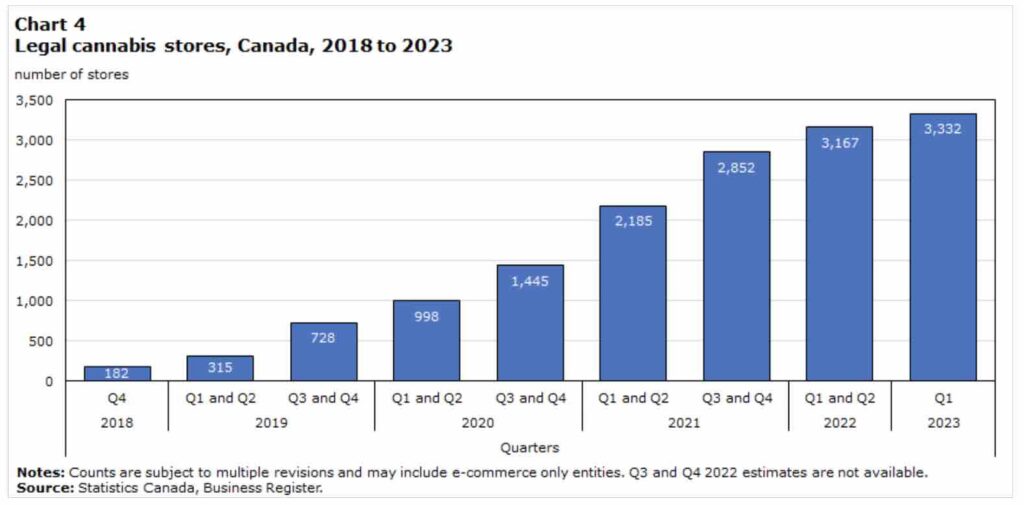
Five years into legalizing cannabis in Canada, the industry appears to be beginning to reach a saturation point.
New statistics shared by the Government of Canada show that the number of cannabis stores in Canada is beginning to stabilize at about 3,300 locations across the country.
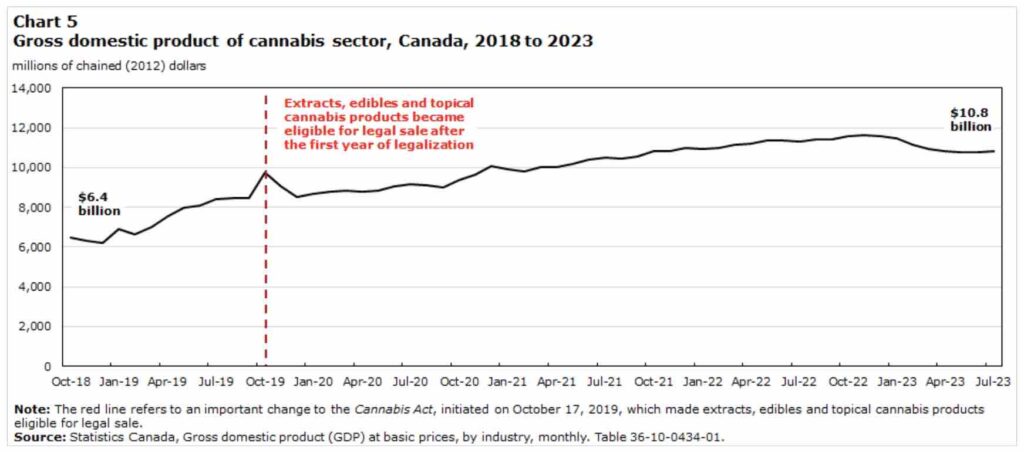
Overall, Canada’s cannabis sector grew significantly from October 2018 to December 2022 but showed signs of decline in 2023. The GDP for the cannabis sector in Canada in late 2018, at the beginning of legalization, was around $6.4 billion. That number appears to have reached a high-water mark at around $11.6 billion by the end of 2022, before declining to $10.8 billion by June 2023.
Despite this growth, overall cannabis use in Canada appears to have only increased slightly compared to ongoing trends prior to legalization. From 2018-2020 cannabis use rates in most provinces saw little to no increase in reported rates of cannabis use, and use among 15-to 17-year-olds has not increased with legalization. Cannabis use is most common among 18-to 24-year-olds followed by those 25 to 44.
The number of Canadians accessing cannabis legally has also continued to increase. By the first half of 2023, more than 70 percent of the non-medical cannabis consumed in Canada came from a legal source. This is up significantly from the 22 percent who reported doing so at the beginning of legalization in late 2018.
Unsurprisingly, the number of cannabis-related drug offences declined significantly following legalization. Although cannabis is now legal to buy, possess, consume and, in most provinces, grow, possession limits are still enforced, as are criminal laws around production and distribution.
While most (81 percent) of the cannabis-related charges in Canada prior to legalization were for possession, as of 2022, most (67 percent) were for illegal import or export. Cannabis possession charges were just 12 percent of all cannabis charges.

by Grow Up Conference | Oct 16, 2023 | Media Partners, Stratcann
A Manitoba judge has upheld Manitoba’s ban on people growing their own cannabis.
In a ruling posted on Friday, October 13, a Manitoba judge dismissed an application by a resident who was challenging the legality of Manitoba’s ban on people growing their own cannabis.
The ban does not apply to those who are authorized to grow cannabis for medical purposes, but instead to those who wish to grow up to four cannabis plants at home, which is allowed under federal law.
The Manitoba law, which has been in place since 2018, was being challenged by resident Jesse Lavoie, who argued the provincial ban was unconstitutional and an overreach of provincial authority.
In their defence, the provincial government argued that the ban on growing cannabis at home was within the province’s power in the name of protecting public health and safety. Doing so helps ensure that the black market doesn’t profit from home-grown cannabis, and helps to keep it out of the hands of young people, they contended.
Although the ruling was somewhat sympathetic to Lavoie’s lawyer’s arguments, Court of Queen’s Bench Justice Shauna McCarthy sided with the arguments made by the Government of Manitoba, saying that the penalties, while strict, were not overly punitive or a violation of the balance between provincial and federal jurisdiction. The province of Manitoba, she ruled, has the right to ban growing cannabis at home, even if federal law allows people to grow up to four plants.
Lavoie’s lawyers in the case, Kirk Tousaw and Jack Lloyd, say they plan to appeal the ruling. Both are prominent lawyers in the Canadian cannabis space.
“We intend on appealing this disappointing decision and continuing our fight for Manitobans to be able to exercise the same freedoms as other Canadians,” says Lloyd.
“While we intend to appeal this decision, it’s important to point out that Manitobans should not need to go to court to challenge bad laws. The government should change them, and we hope that the new NDP government revisits the poor policy choices of its predecessor.”
Lavoie agrees.
“We do not accept this decision, and we are preparing our counter arguments for the Court of Appeal,” he tells StratCann. “No Manitoban should be threatened with one year in jail and $100,000 fine for growing 4 cannabis plants. That’s all the motivation we need. See you in court, Manitoba Government”
In April of this year, the Supreme Court of Canada upheld a similar ban on home-grown cannabis in Quebec, ruling that the province has the authority to enforce such a ban, even in the face of federal rules allowing up to four plants per household.
Quebec and Manitoba were the only two provinces to challenge that authority, banning home growing entirely, as did the territory of Nunavut. While Quebec’s rules implement fines for those found growing cannabis, Manitoba’s ban creates criminal penalties and a $2,542 fine for growing non-medical cannabis in a residence, as well as up to a year in prison and forfeiture of personal property.
In their conclusion, the judge wrote, in part: “The applicant has failed to meet his onus of proving that section 101.15 is in pith and substance criminal law, rather than an area under provincial jurisdiction. Rather, I have found that the pith in substance, or the dominant purpose, of the prohibition against home cultivation in Manitoba, is to support the provincial government scheme enacted to control and regulate the purchase, distribution, and sale of cannabis in a manner which is consistent with the public interest.”
The province’s cannabis laws, including the ban on growing cannabis at home, were put in place by the previous Conservative government in Manitoba. The Manitoba NDP formed government following an election on October 3.
Prior to the election, the Manitoba NDP had told at least one media outlet they opposed the ban on growing cannabis at home.
StratCann reached out to the party for comment on the court’s ruling, but they were not immediately available by press time.
Related Articles
by Grow Up Conference | Oct 16, 2023 | Extraction Magazine, Media Partners
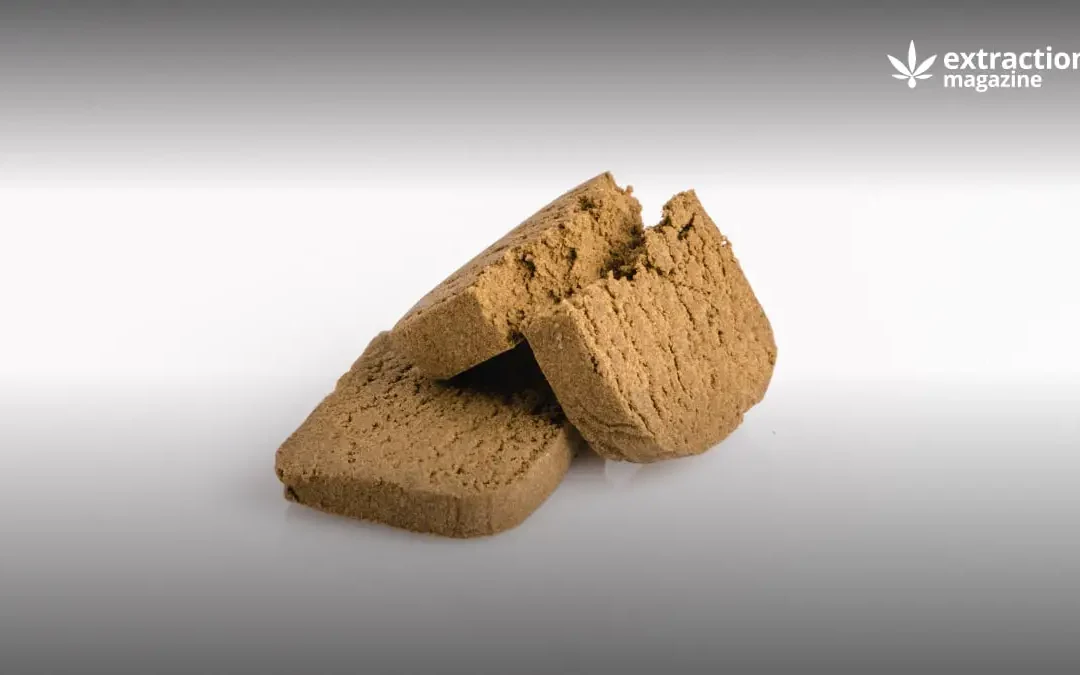
When it comes to producing hashish, there’s more than one way to get the fine results you’re looking for. The underlying requirement for producing this type of concentrate is an agitation of the source material, which causes the trichomes (resin-filled glands) to break loose from the flowers.
Current popular methods of agitation include shaking, vibrating, and tumbling. Bubble hash using ice water agitation is also common. However, more novel ways, such as agitation using sound waves, are beginning to gain popularity. [1]
What Is Hashish Concentrate?
Hashish, often referred to in the cannabis world as “hash,” is a concentrated cannabis product derived from the resin glands (trichomes) of the cannabis plant.
To make hash, a cannabis grower will harvest mature cannabis flowers and separate the resin-rich trichomes from the other cannabis plant material. The extracted resin is then compressed into various forms, such as balls, bricks, or cakes, creating hashish.
The reason cannabis users or sellers want to create hashish is that it is a potent concentrate that contains a much higher concentration of cannabinoids, such as tetrahydrocannabinol (THC) and cannabidiol (CBD). Individuals consume hashish by smoking, vaporizing, or adding it to edibles.
In recent years, many popular extraction methods have been used to make hashish, but in this context ultrasonic waves are gaining popularity.
Ultrasonic wave extraction improves the diffusion process by causing the cell walls rupture and the following release of desired compounds by accelerating the mass transfer within the cannabis plant’s materials and the solvent medium. [2]
It should be noticed that an extract obtained through ultrasonic bath will most likely represent the real phytochemical profile of a particular strain, due to improved extraction of all cannabis constituents.
Ultrasonic waves produced by an ultrasonicator are a reliable method to improve extraction efficiency and reduce the extraction time. Through this method it is possible to obtain a more bioavailable extract compared to other techniques, preserving the delicate molecules and also thermolabile compounds. In addition to that, ultrasonic-assisted extraction helps limit the amount of solvent used, requires less energy compared to other methods and it is capable of efficiently extracting tough plant matter such as roots, bark and seeds.
It should be noticed that this method can be easily scaled-up making it a promising alternative when it comes to cannabis processing and extraction on an industrial scale.
Using Ultrasonic-Assisted Extraction To Extract Cannabis Concentrates
Sound waves at various frequencies and energy levels can be used for extraction. Ultrasonic waves, typically in the range of frequencies between 16 kHz to 100 kHz, are the most common and effective for cannabis when making hashish.
When it comes to cannabis, ultrasonic-assisted extraction can be used to extract cannabinoids, terpenes, and other valuable compounds. For example:
- Cannabinoid extracts: Ultrasonic-assisted extraction can be used to produce high-potency cannabinoid extracts. These extracts can be further processed into various forms such as oils, tinctures, and edibles.
- Terpene extracts: Terpenes are aromatic compounds that contribute to this plant’s unique flavors and aromas. Ultrasonic-assisted extraction can be used to extract terpenes, which are often used to produce cannabis concentrates and vape cartridges to enhance flavor.
- Isolates: Ultrasonic sound waves extraction can be used to isolate specific cannabinoids from the cannabis plant material.
It’s important to note that while ultrasonic extraction is a promising extraction method, the quality and purity of the final concentrate depend on various factors, including the equipment used, extraction parameters, and the cannabis material’s quality.
Wrap-Up On Making Hashish Using Ultrasonic Waves
During ultrasonic-assisted extraction the plant’s terpene and cannabinoid profiles are well-preserved, and harsh solvents are not required, resulting in full-spectrum products that capture the characteristics of the plants from where they came.
References:
- Lazarjani, M. P., Young, O., Kebede, L., & Seyfoddin, A. (2021, July 19). Processing and extraction methods of medicinal cannabis: A narrative review – journal of cannabis research. BioMed Central. https://jcannabisresearch.biomedcentral.com/articles/10.1186/s42238-021-00087-9
- Ultrasonic cannabis extraction – sonics & materials, inc.. (n.d.-b). https://www.sonics.com/site/assets/files/2962/ultrasonic-cannabis-extraction.pdf
by Grow Up Conference | Oct 16, 2023 | Cannabis News Wire, Media Partners
Officials in Georgia recently announced that the state would begin to provide medical cannabis products in pharmacies statewide. Last week, the state’s pharmacy board started accepting applications for independent pharmacies that wanted to take part in the exercise. Once applications have been submitted, all pharmacies will have to undergo inspection before they can receive approval from the board.
Thus far, almost 120 drugstores have agreed to provide drugs from Botanical Sciences, one of the licensed production companies in the state. It is expected that it will take a couple of weeks before medical cannabis is available in pharmacies. At the moment, medical cannabis is available to individuals in the state who have received approval from a physician for the treatment of serious illnesses such as post-traumatic stress disorder, Parkinson’s disease, seizures and terminal cancers.
THC oil should contain no more than 5% THC, which is one of the two major compounds found in marijuana. The expansion of medical marijuana sales into pharmacies will allow many more patients to access THC oil, which adds to the seven dispensaries in the state that have launched since April. Individuals will be able to purchase THC oil at drug stores once they present a state-issued registry card and identification.
Botanical Sciences notes that nearly 90% of the population in the state live within a half-hour drive of a pharmacy that sells medical cannabis. Mindy Leech, a pharmacist in Newnan, stated that this move by the state would help destigmatize medical marijuana while also making it more comfortable for customers to ask questions about the drugs.
In 2019, the Georgia General Assembly approved the distribution of low THC oil. However, it’s taken years to establish regulations for inspections, safety, licensing and distribution.
In other news, the state’s department of public health recently revealed that it had misreported the number of registered medical cannabis patients in Georgia. The inflated figure, 50,000, is far higher than the 14,000 individuals who have signed up for the program.
Jonathan Marquess, Georgia Pharmacy Association VP, stated that patients who didn’t have dispensaries near them would be able to access this healthcare. Marquess, who owns a number of pharmacies in the Atlanta area, noted that with more than 400 independent pharmacies in the state, most would be interested in selling cannabis oil given that the product isn’t being sold in drugstores such as Walgreens and CVS.
Georgia Access to Medical Cannabis Commission’s executive director Andrew Turnage added the pharmacy rule would help licensees as well as patients.
A time will come when states such as Georgia will fully reform their marijuana laws so that local companies can also enjoy the kind of success that enterprises such as Cresco Labs Inc. (CSE: CL) (OTCQX: CRLBF) have earned for themselves in the markets in which they operate.
About CNW420
CNW420 spotlights the latest developments in the rapidly evolving cannabis industry through the release of two informative articles each business day. Our concise, informative content serves as a gateway for investors interested in the legalized cannabis sector and provides updates on how regulatory developments may impact financial markets. Articles are released each business day at 4:20 a.m. and 4:20 p.m. Eastern – our tribute to the time synonymous with cannabis culture. If marijuana and the burgeoning industry surrounding it are on your radar, CNW420 is for you! Check back daily to stay up-to-date on the latest milestones in the fast -changing world of cannabis.
To receive SMS alerts from CNW, text CANNABIS to 844-397-5787 (U.S. Mobile Phones Only)
For more information, please visit https://www.CannabisNewsWire.com
Please see full terms of use and disclaimers on the CannabisNewsWire website applicable to all content provided by CNW, wherever published or re-published: https://www.CannabisNewsWire.com/Disclaimer
CannabisNewsWire
Denver, CO
www.CannabisNewsWire.com
303.498.7722 Office
Editor@CannabisNewsWire.com
CannabisNewsWire is powered by IBN

by Grow Up Conference | Oct 15, 2023 | Media Partners, The New Agora
4 Ways to Hack the Mind of God
by Gary Z. McGee
“The artist cannot and must not take anything for granted but must drive to the heart of every answer and expose the question the answer hides.” ~James Baldwin
What is the mind of God? It’s the infinite interconnectedness of all things, “whose center is everywhere and circumference nowhere (Joseph Campbell). It’s that silent voice that speaks a “language older than words (Derrick Jensen).” It’s a mytheme that subsumes all myths and all memes. It’s the almighty fountainhead overflowing. It’s a quantum question mark in juxtaposition with so-called answers.
It’s our mind, if only we can tap into it. For we are questions, not answers. We are stumbling fumbling question marks going through the motions of not knowing that we don’t know. Just as Truth (the mind of God) is not sharpened by answers but by further questioning, so too is it with the human mind.
Understanding the world is more about opening our minds to a plurality of imperfect depictions than it is about settling our minds on a particular ideal. Therefore, hacking the mind of God is foremost about hacking through the brambles of ideas and ideals that are preventing us from a breakthrough. Let’s break it down…
1.) Remember, reality is just a useful illusion:
”Receive without pride, let go without attachment.” ~Marcus Aurelius
Foremost, hacking the mind of God is letting go of our ego’s attachment to rigid ideals and inflexible boundaries. It’s a deep understanding that nothing in existence is an island. And to the extent that it appears to be, it is nothing more than a useful illusion. It’s useful because we need the illusions of boundaries to navigate the universe and to create finite meaning despite the infinite meaninglessness that surrounds us.
Hacking the mind of God is hacking through the caught reality (preconditioning) and the taught reality (cultural conditioning) in order to disclose the ought reality (reconditioning). We do this to arrive at a state where we are free to create meaning despite our conditioning. As Henry Miller said, “Life has to be given a meaning because of the obvious fact that it has no meaning.” When we arrive at a place where we are free to create meaning we realize that the meaning of life is whatever we want our lives to mean.
But the ought reality will always push back. The ought reality (universal law or cosmic law) dictates if our opinions are valid or not. It is our responsibility alone to figure this out. Often, our caught/taught reality clouds our perspective regarding the cosmic law of the ought reality. Our ability to reason is not a given. It must be taught, untaught, retaught, and then revised again and again. And when our ability to reason fails, we must be held accountable by those whose ability to reason has not failed.
Applying ‘reality as a useful illusion’ is a powerful way to hack the mind of God because it turns the tables on conditioning. It flips the script on small picture perspectives. It squares the circle. Where the circle is the infinite interconnectedness between all things (God), the squaring is the Camus-like rebellion, and the result is the magic elixir (the meaning) that we bring back to the world.
2.) Embolden your shadow aspect:
“Truth-seeking is the path to self-annihilation and thus to liberation.” ~Bernardo Kastrup
A powerful way to hack the mind of God is to transform our demons into diamonds, our wounds into wisdom, and our existential angst into providence. We do this by integrating our shadow, by tapping latent aspects of the Self that have been repressed or oppressed, and then using them to empower ourselves.
When we embolden our shadow aspect, we unleash our courage. We learn how to be fierce. We learn how to be ruthless. We learn how to be audacious. All of which will be needed to take on the greatest task of all: destroying our naïve idea of God.
Yes, in order to hack the mind of God, we must first destroy our idealized depiction of God, and then reinvent a God that’s in sacred alignment with reality. Seek God; kill God; rebirth God. As Bruce Lee said, “Learn the Form, master the Form, forget the Form.” Inform; reform; transform.
As Michel de Montaigne said, “There are some defeats more triumphant than victories.” Killing the ideal of God is a defeat more triumphant than a victory. Why? Because it gets us out of our own way. It cleanses us of our insufferable clinginess. It rids us of our codependent placation. It washes us clean of ourselves. As Rumi said, “Be melting snow. Wash yourself of yourself.”
Cultivating our shadow aspect teaches us how to wash ourselves of ourselves. It teaches audacity and tenacity. It gives us teeth sharp enough to bite through the culturally conditioned throat of God so that we are free to tap the bloodroot of Infinity (the mind of God). It gives us eyes keen enough to see through all the religious/political bullshit. It gives us the ability for ruthless inquiry which we can use to think through indoctrination, conditioning, and brainwashing.
3.) Embrace fractal weirdness:
“Normal is an illusion. What is normal for the spider is chaos for the fly.” ~Charles Addams
You are not merely weird. You are weird at every conceivable scale of resolution. Zooming in on any point of your worldview finds beliefs exactly as weird as your entire worldview. You are weirdness all the way down perceiving weirdness all the way up. Embrace it.
This is a powerful way to hack the mind of God because it allows you to be free. It allows you to be playful and humorous. It unleashes the imagination. It unfetters the creative urge. It liberates paradox. It tears down the obscenely tall walls of the comfort zone and reveals that nearly all boundaries can be transformed into horizons. Most importantly, it prevents you from taking yourself too seriously.
Allow yourself to be imperfect, fallible, and prone to mistakes. Then flip the script on that shit. Be curious, not certain. Be creative, not convinced. Be eccentric, not conformist. Be humorous, not full of hubris.
Be the glitch. Practice the ability to embrace paradox and to hold the tension between opposites. Learn how to live with uncertainty. Learn how to be comfortable with being uncomfortable. Reimagine imagination itself.
As Bill Murray famously said, “Weird is just a side effect of being awesome.” Indeed.
When you allow yourself to be weird, you free yourself to be whatever you want to be. Fear of the unknown dissipates. You become the unfamiliar, the strange, the quixotic. All fetters fall away. Boundaries dissolve. The world unlocks. Suddenly everything is permitted, and both your curiosity and your creativity is heightened.
Destiny becomes a plaything. The will to power is trumped by the will to humor. The Infinite Game reveals itself, and you are the gamemaster.
4.) Laugh into the abyss:
“Like they say in Zen, when you attain Satori, nothing is left for you in that moment than to have a good laugh.” ~Alan Watts
Mortal dread is all too real. Death is ever-looming. Existential angst outflanks us all. What is a mortal to do with such fleetingness, such inept impermanence? How do we react to such transgressive transience? We meet it with humor and courage. We meet it with audacity and tenacity. We meet it with honesty and honor. We “rage, rage against the dying of the light.”
There is a sacred tomfoolery hidden within each of us. It gives us the strength to mock authority and power. It gives us the endurance to withstand tragedy and loss. It gives us the audacity to topple ivory towers, kneecap high horses, and melt down golden idols.
Forced to gaze into Infinity, only a few things become clear: Absurdity rules. Certainty is folly. Security is an illusion. Rescue isn’t coming. No God is coming to save us from our sins. No so-called authority is coming to bail us out. No hero is coming to liberate us from taking responsibility for our own freedom. Unless…
Unless that hero is you, living a courage-based lifestyle despite a fear-based culture. Unless that authority is you, questioning all things. Unless that God is you, hellbent on destroying the hell that surrounds you with a will to humor that trumps the will to power.
Laughing into the abyss is a revolt against hell. It’s a revolt against meaninglessness, senselessness, and pointlessness. It’s a revolt against anything seeking to force itself down anyone’s throat. It’s the spirit of revolution, the heart of insouciance, the soul of audacity. It’s an ecstatic celebration in the face of impending doom. It hacks the mind of God by transforming gravity into levity.
On a long enough timeline, we outgrow the problem of mortality and death. We outgrow the problem of perfection and God. We outgrow our need to pigeonhole infinity. We outgrow by letting go. Rather than cling to our ideals, we wring out our ideas. We grow our consciousness. We bring more of the universe into being. We synthesize the one and the many, the ego and the eco, the individual and the individuation. We become bigger than we are by hacking the mind of God.
As Carl Jung said, “We don’t so much solve our problems as we outgrow them. We add capacities and experiences that eventually make us bigger than the problems.”
Image source:
Power by Clayshaper
About the Author:
Gary Z McGee, a former Navy Intelligence Specialist turned philosopher, is the author of Birthday Suit of God and The Looking Glass Man. His works are inspired by the great philosophers of the ages and his wide-awake view of the modern world.
This article (4 Ways to Hack the Mind of God) was originally created and published by Self-inflicted Philosophy and is printed here under a Creative Commons license with attribution to Gary Z McGee and self-inflictedphilosophy.com. It may be re-posted freely with proper attribution, author bio, and this statement of copyright.

by Grow Up Conference | Oct 14, 2023 | Media Partners, Stratcann
This week’s big news was, of course, the release of the What We Heard Report on the ongoing legislative review of the Cannabis Act, and StratCann’s David Brown shared his thoughts on how the Cannabis Act review will not save your business.
In Alberta, AGLC announced several rule changes for cannabis producers and retailers, and in BC, a First Nation-owned cannabis retailer recently opened a new “sovereign” edibles store next to their provincially licensed cannabis store and federally licensed production facility. Aly Benson also shared a piece with StratCann asking if Manitoba’s new Indigenous premier could mean changes to the province’s strict cannabis laws, while researchers in Canada and the US shared their work on using smartphones to detect cannabis impairment.
Also, Tether’s Holiday Showcase takes place at Millworks Creative Studios in Dundas, ON, on November 1.
In other cannabis news this past week…
Several major media outlets also covered the What We Heard Report, including the Canadian Press, which ran a story on the five-year anniversary of legalization, with a focus on the winding down of the stock market bubble, with comments from Abi Roach, Vivien Azer, a managing director and senior research analyst at TD Cowen, and Canopy CEO David Klein.
CTV carried a similar story on the persistence of stigma with comments from Kate Grimmell from Greentown Cannabis in Ontario.
The Canadian Medical Association Journal also released a report on the five-year anniversary of cannabis legalization. The key takeaways are that cannabis use and its associated harms have remained steady or slightly increased (but more data is required), and there have been substantial reductions in criminal arrests and charges related to cannabis use.
CBC ran an in-depth piece on this report, featuring interviews with several of the researchers involved.
Researchers from the University of Quebec at Trois-Rivières (UQTR) are launching a survey with the goal of “a better portrait of cannabis consumption among parents” of children under 12 years old. This would be one of the first studies of its kind to be carried out in Quebec.
A would-be Whitehorse cannabis shop has again lost its bid to get a retail licence—this time, in front of the courts. Community Cannabis Inc. applied for the licence last year after signing a lease and beginning renovations at a space on Second Avenue in downtown Whitehorse. The board held a public hearing on the application before denying it in February.
Some residents in Drummondville, Quebec, have launched a petition complaining about what they say is the smell of cannabis from nearby indoor and outdoor producer Canna-Culture.
Radio Canada ran a story on Quebec producer Sumo, whose first batch of products will be available in the SQDC in November.
Joi Botanicals and Freedom Cannabis announced that Freedom will be taking on processing and distribution for Joi.
Greenway Greenhouse Cannabis Corporation announced it was engaging cannabis distributor Green Hedge to act as an outside sales force, providing coverage to licensed cannabis retailers and provincial wholesalers across Canada.
Eurofins CDMO Alphora Inc. announced that it had received its Health Canada Cannabis Drug License for its Oakville, Ontario operations in September 2023. This complements the Institutional Research License obtained through Health Canada in June 2021 for its Mississauga development site, and a Standard Processing License obtained for the Oakville manufacturing operation in May 2022.
The Laval Police Department in Quebec carried out three searches and three arrests on October 3 in connection with the production, processing, distribution and sale of cannabis, seizing 1,453 plants as well as dried cannabis.

by Grow Up Conference | Oct 13, 2023 | Media Partners, Stratcann
Licensed in late 2022, Alberta’s Wildwood Weed is finally ready to bring its first crop to market, launching in Saskatchewan in November.
Located just west of the Alberta/Saskatchewan border town of Lloydminster, Wildwood Weed is a micro cultivator and processor taking the sales channel into their own hands: growing, processing, and distributing their cannabis all themselves.
Initially, the company was only licensed to cultivate and had planned on selling to other processors, but they quickly decided to take more control over the entire process.
“We were initially looking at doing B2B sales,” explains Casey Tulloch, who handles business development and sales for the small owner-operated company, “but having the ability to bring it to people fresh, it just makes for a much better product.”
Although they are located in Alberta, Tulloch says they chose their first sales to go into nearby Saskatchewan as a way to ensure they can get a fresh product directly to retailers.
“We’re really excited about the opportunity to do direct sales in Saskatchewan, direct to the stores and get them some fresh flower,” he says.
“Saskatchewan is structured well as far as being able to do direct sales. I really wanted to stay away from something like the AGLC if we can—having to package it, book it to be sent to the warehouse, then, by the time they get it, turn it around and get it back out to the store. It just makes it tough to get good flowers out there.”
The entire team at Wildwood is not new to cannabis, and they know what they like. Between the core team, they have decades of experience growing and consuming the plant, which also guides their decision on what they want to grow. It also helped inform how they built out their state-of-the-art, purpose-built micro facility, which took into account their team’s past experience building and advising on grow facilities.
“We spared no expense,” says owner Kevin Jack, who also helped select their location and worked with the local government for approvals.
Wildwood Weeds’ current ounces from this facility will be Gelato Animal Mints, Jelly Breath, and Galactic Cake, all choices owner Kevin Jack and Master Grower Jack Tomashiro both wax poetically about as some of their favourites.
“It’s a balance of what the market wants and what grows well, but we always want to offer a few different flavours, and we want to bring people what we know we love, as well,” says Tomashiro.
As a small business, Tulloch says they have kept their approach to processing and packaging their own cannabis flower as simple as possible. The choice to start with ounces is not only about an already over-saturated market for smaller SKUs like 3.5 grams but also because ounces are less work to hand package.
“It’s a lot less time,” he says. “That means we can spend extra time getting a good, clean hand trim, and then we can sit down at the end of the day and spend a few hours packaging it up. We have to be efficient with everything we do.”
As they refine their systems, Tulloch says Wildwood also plans to begin processing their own pre-rolls and ice water hash.
Still, he knows the first few crops into the market are important, so he remains focussed on sales: first serving the Saskatchewan market, then beginning to look at Manitoba, taking advantage of their own direct-to-retail sales channels before potentially looking to other provinces.
“One step at a time,” he says. “We know there is a demand for quality flower, and every step we take as a small business needs to be ensuring we can meet that demand.”
This profile is brought to you by Life Cycle Botanics, the preferred cannabis nursery supplier for Wildwood Weed. Images via Wildwood Weed.
by Grow Up Conference | Oct 13, 2023 | Cannabis News Wire, Media Partners
A federal court of appeals recently held oral arguments in a case addressing the constitutionality of the federal ban that prevents medical cannabis patients from buying or owning firearms. The proceedings unfolded before a three-judge panel of the U.S. 11th Circuit Court of Appeals, where lawyers representing the Justice Department and Florida’s medical marijuana patients presented their respective arguments. The case has been extensively discussed through numerous briefings spanning over a year.
The plaintiffs’ attorney, Will Hall, outlined two key reasons supporting the federal ban’s unconstitutionality. Firstly, Hall argued that regardless of whether marijuana usage is lawful, committing a crime does not automatically deprive people of their Second Amendment rights. Secondly, he asserted that the Supreme Court has established new standards for evaluating gun limitations, declaring them illegal unless they are consistent with the historical background of the Second Amendment, which was passed in 1791. Hall said that prohibiting people who use medical cannabis is inconsistent with this historical setting.
While the Justice Department’s counsel conceded that illegal drugs were not widely used when the law was set, he argued that early laws restricting gun rights because of conditions such as mental health and intoxication serve as historical precedents consistent with the goal of the federal gun ban for regular cannabis users.
The discussion also delved into the definition of a law-abiding person whose Second Amendment rights should be safeguarded. One of the judges observed that it would seem incongruous to categorize state-registered medicinal cannabis patients as not adhering to the law in light of the federal rider, which has been extended yearly since 2014 and bans DOJ involvement in state medical-marijuana programs.
Both parties and judges acknowledged that the forthcoming Supreme Court case, U.S. vs. Rahima, which addresses the disarming of individuals with domestic violence injunctions, could influence the ruling in this case by clarifying whether Second Amendment rights can be systematically denied to nonlaw-abiding individuals for whatever reason.
The hearing also referenced a ruling by the U.S. Fifth Circuit Court of Appeals in Daniels vs. the U.S., which declared the ban on marijuana users possessing firearms unconstitutional, even for recreational cannabis users. The DOJ expressed disagreement with this ruling, reiterating its reservations about the foundation of the decision.
The plaintiffs in the current case are seeking a narrow declaration, distinct from Daniels, specifically addressing state medical marijuana patients who are law compliant.
Several district court rulings have also questioned the constitutionality of the firearms ban for marijuana users, including cases in Oklahoma and Texas. Additionally, the ATF has voiced concerns regarding state laws allowing medical marijuana patients to obtain concealed carry gun licenses, citing potential risks and conflicts with federal firearm licensing policies.
Major marijuana companies such as TerrAscend Corp. (TSX: TSND) (OTCQX: TSNDF) are likely to follow this court case keenly since it would address one of the big concerns that many people have about using state-legal marijuana products, which are regarded illegal by the federal government.
About CNW420
CNW420 spotlights the latest developments in the rapidly evolving cannabis industry through the release of two informative articles each business day. Our concise, informative content serves as a gateway for investors interested in the legalized cannabis sector and provides updates on how regulatory developments may impact financial markets. Articles are released each business day at 4:20 a.m. and 4:20 p.m. Eastern – our tribute to the time synonymous with cannabis culture. If marijuana and the burgeoning industry surrounding it are on your radar, CNW420 is for you! Check back daily to stay up-to-date on the latest milestones in the fast -changing world of cannabis.
To receive SMS alerts from CNW, text CANNABIS to 844-397-5787 (U.S. Mobile Phones Only)
For more information, please visit https://www.CannabisNewsWire.com
Please see full terms of use and disclaimers on the CannabisNewsWire website applicable to all content provided by CNW, wherever published or re-published: https://www.CannabisNewsWire.com/Disclaimer
CannabisNewsWire
Denver, CO
www.CannabisNewsWire.com
303.498.7722 Office
Editor@CannabisNewsWire.com
CannabisNewsWire is powered by IBN






Recent Comments